What the Best Car Paint Shop Near Me Should Deliver
Finding the best car paint shop near me comes down to a handful of clear markers: proper preparation, a controlled spray environment, accurate colour matching, and a finish that holds up under UK weather. We treat every respray or panel repair as a technical process, not a quick cosmetic fix, because the way a panel is prepped, primed, painted, and lacquered decides whether the finish lasts or fades, peels, or flakes within a season.
Paint work also affects resale value. A poorly blended respray can drop a vehicle's value by far more than the cost of the original repair, while a clean factory-style finish protects the panels underneath from rust. That is why drivers searching for the best car paint shop near me usually need more than a quick quote; they need a shop that explains what they will actually do to the car before any spraying starts.
Services a Reputable Car Paint Shop Should Offer
A professional bodyshop that handles paint work usually offers a wider range of refinishing services than a basic SMART repairer. Before booking, check that the shop can cover what your car actually needs.
Common paint services include:
- Full resprays: complete vehicle repaint, usually after major accident damage, restoration work, or a colour change.
- Panel resprays: single-panel or multi-panel repainting to match existing colour, often used after bumper repair or panel replacement.
- Spot repairs and SMART repairs: localised fixes for stone chips, small scratches, and minor scuffs without repainting an entire panel.
- Alloy wheel refurbishment: cosmetic repair for kerbed wheels, often paired with paint correction.
- Paint correction and polishing: machine polishing to remove swirl marks, oxidation, and light surface scratches.
- Insurance accident repair: end-to-end handling of accident damage, including structural and paint work.
Shops that offer a complete refinishing service under one roof tend to control quality more tightly than those who sub-let spray work to a third party.
Why Preparation Matters More Than the Paint Itself
Most premature paint failures, peeling, flaking, and mismatched finishes, come down to poor preparation, not bad paint. We spend the majority of the job on prep rather than spraying, and that preparation is the single biggest difference between a respray that lasts 10 years and one that fails in 2.
Proper preparation usually includes:
- Strip-down and assessment: removing trims, handles, and lights to access panel edges and avoid overspray.
- Panel repair or panel beating: knocking out dents, addressing corrosion, and replacing panels that are beyond repair.
- Sanding and keying: using progressively finer sandpaper or abrasive pads to give the new paint something to bond to.
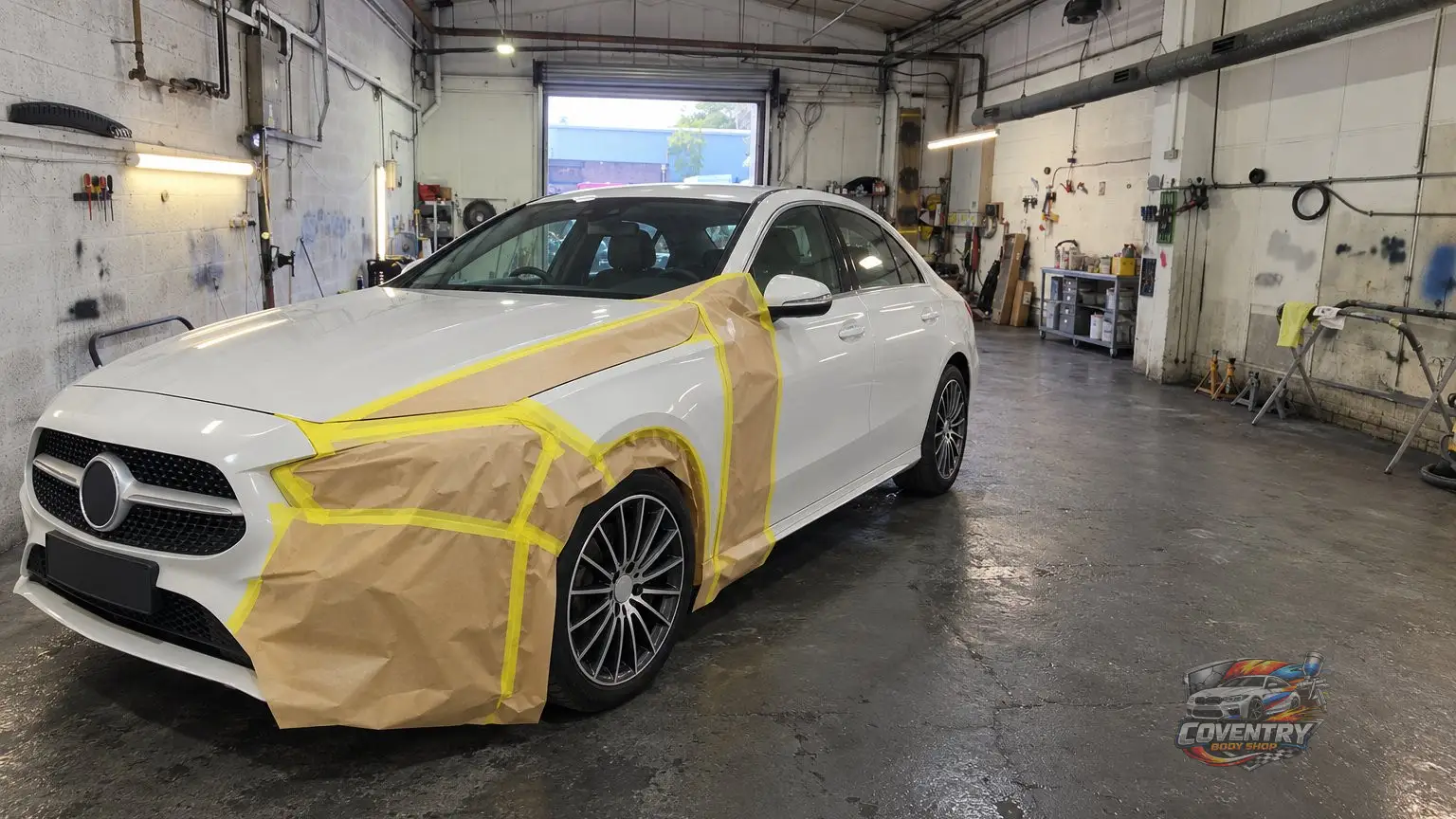
- Masking: covering glass, rubber seals, and adjacent panels to keep the spray environment clean.
- Primer and sealer: applying the right primer for the substrate (bare metal, plastic, filler) to lock down previous repairs and provide a uniform base.
- Dust control: using a filtered spray booth so airborne particles do not embed in the wet paint.
If a shop quotes a respray without mentioning prep, preparation steps, or booth work, treat that as a warning sign rather than a discount.
How Colour Matching and Blending Really Work
Modern car paint is not a single colour out of a tin. Factory colours include metallic flakes, pearlescent pigments, and clear coats that vary across model years. Even a brand-new car from the same factory batch can show subtle differences between panels once it has been baked, so a quality paint shop does not simply spray colour straight from a mixing scheme.
The blending process typically involves:
- Reading the paint code: locating the manufacturer's paint code, usually on a sticker in the door shut, boot, or under the bonnet.
- Mixing a tinted variant: the sprayer adjusts the base formula to match the age and fade of the existing paint.
- Blending panels: spraying the new colour into the adjacent panel rather than stopping at a hard edge, so the repair is invisible.
- Applying clear coat and finishing: sealing the colour in lacquer and polishing for a uniform gloss level.
This is also why understanding the type of paint system a shop uses matters. Modern waterborne basecoats are standard for environmental reasons, but the clear coat and hardener system underneath them is what gives the finish its depth and durability.
What to Look For in the Workshop
The workshop itself tells you almost as much as the quote. A modern car paint shop should run a heated, filtered spray booth, a separate prep bay, and a dust-controlled mixing room. Paint that is sprayed in an open bay will collect dust, fibres, and contamination, which becomes visible as soon as the finish is polished.
Signs of a quality workshop include:
- Dedicated spray booth: a sealed, downdraft or crossdraft booth with proper extraction and lighting.
- Low-bake or infrared curing: controlled drying so each coat cures fully before the next is applied.
- Manufacturer paint systems: documented use of a major paint brand, with regular training and updates.
- Documented quality checks: thickness readings, colour checks under daylight lamps, and final inspection reports.
- Photo updates: the workshop taking progress photos and sharing them with you during the job.
These are the same kinds of processes that separate a professional paint job that lasts from a quick cover-up.
Questions to Ask Before You Book
A reliable car paint shop will not be offended by straightforward questions. In fact, vague answers are usually a bigger warning sign than a higher price.
Useful questions to ask include:
- What paint system do you use, and who supplies it? Major suppliers include BASF, PPG, Axalta, and Standox; each has its own training and quality framework.
- Is the work done in a booth, and how is dust controlled? This directly affects finish quality.
- How do you handle colour matching for metallic or pearlescent finishes? Blending into adjacent panels is normal; a hard colour edge is a problem.
- What is your warranty on the work? Most reputable bodyshops offer a written workmanship guarantee, often tied to the paint supplier's own product warranty.
- Will the car be in for an assessment before final cost? Stripping a panel often reveals hidden damage, especially after an impact.
- Can I see recent examples of similar work? Past projects in similar colours or models are the best evidence of capability.
Common Red Flags When Choosing a Shop
Most drivers only notice a bad respray months later, when the colour fades unevenly, the clear coat peels, or rust creeps back under a thin layer of filler. Avoiding these outcomes is mostly about spotting warning signs before the work starts.
Watch out for shops that:
- Quote without seeing the car: a proper estimate needs a visual inspection or clear photos under good light.
- Promise same-day paint work: quality preparation, spraying, and curing take time; rushed jobs usually fail.
- Offer unusually low prices: genuine paint costs are high, and labour is intensive; rock-bottom prices often mean corners are being cut.
- Spray outside or in an open unit: weather and contamination will end up in the finish.
- Refuse to explain the process: if a shop cannot tell you what prep, primer, or clear coat they use, they likely skip steps.
Cost Factors That Affect a Car Paint Quote
Pricing varies hugely between a SMART repair on a single bumper corner and a full multi-stage respray after accident damage. Rather than chasing the cheapest quote, drivers get better value by understanding what drives the price.
Key cost factors include:
- Number of panels: a single bumper is cheaper than a front wing and door blend.
- Paint type: solid colours are simpler than tri-coat pearlescent or custom finishes.
- Repair vs replacement: if a panel needs full replacement, painting and blending the new panel adds cost.
- Prep time: heavy filler, corrosion, or previous poor repairs all need extra prep hours.
- Hidden damage: accident damage often reveals further issues once the panel is stripped down.
- Insurance involvement: approved repairer status may affect the process, but does not guarantee better quality on its own.
Always send clear, well-lit photos of the damage to the bodyshop before booking, and ask for a written estimate that lists preparation, paint, and lacquer separately.
How Long Should Paint Work Take?
A realistic timeline depends on what is being painted and the condition underneath. As a rough guide for non-structural work:
- SMART or spot repair: often same day or next day, with paint cured enough to drive away.
- Single panel respray: usually 2-3 days for prep, spray, and bake, plus a final polish.
- Multi-panel respray: up to a week or more, especially if blending across several panels.
- Full respray: often 1-2 weeks, sometimes longer for restoration work.
Insurance-driven accident repair can take longer because of approval steps, parts delays, and additional structural or ADAS work. Always confirm expected timescales up front and ask what happens if parts are delayed.
Insurance, Courtesy Cars, and Approved Repairers
For accident-related paint work, insurance policy wording matters as much as the shop's skill. Most insurers allow you to choose your own bodyshop, but using an approved repairer can simplify the process because the shop handles the claim paperwork directly.
Things worth checking before booking:
- Excess: the amount you pay before the insurer covers the rest, which can vary by claim type.
- Parts policy: whether the insurer requires used, aftermarket, or manufacturer parts.
- Courtesy car: availability depends on the shop's fleet and the insurer's terms, not on the bodyshop alone.
- Repairer choice: drivers are usually free to choose their own bodyshop, but may need to follow specific steps to keep the claim valid.
Finding a Quality Car Paint Shop in Your Area
Local workshops that handle their own paint work, rather than outsourcing it, tend to give more consistent results because the spray team is in-house. For drivers in and around Coventry, that means looking for a bodyshop with a visible spray booth, a documented paint supplier, and a track record on similar vehicles.
We regularly cover neighbouring areas, including car body repair in Leamington Spa, so customers outside the city centre can still access the same workshop standards and warranty terms without travelling further than necessary.
Send Photos to Get an Honest Estimate
The fastest way to judge whether a car paint shop is right for your vehicle is to send clear photos of the damage, the panel area, and any visible paint code, then ask for a written breakdown of prep, paint, and lacquer. We will assess the work, explain the options, and give you a realistic timeline based on what the car actually needs rather than a guess.
Leave a Comment
Comments
No comments yet.