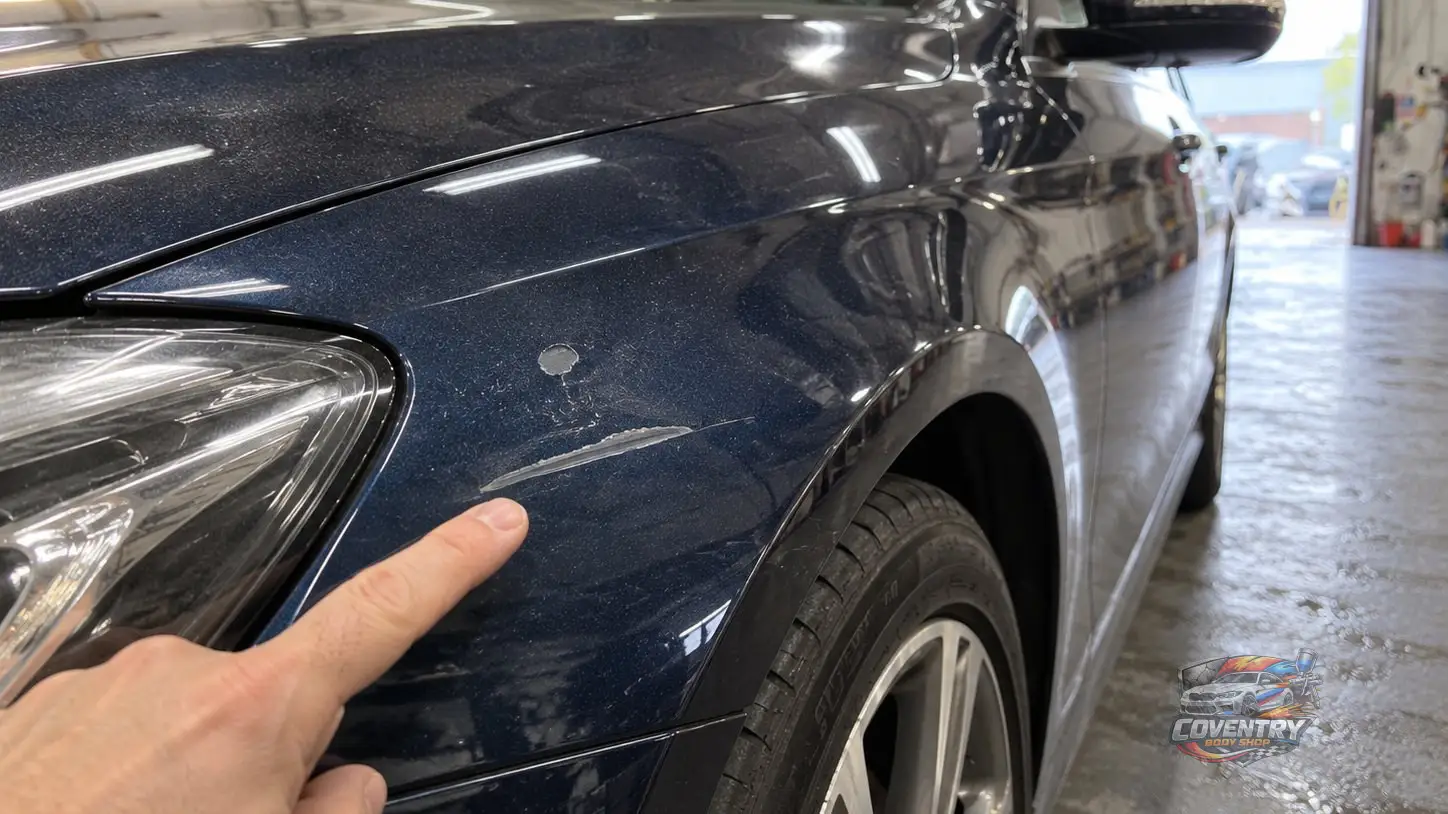
Understanding Stone Chips and Their Impact on Car Paint
Stone chips happen when grit and small stones thrown up from the road hit the paint hard enough to break it. Bonnets, front bumpers and the leading edge of the roof take many of them.
A chip that stops in the lacquer is usually a cosmetic mark. A chip down to the primer has lost the paint layers above it. Where it reaches bare steel, rust can start and spread under the paint around the chip. On a plastic bumper there is no metal to rust, though a deep chip still has to be repaired with materials suited to plastic.
The right repair depends on how deep the chip goes and how many there are. A few small chips can be filled in. A bonnet peppered with them may be better repainted.
Preparation: The First Step to a Smooth Finish
Any chip repair starts with a clean surface. Wash the area, then wipe it with a degreaser, since wax, grease and road film can stop new paint from sticking.
Next, look closely at each chip. If you can see grey primer or bright metal at the bottom, the chip has gone through the colour. Loose flakes of paint around the edge need to come away, or the new paint can lift with them.
Where the edge of a deeper chip is raised or rough, it may be sanded lightly so the new paint has a key, keeping to the chip itself so the lacquer around it is not marked. Rust in the chip needs removing before paint goes on, as paint over rust is unlikely to hold.
Choosing the Right Paint System
The colour starts with the paint code. On many cars it is printed on a label in the door shut or under the bonnet. The code gives the factory colour, but the paint on the car can differ from it, for example through age or an earlier repaint, so the match needs checking against the car itself.
We match colour with the manufacturer's paint code, specialist colour mixing and a spectrophotometer.
Most modern cars have a base colour under a clear lacquer, so on those a chip repair is usually primer where metal is showing, then colour, then lacquer on top. The exact steps depend on the panel material and the paint system used. Paint and lacquer from the same system are made to work together.
Application Techniques for Stone Chip Repair
At home, small chips can be filled with a fine brush or a touch-up pen. Where metal is showing, primer goes in first. The colour is then built up in thin layers with lacquer on top, and a touch-up can still leave a slight edge or dip. Thin layers dry more evenly and are less likely to leave a blob that stands above the surface.
Larger areas, or a panel covered in chips, usually need spraying to get an even finish. Panels we paint are sprayed in our spray booth in Wyken, Coventry, by the director, a former Aston Martin technician and painter, who is our only painter.
The base coat needs the flash-off time the paint maker gives before the clear coat goes on. The lacquer gives the repair its gloss and protects the colour, and the paint is then left to cure.
Blending and Finishing the Repair
On a sprayed repair, the edge of the new colour is usually faded out into the paint around it, so the repair is harder to see. On a panel repaint the new colour is blended into the surrounding paint where it needs it.
Once the paint has cured for the time the paint maker gives, the repaired spots can sometimes be levelled by careful wet sanding with a very fine paper and then machine polished to bring back the gloss, where there is enough lacquer around them to work with. This can make a filled chip much harder to see, but sanding through the lacquer means painting the area again, so leave this step to a bodyshop if you are unsure.
The repair should then be checked in daylight and from more than one angle, since a colour step that is hard to see under some lights can show in sunlight.
Ensuring Longevity and Durability
New paint needs time to harden fully. When it can be waxed or machine polished depends on the products used, so ask us when you collect the car. After that, a coat of wax or sealant leaves a thin layer on the lacquer that makes road grime easier to wash off.
If you want to look after the paint once a repair has cured, ask us what our paint protection and detailing service includes. No coating stops stones hitting the car, though.
Regular washing lets you spot new chips soon after they happen.
Professional vs. DIY: When to Seek Expert Help
A DIY touch-up kit can work for one or two small chips if you take time over the preparation and build the paint up slowly. The colour from a kit mixed to the paint code may sit a shade away from faded paint, and a filled chip done by brush may still show at close range.
The depth of the chip is a rough guide. A chip in the lacquer only may need no more than polishing, or a little lacquer and then polishing. One down to sound primer usually needs colour and then lacquer. One showing bare metal needs the metal cleaned and primed first.
A bodyshop repair can make more sense for a metallic colour that is hard to match by hand. Chips that have started to rust are worth showing to a bodyshop early. We do not cut or weld metal. A paint touch-up covers minor chips, with its starting price on the service page. If the panel is better repainted, a single panel repaint is the service to look at. Where chips are spread over several panels, each panel can be painted, so a full body respray is seldom needed for chips alone.
The final price is set once we have inspected the car, and you get a quote before any work starts. If you are not sure which repair you need, a small inspection is free. Our work carries a 6-month workmanship guarantee from the day you collect the car.
Conclusion: Protecting Your Investment
For a chip you repair yourself, follow the instructions for the kit and paint system you use, since the steps differ between metal and plastic panels and between paints.
If the impact has also dented the panel, see our panel dent repair and respray service.
To arrange an inspection or ask about a chip repair, call or WhatsApp +44 7903 105777, send photographs with the Send enquiry button, or use our contact form.
Leave a Comment
Comments
No comments yet.