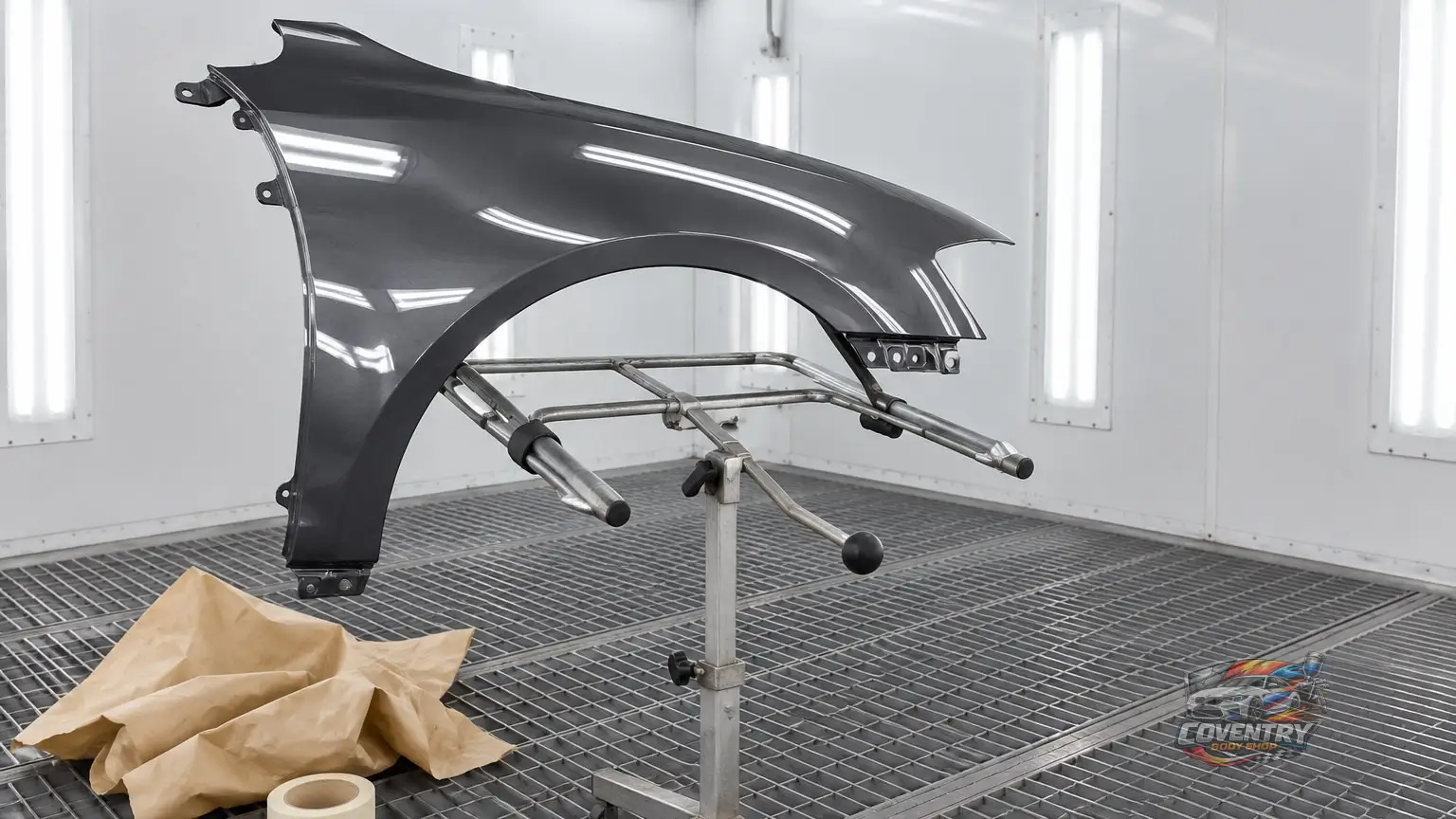
What Makes High-End Paint Jobs Different?
A high-end paint job differs from a standard respray in three measurable areas: preparation depth, paint system quality, and the skill of the sprayer. Premium work starts with proper panel correction, uses waterborne or high-solids basecoats matched by spectrophotometer, and finishes with multiple coats of clear lacquer that are baked, polished, and inspected under workshop lighting. The result is a finish that holds its gloss for years rather than months.
For most drivers the difference shows up in how the paint catches light, how clean it stays between washes, and how well it resists stone chips and UV fade. If you want to understand the specific materials involved, our guide on acrylic, enamel, and urethane car paint walks through the chemistry behind each option.
Why Preparation Decides the Final Result
Preparation is the single biggest factor separating premium paintwork from a quick respray. We spend more hours prepping than spraying on most high-end jobs, and the time is visible in the finish.
Typical prep work on a premium job includes:
- Panel assessment: We check for micro-dents, sanding marks, pinholes, and old paint thickness with a coating gauge. Repainting over hidden filler or previous poor work causes the new finish to fail early.
- Strip-down: Trim, badges, door handles, mirrors, and sometimes lights are removed so we can spray to the edge of every panel. This avoids the visible tide line you often see on cheaper resprays.
- Bodywork repair: Dents are worked out or filled, then block-sanded flat. On a high-end job we aim for panels that are straight to the eye and true to a long board.
- Priming and sealing: Epoxy or high-build primer is laid down, then guide-coated and block-sanded again. This is what gives the topcoat a perfectly flat base to sit on.
- Masking: Quality masking tape and paper, fitted tight to panel gaps, keeps edges clean and overspray off glass and trim.
Skip any of these steps and the topcoat will show every wave, scratch, and edge line. A premium finish needs a flat, clean, and correctly primed panel underneath.
How Premium Paint Systems Differ From Standard Products
The materials used on a high-end paint job are not the same as the aerosols or budget basecoats used by some fast-fit resprays. We use approved mixing schemes, waterborne basecoats where regulation requires it, and high-quality clear lacquers from the major suppliers.
Premium systems usually include:
- Waterborne basecoat: Modern basecoats are water-based rather than solvent-heavy. They lay down thinner, match modern OEM colours more accurately, and meet UK VOC rules. They are harder to spray, which is why training matters.
- High-solids or ceramic clear lacquer: Standard clearcoats are thinner and softer. Premium clears are tougher, deeper, and resist swirl marks longer.
- Flexible additives: On plastic panels such as bumpers, we add flex agent to the clear so the paint moves with the panel and does not crack at low temperatures.
- Hardener matched to climate: Slow, standard, or fast hardener is chosen for the workshop temperature. This affects flow, drying time, and final hardness.
For a deeper look at why these materials outlast cheaper alternatives, our article on why professional paint jobs last longer covers the durability side in detail.
The Role of Colour Matching and Blending
One of the hardest parts of any high-end paint job is making the new panel match the rest of the car. Factory paint fades slightly with UV exposure, so even an exact factory colour code rarely matches a five-year-old panel perfectly.
This is how premium shops handle it:
- Colour code lookup: We pull the manufacturer's code from the VIN plate or under-bonnet sticker.
- Spectrophotometer reading: A digital reader scans the adjacent panel and suggests a formula adjusted for the age of the paint.
- Spray-out cards: Test panels are sprayed and compared in daylight and under workshop lamps before any car panel is touched.
- Blending: Rather than stopping the new colour at a hard edge, we fade it into the next panel. Blending hides the join and is a skill that takes years to learn.
If you are having a single panel resprayed, ask the bodyshop how they handle blending. A hard edge at a door shut or bumper corner is the most common giveaway of a basic respray.
Application Technique: Why Skilled Sprayers Matter
A premium sprayer does not just pull a trigger. They control gun distance, fan width, fluid flow, air pressure, and overlap pattern so the paint lays down wet and level without runs, dry spray, or orange peel.
Key technique differences include:
- Spray gun quality: Premium HVLP or RP gravity guns atomise paint more finely than entry-level guns.
- Wet-on-wet basecoat: Each basecoat pass goes on while the previous one is still wet. This gives even coverage and depth.
- Clear in two or three coats: A premium clear is built up gradually, not laid on thick. Thick coats run and orange peel.
- Workshop conditions: Temperature, airflow, and dust control all matter. A clean, heated booth with filtered air is standard for high-end work.
Even with the same materials, an experienced sprayer will produce a flatter, deeper finish than someone learning on the job. Skill is the cheapest upgrade and the hardest to fake.
Curing, Polishing, and Final Inspection
The final stage of a high-end paint job is where many cheaper resprays cut corners. We bake the clearcoat at the correct temperature, let it harden fully, then polish and inspect.
The finishing process usually includes:
- Forced drying or bake: The panel is warmed to around 60 degrees so the clear cures hard, not soft. Soft clear scratches easily and stays dull.
- Cut and polish: Minor dust nibs and orange peel are removed with fine abrasives, then polished to a high gloss.
- Detailing check: The car is inspected under colour-correct lighting for runs, dry edges, and match issues.
- Reassembly: Trim, badges, and lights go back on, and the car is given a full wash and final wipe-down.
On a related repair, our bumper repair service in Coventry uses the same prep, paint, and clear process for scuffed and cracked plastic bumpers so the finish matches the rest of the car.
When a High-End Paint Job Is Worth the Investment
A premium respray is not always the right answer. It is worth considering when the car's value justifies it, the damage is widespread, or the colour is difficult to match.
A high-end paint job makes sense for:
- Older or higher-value vehicles where resale or keeping original panels matters.
- Multi-panel resprays after a collision or vandalism, where blending across several panels is needed.
- Metallic or pearl finishes that are harder to match and easier to spot when done badly.
- Bespoke colours where the owner wants something outside the factory range.
For a small scuff or scratch, a SMART repair is often more cost-effective and keeps the original paint intact. You can see the kind of finish that is possible on a Porsche before-and-after project we completed in Coventry using our full collision repair and paintless dent removal process.
Common Misconceptions About Premium Paintwork
A few myths come up again and again when customers ask about high-end work.
Any paint shop can match any colour. Not true. Some colours, especially tri-coat pearls and custom shades, need experience and good equipment. We always spray a test panel first.
Thicker clear is better. The opposite is true. Multiple thin coats cure harder and look deeper than one thick coat, which tends to run and stay soft.
If it shines, the prep was good. Shine can hide poor prep for a few months. Six months later, edges, waves, and shrinkage start showing. Quality work is visible after a year, not just on day one.
What Affects the Cost of a High-End Paint Job
Without seeing the car, we cannot quote a fixed figure, but the main cost drivers are predictable.
- Number of panels: A bonnet is cheaper than a full respray.
- Type of paint: Solid colours are simpler than metallics, which are simpler than pearls and tri-coats.
- Bodywork needed: Filler, panel beating, and rust repair all increase labour time.
- Parts and trim: New badges, mirror caps, or door handles add cost but improve the final finish.
- Paint supplier: Premium suppliers cost more per litre, but the colour accuracy and finish justify it.
For an accurate estimate, send clear photos in daylight, the vehicle registration, and a short description of the damage. We can then give you a realistic range rather than a guess.
How Long a Premium Paint Job Takes
Timelines vary with the scope of work, but a high-end job should never be rushed. At our workshop, most repairs take 3 to 7 working days once started, parts permitting. A full respray takes 3 to 7 days, depending on the work needed.
The main time factors include paint drying and curing between coats, parts waiting time if trim or panels need replacing, and quality checks at the end. A bodyshop that promises a full respray in two days is usually cutting prep or curing time.
Next Steps for Your Vehicle
If you are weighing up whether a high-end paint job is right for your car, the simplest next step is a quick conversation. Send us a few daylight photos of the affected panels, your registration, and a short description of what happened. We will come back with a realistic estimate, an outline of the prep and paint process, and an honest view on whether a premium finish or a standard respray is the better fit for your vehicle and budget.
For Coventry drivers and surrounding areas, we can usually book an inspection within a few working days. The clearer the photos and information you give us upfront, the more accurate your estimate will be.
Leave a Comment
Comments
No comments yet.