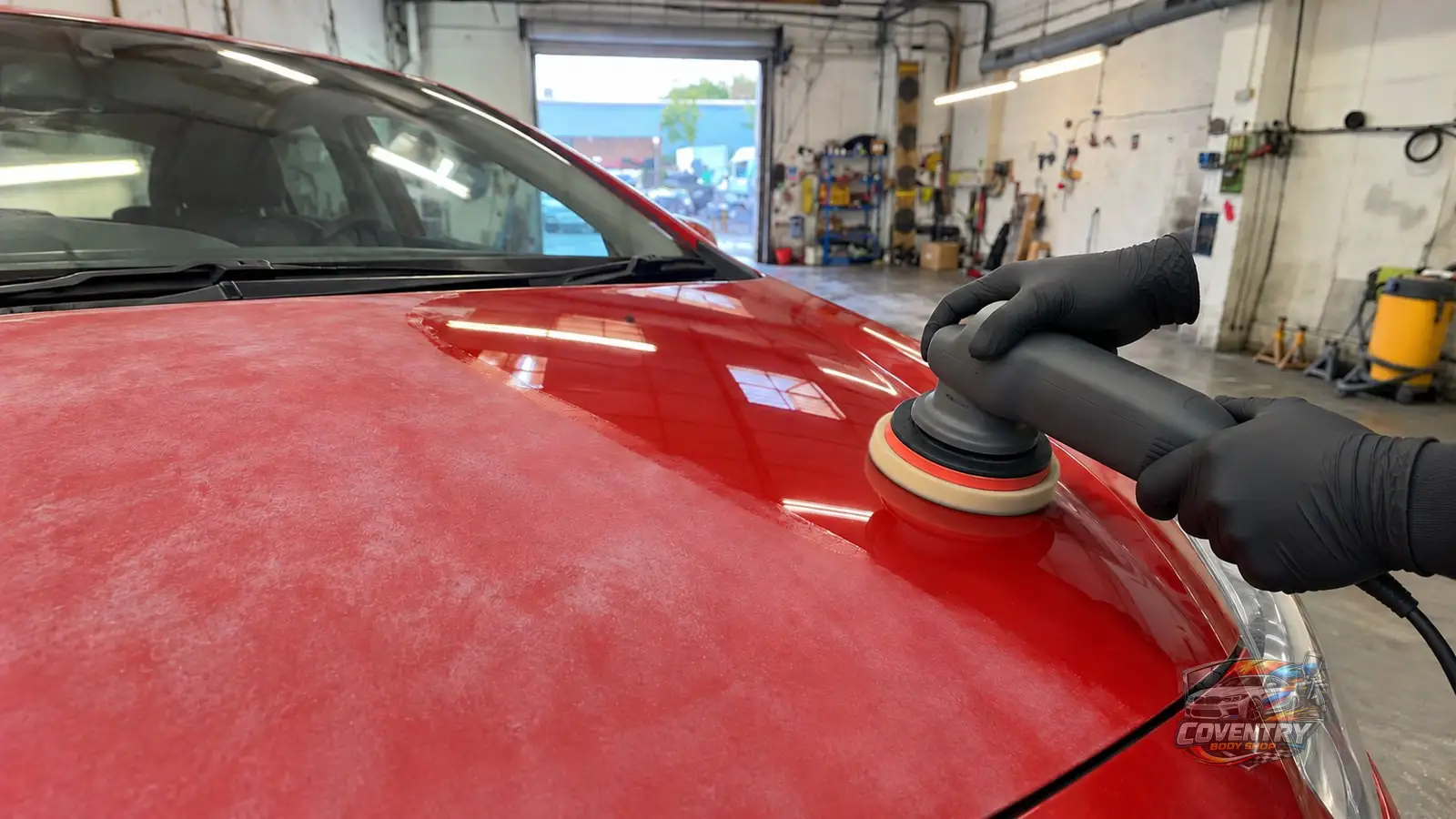
Oxidised car paint can often be restored by machine polishing, as long as the paint is still intact and there is enough of it left to polish. Polishing removes the thin, weathered surface that makes the paint look chalky and flat, and exposes sound paint underneath that reflects light again. If the clear coat is cracking, flaking or peeling, polishing cannot fix it, and the panel needs repainting.
This guide explains how to tell which situation your car is in, what you can safely try yourself, why paint thickness limits how far polishing can go, and what a repaint involves when the paint is past saving.
What is oxidised car paint?
Sunlight, heat and weather slowly break down the resin that binds car paint together, starting at the surface. The top layer becomes rough at a microscopic level, so it scatters light instead of reflecting it. That is what you see as dullness, a white or chalky haze, or colour that looks washed out.
Not every dull finish is oxidised. Swirl marks and bonded dirt also dull paint, which is why the checks further down are worth doing before you choose a fix.
How oxidation shows depends on the type of paint:
- Basecoat and clear coat: Most modern cars have a colour layer protected by a transparent clear coat, also called lacquer. Weathering affects the clear coat first, which turns hazy and loses its gloss. Over time a weathered clear coat can also go cloudy, crack or start to peel, although peeling can have other causes too, such as a poorly applied earlier repair.
- Single-stage paint: Colour and gloss are in one layer, with no separate clear coat. It is found on many older and classic cars and on some commercial vehicles. The coloured layer itself oxidises, so the paint fades and can leave a chalky film of colour on your hand or a cloth.
The roof, bonnet and boot lid usually show oxidation first because they face the sun most directly. A car that is always parked outside will usually show it sooner than one kept in a garage.
Is it oxidation, contamination or clear coat failure?
Three different problems can make paint look dull, and each needs a different fix. Check the car after washing and drying it, in daylight, because water and wax can make dull paint look glossier than it really is.
Simple checks you can do at home include:
- The cloth test: Rub a little car polish onto a small, hidden area with a clean white cloth. If the cloth picks up the car's colour, the panel probably has single-stage paint, or its clear coat has worn through. An intact clear coat should not colour the cloth. A panel that has been repainted can give a different result from the rest of the car, so treat the test as a clue rather than a diagnosis.
- The plastic bag test: Put your hand in a thin plastic sandwich bag and glide it lightly over freshly washed paint. If the surface feels rough or gritty, there is probably bonded contamination, such as tar spots or industrial fallout. Removing it is a separate job from removing oxidation. Keep the pressure light so you do not drag any remaining grit across the paint.
- A close look at the surface: Look for flakes, an edge where a clear layer is lifting, fine cracks, or cloudy patches under the remaining gloss. Lifting edges and flaking point to clear coat failure rather than surface oxidation; cracks and cloudy patches are a reason to have the paint looked at.
Bonded contamination can usually be removed, and surface oxidation can often be polished away while enough sound paint remains. A clear coat that has started to lift has lost its bond with the colour underneath, and no polish can stick it back down. Our guide to what causes clear coat peeling explains the signs of failure in more detail.
When can polishing restore oxidised paint?
Polishing works when the oxidation has not gone deeper than the layer that can safely be removed. Abrasive polishes and compounds level the weathered surface until sound paint is exposed. Products that fill or hide the dullness, such as glazes and some waxes, can improve the look temporarily, but the oxidation is still there underneath.
These are not formal grades, but they describe what most owners see:
- Light oxidation: The paint looks flat and slightly hazy, but the colour is even. A single polishing stage, by machine or carefully by hand, often brings the gloss back.
- Moderate oxidation: The surface is chalky and the colour looks faded. This usually needs machine polishing, starting with the mildest polish and pad that work on a test area and moving to a cutting compound only if needed, followed by a finer polish to refine the finish.
- Severe oxidation or failure: The clear coat is crazed, cracked or peeling, or single-stage paint has worn thin enough to show primer. Polishing would remove what little sound paint is left, so the panel needs repainting.
A cloudy or milky patch under the gloss sits between these stages. Sometimes it is on the surface and polishes out; sometimes it is inside the clear coat and will not. A test area, or an inspection, shows which.
Our scratch removal and machine polish service is for paint at the light and moderate stages, where the existing paint can be corrected rather than replaced. Each car is looked at before any work is agreed, so you know whether polishing or a repaint is the realistic option.
How does paint thickness limit polishing?
Every abrasive polish or compound removes a thin layer of paint, and that layer does not grow back. The clear coat is thin to begin with, and it is often thinnest on edges, body lines and corners, where a machine can cut through it quickly. Once the clear coat is gone, the colour underneath is exposed and the panel needs repainting.
We measure paint depth with a paint depth gauge. Readings taken across a panel and compared with the panels around it can suggest where the paint is thinner and where a panel may have been repainted before, which helps decide where polishing needs extra care or should be avoided. A car that has been machine polished several times in the past may have less paint left than its age suggests.
A gauge reads the total thickness of the paint, not the clear coat on its own, so it cannot show exactly how much clear coat is left to polish. The readings are used alongside a close look at the surface. A gauge designed for metal panels also cannot read paint on plastic parts such as most bumpers. For more on what the readings can and cannot tell you, see our guide to paint depth measurement.
What can you safely try at home?
Light oxidation on sound paint is a reasonable job for a careful owner. Work slowly and test before treating a whole panel.
- Wash and dry the car: Use a pH-neutral car shampoo and a clean wash mitt, so loose grit is not rubbed into the paint.
- Remove bonded contamination: If the plastic bag test felt gritty, use a clay bar or clay mitt with plenty of the lubricant it comes with, following the product instructions. Polishing over contamination can drag it across the paint and add fine scratches.
- Test a small, hidden area: Try a fine, non-aggressive car polish on a small section first, using a clean applicator and light pressure. Wipe off the residue and check the result in daylight before going further.
- Work one small section at a time: Keep away from edges, body lines and badges, where the paint is thinner and easier to cut through.
- Protect the result: Once the gloss is back, apply a wax or sealant, because polishing removes any old protection along with the oxidation.
Stop and have the paint assessed if:
- The test area shows no improvement, or the dullness comes back quickly.
- You find cracks, flaking, lifting edges or cloudy patches under the surface.
- The cloth picks up colour you did not expect. On clear-coated paint, that means the colour layer has been reached.
- The next step would be wet sanding (flatting) or a rotary polisher. Both remove paint fast and can go through thin paint very quickly, especially on edges.
When does oxidised paint need a repaint?
Once the clear coat has failed, or single-stage paint has worn through, the lasting fix is to refinish the affected paint, which usually means repainting the panel. Waxes and glazes can disguise the problem but do not repair failing paint, and spraying fresh lacquer over a failing layer leaves the original weakness underneath, so the damage usually comes back.
A panel repaint for oxidised or failed paint usually follows these steps:
- Remove the failed layer: The damaged clear coat or oxidised paint is sanded back to a sound, stable surface, so nothing loose is left under the new paint.
- Fill and prime where needed: Chips and low spots are filled, and primer goes on where sanding has reached it, so the new colour has an even base.
- Match the colour: The paint is mixed to the manufacturer's paint code, and the colour is matched with a spectrophotometer.
- Spray the colour and lacquer: The colour and lacquer are sprayed in our spray booth. Fresh lacquer usually goes across the whole panel, because a lacquer edge in the middle of a panel tends to show.
- Blend where needed: The new colour can be blended into the neighbouring paint, so the repaired panel sits closer to the older paint around it.
Colour matching takes extra care next to oxidised paint. The panels around the repair may have faded, and one paint code can cover more than one shade from the factory, so a colour mixed to the code alone may not match. On a car with faded paint, polishing the neighbouring panels before the colour is matched can help the repair sit closer to the rest of the car. Our director, a former Aston Martin technician and painter, is the only person who paints the cars.
Where the failure is limited to a panel or two, repainting just those panels with single panel paint is usually the smaller job. If oxidation and clear coat failure have spread across the roof, bonnet, boot and sides, a full body respray may give a more even result than repainting panel by panel, although it is a bigger job. A full respray takes 3 to 7 days, depending on the work needed.
How much does it cost to restore oxidised paint?
The cost depends on how far the oxidation has gone, how many panels are affected, the type of paint, and whether the surface can be polished or has to be repainted. Three services cover it, and the page for each gives its starting price:
- Machine polishing: scratch removal and machine polish, priced per panel.
- Repainting one panel: single panel paint.
- Repainting the whole car: a full body respray.
The final price is set after an inspection, and you receive a quote before any work starts. No deposit is taken. A small inspection is free. If a deeper inspection is needed, it costs from £240 including VAT (£200 plus VAT), and the charge is taken off the repair bill if you go ahead with the work.
How do you stop oxidation coming back?
Restored paint will oxidise again if it is left unprotected, because the same sun and weather keep working on it. A few habits slow it down:
- Keep the paint protected: Wax, sealant or a ceramic coating adds a protective layer over the paint. The products work differently and last for different lengths of time, so follow the instructions for the one you use.
- Park out of direct sun where you can: A garage, carport or shaded space cuts the sunlight and heat the paint takes, especially on the roof and bonnet.
- Wash regularly and gently: Bird droppings, tree sap and traffic film left on the paint can etch the surface. A pH-neutral shampoo and a clean mitt are less likely to strip the protection than harsh cleaners.
If you would like the paint protected after polishing or a respray, our paint protection and detailing service covers machine polishing and paint protection, quoted after the paint has been seen. Fresh paint needs time to cure before some protective products can go on, so ask when your car is ready for them.
How do you get oxidised paint assessed in Coventry?
If you are not sure whether your paint can be polished or needs repainting, an inspection is the most reliable way to find out. At an inspection we can look at the paint closely in good light and measure its depth, which photographs cannot do.
To start, call or WhatsApp +44 7903 105777, or send photographs with the Send enquiry button. Useful photos include the whole car in daylight, each affected panel from a few steps back, and a close-up of the worst area. If you tried the cloth test, a photo of the cloth helps too. Clear damage such as peeling often shows in photos, but paint depth can only be measured with the car in front of us.
You drop the car off and collect it from our workshop in Wyken, Coventry. Every job carries our workmanship guarantee for six months from collection.
Leave a Comment
Comments
No comments yet.