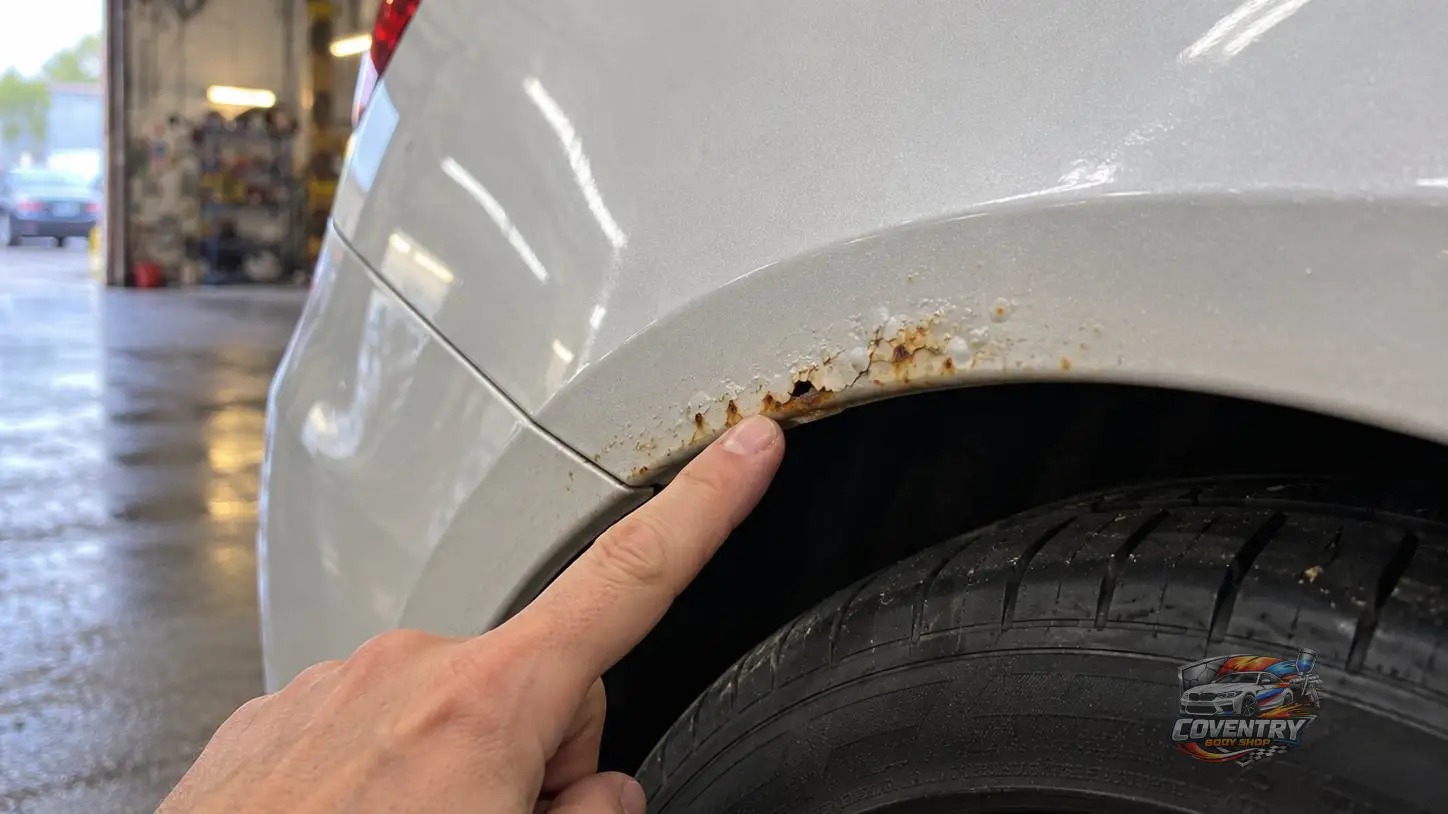
Ordinary car paint applied directly over untreated rust is unreliable. Rust can keep spreading beneath it and cause the finish to lift. The rust needs removing or treating with a compatible system before painting; metal that has rusted through needs metal repair or a replacement panel.
Why does paint over rust fail?
Moisture and air can stay in contact with the steel beneath the new paint. Ordinary refinishing paint may fail to adhere to untreated rust; protective coatings designed for prepared rusty steel have different requirements. No coating can restore metal that corrosion has already weakened.
The visible orange spot may only be part of the damage. Rust can spread beneath surrounding paint that still looks sound, so covering the mark leaves the cause in place.
Is it surface rust, bubbling paint or rot?
What you can see gives a first idea of the work. These are signs to look for; corrosion can also develop out of sight:
- Surface rust: Orange or brown spots appear in a chip or scratch, while the metal remains solid. Once the rust is removed, paint touch-up for small chips may be suitable, depending on the size and position.
- Bubbling or blistered paint: Often rust spreading underneath and lifting the finish, though trapped moisture or an earlier paint fault can raise bubbles too. When rust is the cause, the affected area is usually bigger than the bubble, so the paint around it has to be taken back to find where the rust ends.
- Rot or holes: Flaking, crumbling or perforated metal means material has been lost. Paint and filler cannot replace its strength. This usually needs metal work or a replacement panel.
Until the area is inspected, keep it clean and dry where practical. Sanding into bubbles can expose bare metal that needs prompt protection; leave them intact if you cannot assess and protect the area.
Where should you look for rust?
Look at exposed edges and places where dirt and moisture collect. Common starting points include:
- Bonnet edges: Stone chips that expose the metal.
- Wheel arch lips: Folded edges behind the visible arch.
- Door bottoms and sills: Lower edges that are easily overlooked.
- Boot lid or tailgate edges: Seams and corners around the lower edge.
- Seals and trim: Areas around their edges where moisture can linger.
On folded edges, seams, door bottoms and sills, rust often starts on the back face or inside the fold, where you cannot see it. Cleaning up and painting the outer face leaves that rust in place, so a clean outer face does not prove the panel is sound.
Can you use rust converter before painting a car?
A rust converter may be suitable where the remaining metal is sound and the treatment is compatible with the intended finish. It chemically treats remaining corrosion after loose rust has been removed. Follow the treatment and paint manufacturers' instructions, including whether a separate primer is needed. Rust-resisting paints are a separate product type: protective coatings whose uses depend on the product and the condition of the metal.
For a matched body-panel repair, a converter needs a compatible finish over it. Some rust-resisting paints are topcoats in their own right; check their suitability before using them beneath automotive paint. A matched body-panel finish may use colour followed by clear coat, or a direct-gloss paint that needs no separate clear coat. Neither a converter nor a rust-resisting paint can reach rust that has spread under paint that still looks sound, and neither replaces metal that has rusted away. A label saying a product can be painted over does not mean your panel is ready for a cosmetic repair.
What does a proper paint repair involve?
A paint repair is suitable only where sound metal remains or any necessary metal work has been completed. The work normally follows these steps:
- Inspection: Establish how far the damage extends and whether the area needs metal work before painting. Affected reverse faces and any seams or cavities also need assessment, with suitable corrosion protection included in the repair plan.
- Expose the affected area: Take back the paint around the visible spot until clean metal is found at its edges.
- Prepare the metal: Remove corrosion back to sound metal or use a treatment compatible with the refinishing system where appropriate. If this reveals holes or weakened metal, the repair plan must change.
- Protect and shape: Bare metal gets a primer suited to it. Filler is used only to correct a shallow shape on sound, prepared metal, never to cover rust or bridge a hole. The order and products follow the paint system being used.
- Match the colour: We start from the manufacturer's paint code and use specialist colour mixing to suit your car's existing paint.
- Apply the finish: In a basecoat and clear-coat system, the colour is followed by clear coat; direct-gloss finishes do not need that separate layer. The repair may need blending into the surrounding paint so the new paint does not stand out against the old.
We spray cars in our workshop's spray booth. All the painting is done by our director, whose previous work was as an Aston Martin technician and painter. Where the prepared area is too extensive for a small repair, repainting a single panel may be appropriate.
When does rust need metal work instead?
Holes and rot need a decision about repairing or replacing the metal. Bolt-on panels such as a wing, door or bonnet can be replaced where the rust is too far gone.
Rust on structural parts, including sills, subframes and areas around suspension mounts, is a safety matter and can lead to an MOT failure. A garage needs to inspect it. Paint must never be used to hide structural corrosion.
We do not cut or weld metal panels. If your car needs that, we will tell you and recommend a garage we have trusted with welding work before.
How do you decide whether the repair is worth doing?
The decision depends on how far the rust has spread, whether it affects structural metal and the overall condition of your car. An isolated patch on an otherwise sound panel is a different decision from corrosion across several areas.
Inspection establishes whether we can prepare and paint the area or whether metal work is needed first. The final price is set after inspection, so you can weigh the repair cost against the car's condition before deciding.
A small inspection at our workshop in Wyken, Coventry, is free. If the rust needs a deeper inspection, this costs from £240 including VAT (£200 plus VAT). We take that charge off the repair bill if you go ahead with the work.
Arrange a rust inspection
We advise sending photos of the rust by WhatsApp on +44 7903 105777 or the Send enquiry button to help avoid a wasted trip if the work is outside our scope. You can book without them. After booking, we advise every customer to bring the car in so we can inspect it in person.
No deposit is needed.
Leave a Comment
Comments
No comments yet.