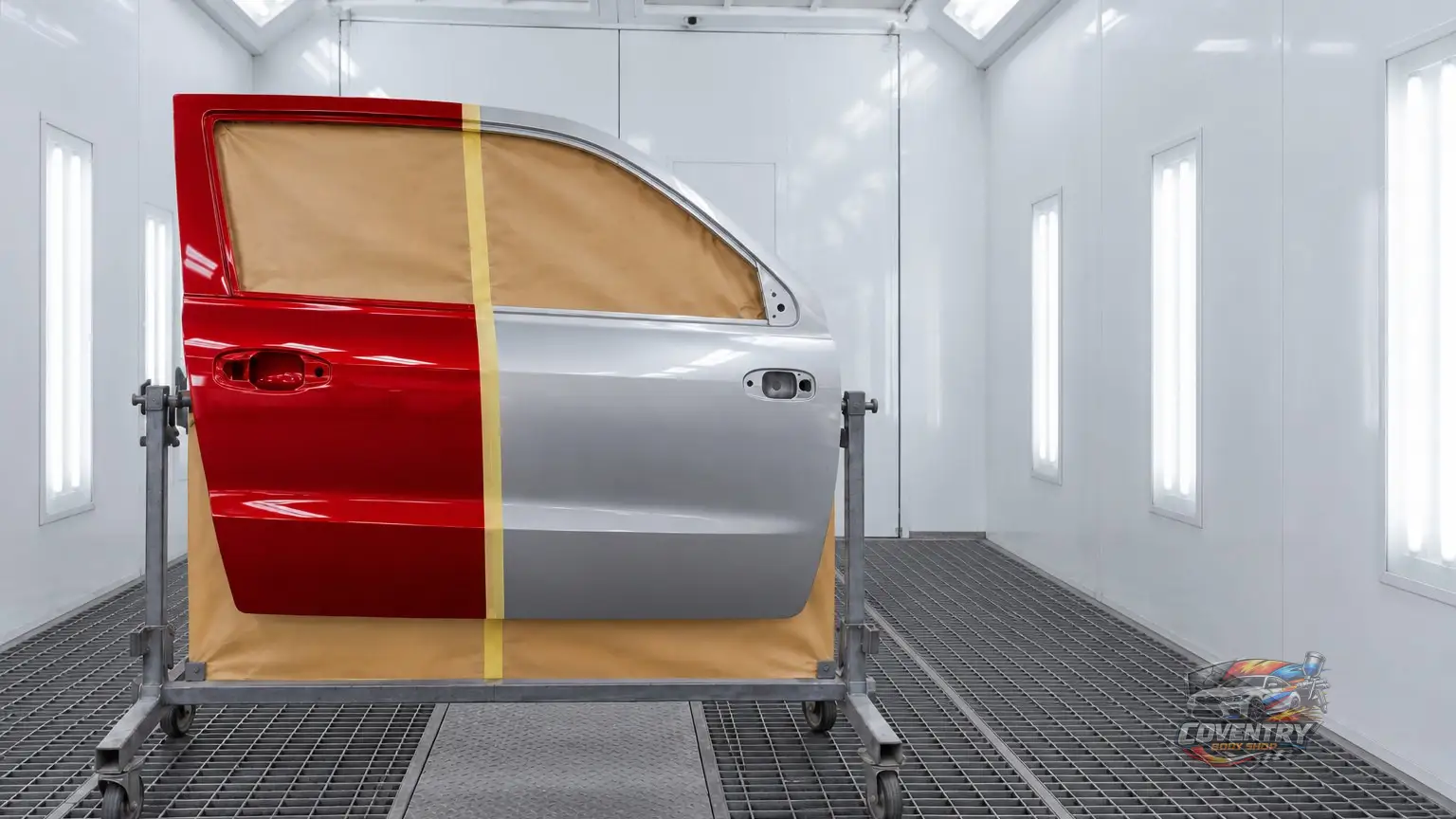
What a car colour change costs
Changing the colour of a whole car with paint means a full respray. The price comes from the paint you choose and from the labour your car needs, and both vary from car to car. Paint prices differ a great deal from one colour and paint type to another, and a car with dents or failing lacquer needs more preparation than one with sound paint.
A colour change is quoted separately after inspection, and we do not publish a starting price for it. Our full body respray has its own published price, from £1,495 plus VAT (£1,794 including VAT), and that figure is not a colour change price.
At our workshop in Wyken, Coventry, all paintwork is sprayed in our spray booth. The company director, a former Aston Martin technician and painter, is the only painter on our small team, so he sprays every colour change himself. A full respray takes 3 to 7 days, depending on the work the car needs.
What changes the price of a colour change
The paint you choose
Metallic and pearl paints contain flakes or pearl pigments, and they are often priced differently from solid colours. A pearl or special effect colour can need an extra coat to get the right look, which adds both material and spraying time.
If you already have a colour in mind, tell us its name and the car maker it comes from, or its paint code if you know it. Seeing the colour on a real car in daylight gives a better idea of the finish than a small sample does, because metallic and pearl paints change with the light.
How much of the car is painted
On a colour change, paint on the outer panels alone leaves the old colour in the door shuts and under the bonnet and boot lid, where it shows each time they are opened. Your written estimate lists the areas to be painted, so you can see before any work starts whether those inner areas are included.
The condition of the bodywork
New paint will not hide a dent, and it can make a ripple easier to see. For that reason dents are usually repaired before the colour goes on. Dent repair is listed on the estimate as its own item, and it is your choice whether that repair is done. At inspection we may also check the paint thickness with a paint depth gauge, which reads the total thickness of the paint film. A reading that is much higher than the rest of the car can point to an earlier repair or respray, and that area may need more work.
The size of the car
A larger car has more surface to prepare and paint, and it uses more material, so its size affects the price. A car with many separate trims or sensors also takes longer to strip and mask before painting.
Trims, lights and other parts
Badges, trims, handles and lights have to be taken off or masked before painting, so that no paint lands on them. Taking parts off gives a cleaner edge, but it takes longer, and some clips may need replacing once they have been removed. Which parts come off depends on the car and on the finish you want.
How we prepare a car for a new colour
The car is cleaned and degreased before any sanding, so that wax and road grime do not stop the new paint from bonding. Next come the repairs you agreed from the estimate. Bent panels can be straightened by panel beating, and a damaged bolt-on panel such as a wing or a door can be replaced. We do not cut or weld metal panels. If your car needs that, we will tell you and recommend a garage we have trusted with welding work before.
The old paint is then sanded to give the new coats something to grip. Where the old finish is cracked or peeling, it is taken back further, because paint sprayed over a failing layer can lift with it later. Filler goes into small marks where needed, and primer goes on where the repair or the bare areas need it.
Sanding can show damage that was not visible at the start, such as an old filler repair or rust under the paint. If that happens, we tell you what we found and what any extra work would cost before it is done, and it goes ahead only if you agree. Rust that has gone right through a panel needs cutting and welding, which is work for the welding garage we recommend.
Painting the new colour
With the preparation finished, the car goes into the spray booth. For a colour change, the new paint is mixed to the colour you have chosen, from its paint code where it has one. When we match a car's existing colour instead, for a panel repair, we use the paint code, specialist colour mixing and a spectrophotometer.
The colour is applied in coats, with the drying or flash-off time between them that the paint maker's instructions set. Where the paint system uses a lacquer, it goes on over the colour to protect it. Curing then follows the paint maker's instructions too.
Once the paint has cured, small dust marks in the lacquer can be flatted and polished out. Any parts that were removed are then refitted.
Colour change or single panel paint?
Not every paint problem needs the whole car painted. If one panel is faded or damaged, painting that panel in the existing colour usually costs far less than a colour change. Our single panel paint service starts from £150 plus VAT (£180 including VAT), and where it helps, the new colour is blended into the paint around it.
Light scratches and dull paint can sometimes be improved without any new paint at all. On a lacquered finish, machine polishing takes off a very thin layer of lacquer to level light marks, and our scratch removal and machine polish is priced per panel from £120 plus VAT (£144 including VAT). If the real problem is tired paint, ask about these options before deciding on a colour change.
Telling the DVLA and your insurer
A change of colour has to be recorded with the DVLA. You record the new colour on the vehicle's V5C registration certificate, the log book, and follow the DVLA's current instructions on GOV.UK for sending it in.
Tell your insurer about the planned change before the work is done. Check your policy wording and ask whether the new colour affects your cover or premium.
Looking after new paint
New paint needs gentle treatment while it finishes curing. When it can be waxed or polished depends on the products used, so ask us when you collect the car. After that, regular washing and a coat of wax or sealant now and then help protect it.
Some owners choose a ceramic coating once the paint has fully cured. It is a thin layer over the lacquer that can help water and dirt rinse off, and it is part of our paint protection and detailing service, priced after we have seen the car. A coating does not repair scratches or chips.
How to get a colour change quote
A small inspection is free. A deep inspection costs from £200 plus VAT (£240 including VAT), and that fee is taken off the repair bill if you go ahead with the work. After the inspection you get a written, itemised estimate before any work starts. Photographs sent beforehand help us see the condition of the car.
When you ask for a quote, tell us the colour you want and which areas you would like painted. Mention any dents or scratches you want put right at the same time, so the estimate covers them.
There is no deposit to pay, and you can cancel or move a booking at any point free of charge. You drop the car off at the workshop in Wyken and collect it from there, as we do not offer collection or delivery.
Book an inspection
To book an inspection for a colour change, call or WhatsApp +44 7903 105777, or send photographs with the Send enquiry button. For general questions, you can also use our contact form.
Leave a Comment
Comments
No comments yet.