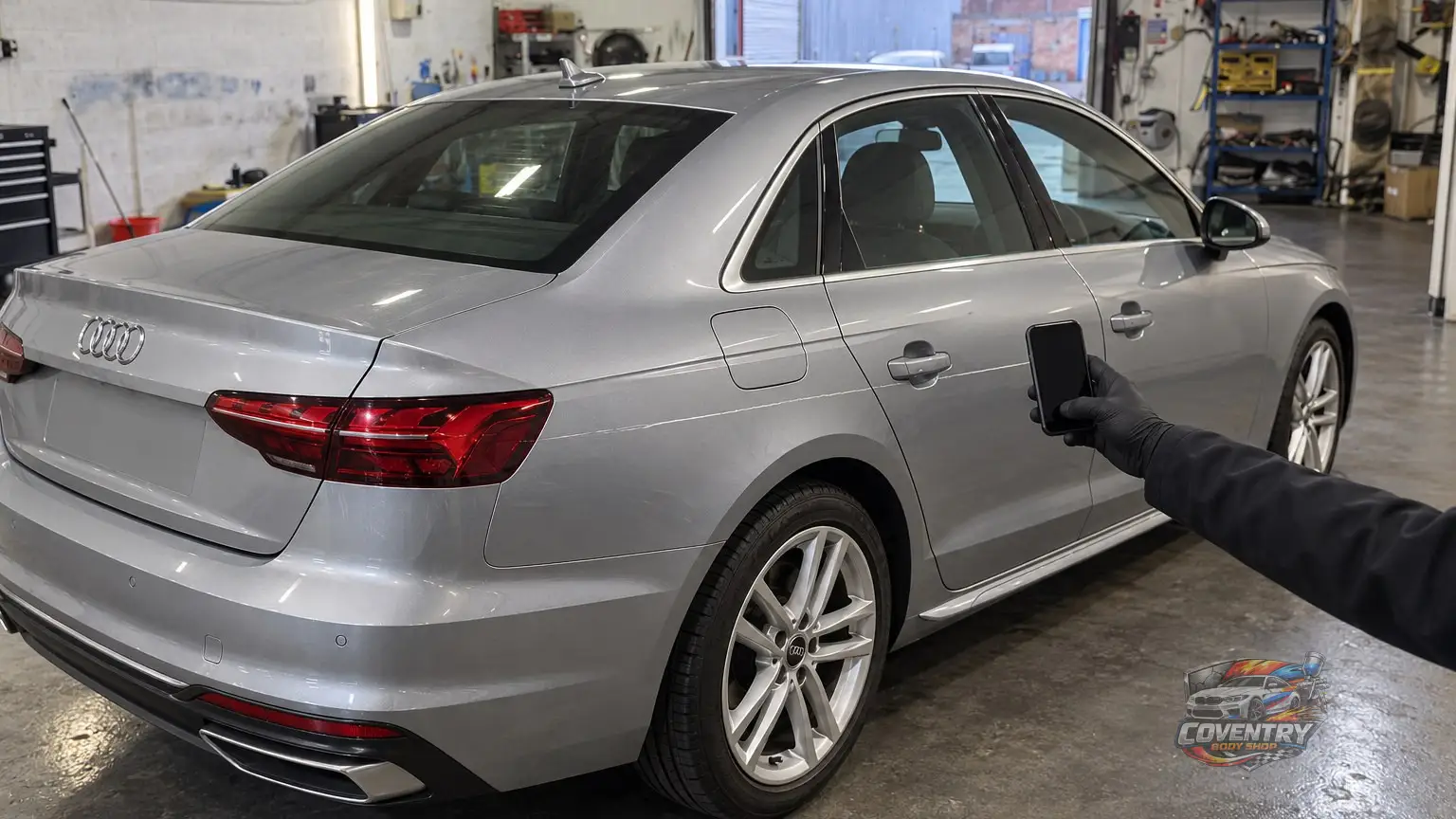
Coming back to your car and finding a fresh scratch is frustrating, and what you do first can make it easier to sort out. Make sure you and the car are safe first. Then photograph the damage, note the time and place, look for witnesses or CCTV, and speak to the other driver if they are still there. Telling the police and telling your insurer are separate questions: the police deal with a driver who left without giving details or with damage that looks deliberate, while whether to claim depends on your policy and the cost of the repair.
How do you know how serious a car scratch is?
Once you are safe and have taken your photos, look at how deep the damage goes. Depth is a large part of whether a quick repair will do or the panel needs a respray.
On many modern cars the paint sits in layers over the metal or plastic: primer, then the base colour, then a clear coat. A scratch that only marks the clear coat usually looks like a light surface line and may polish out. A scratch that cuts through the colour layer can expose the primer. One that goes on through to bare steel can let rust start if it is left, while a plastic bumper will not rust. If your fingernail catches in it, it may need more than a polish.
What different marks can mean:
- White or grey lines: these can be primer showing through, but they can also be scuffed clear coat, paint left by the other car or bare plastic, so colour alone does not tell you how deep the scratch goes.
- Dark or black marks: often rubber, plastic trim transfer or scuffing from another bumper, which may sit on top of your paint rather than cutting into it, though a dark line can also be black plastic showing through.
- Rust spots: often a sign that moisture has reached exposed metal, though small orange specks can also be iron particles sitting on top of the paint.
- Creased or lifted paint: can point to a deeper impact, sometimes with a dent.
If you cannot tell how deep it goes, a bodyshop can look at it closely and, on a metal panel, measure the total paint thickness around it with a paint depth gauge.
What should you photograph and write down straight away?
Photos and notes taken on the spot are more useful than what you remember later, especially if another driver is involved or you may need to claim. If the car is parked somewhere safe, record as much as you can before you move it or clean the area. If it is in a dangerous spot, get yourself and anyone with you clear first.
Photos worth taking:
- Wide shots: the whole car in its parking spot, with the scratch in frame.
- Close-ups: the scratch itself from two or three angles, ideally with something for scale like a coin or your hand.
- Adjacent panels: any nearby damage, debris, or transferred paint from the other vehicle.
- Surroundings: the location, road markings, signage, and any CCTV cameras you can see.
- Other vehicle: registration plate, make, model, colour, and any visible damage if the driver is still there.
Write down the time, date, weather, and a short description of what happened. If anyone saw what happened, ask for their name and a contact number. An independent witness can help if a dispute follows. If you can see a CCTV camera, ask whoever runs it to keep the footage, as recordings can be deleted or recorded over after a while.
Should you speak to the other driver and exchange details?
If the person who scratched your car is still there, it is worth talking to them, and their details can help you later. Stay calm and stick to facts. Avoid arguing about fault at the roadside. Who pays is a civil matter: it is usually worked out through the insurers, drivers can also settle it between themselves, and a dispute can end up in court. The police deal with any offence, such as a driver leaving without giving details.
If their vehicle caused the damage on a road or in a public place, the driver has to give their name and address, the owner's name and address if the car is not theirs, and the registration. A phone number, an email address and their insurance details are worth asking for too, though they do not have to give those after a collision that only damages property. Note the make, model and colour of their car yourself.
If they refuse to give their name and address, or drive off without giving them, note their registration and the direction they went, and report it to the police: call 999 in an emergency, such as when someone is in immediate danger or seriously hurt, and otherwise call 101 or report it online. A scratch alone may not always warrant a police response, but if you suspect a deliberate act or the other driver left without giving details, report it as soon as you can.
Do you need to report the scratch to the police?
You do not always need to call the police for a minor scratch, but in some situations you should. If the other driver left without giving details, that may be an offence, and it is worth reporting. Under section 170 of the Road Traffic Act 1988, when a vehicle on a road or in a public place is involved in an accident that damages another vehicle, its driver must stop. They must give their name and address, the vehicle owner's name and address and the registration to anyone with reasonable grounds to ask. If they do not give their name and address at the time, they must report the accident to the police as soon as they reasonably can, and in any case within 24 hours. Failing to stop, or failing to report, is an offence. These rules cover damage caused by a vehicle; someone scratching a parked car with a key is a different matter, which can be reported to the police as criminal damage.
A police report can also help if you suspect deliberate damage or vandalism, if the scratch came with a more serious collision, if the other driver seemed drunk or was aggressive, or if other cars on the street have been damaged too.
If you find a scratch in a car park and do not know how it happened, ask your insurer whether it wants a police report. If you think the damage was deliberate, you can report it to the police as criminal damage.
When should you contact your insurance company?
You may need to tell your insurer even when you do not plan to claim. Your policy may require you to report any incident, whether or not a claim follows, so check its terms. Telling the insurer about an incident is not the same as making a claim, and not telling them when the policy says you must can affect a later claim, depending on the policy terms.
Before you decide whether to claim or pay yourself, check:
- Repair cost: if the repair costs less than your excess, a claim on your own policy would usually pay nothing towards it.
- Excess level: check which excess your policy applies to this kind of claim.
- No-claims discount and premium: whether a claim affects your no-claims discount depends on your policy and on whether the insurer gets its costs back from the other side. Even a non-fault claim can still affect your premium at renewal.
- Fault position: if the other driver looks to be at fault and is insured, you can ask their insurer to pay for the repair, but they may dispute who was at fault or how much the repair costs.
When you call your insurer, have your policy number, the photos, the other driver's details, and the police reference if you have one. Ask how they expect to record the incident, whether you would pay an excess, and whether the excess can be recovered from the other driver's insurer.
Can you fix a scratch yourself, or do you need a bodyshop?
A light mark that stays in the clear coat can sometimes be polished out. Touch-up paint in the right colour code is for a small chip or nick where paint is missing, not for a mark in the clear coat, where added colour can make it stand out more. A long or deep scratch, one across a body line, or a keyed plastic bumper is harder to put right at home.
A bodyshop repair for a scratch is usually one of these:
- Machine polishing: for a light mark that stays in the clear coat.
- SMART repair: a repair to the damaged area only, rather than the whole panel. It suits minor scuffs and scratches in one area of a panel.
- Panel respray: can be the better choice when the scratch runs across a large area of the panel.
- Panel replacement: for a bolt-on panel, where the scratch comes with a crack or other damage that cannot be repaired.
What does a bodyshop actually check during a scratch estimate?
Photos can give a first idea of the work, but some things only show when the car is seen in person, such as a shallow dent under the scratch.
- Depth of the scratch through the paint layers.
- Whether there is an underlying dent or stretched metal.
- The paint on the car: whether the colour is solid, metallic or pearl, and how many layers it was applied in, which can affect colour matching and blending.
- Panel condition: signs of earlier repairs, which a paint depth gauge reading can point to on a metal panel. Old filler may only come to light once the paint is sanded during the repair.
- Blending: whether the colour needs blending so the repair is harder to see.
- Sensors: some bumpers hold parking sensors, radar or cameras. Work near them can add to the job, and some cars need these systems checked or recalibrated afterwards, so ask at the inspection whether your car needs this and who would do it.
If the damage is minor and in one area, our SMART repair service may suit it; larger damage may need a panel repaint.
How is colour matched on a repaired scratch?
A paint code gives the factory formula for your colour, but the shade can vary between factory batches, and paint fades with sun and age. An off-the-shelf colour pen made to the code can still sit a shade away from the car.
At our workshop colour matching uses the manufacturer's paint code, specialist colour mixing and a spectrophotometer. Where the finish has a clear coat, it goes on over the colour to protect it and bring back the gloss. On a panel repaint the new colour is blended into the surrounding paint where it needs it, so the change from new paint to old is harder to see. Preparation matters too: sanding, masking, priming where needed and keeping the area clean, all covered in our guide on why proper surface preparation is crucial in auto painting, and it is a large part of why professional paint jobs last longer.
How long does a scratch repair usually take?
Time depends on what the scratch actually needs. At our workshop, small jobs can sometimes be done the same day, depending on how busy we are, but allow 1 to 2 days. A full respray takes 3 to 7 days. A bumper that has to come off for the repair can take longer.
The job can take longer because of:
- Parts waiting time: replacement trim clips or a new bumper cover.
- Hidden damage: a dent that looks small until the panel is stripped down.
- Colour complexity: three-stage pearl colours can need more blending and drying time.
- Insurance authorisation: if the insurer wants their own assessor to inspect the car.
Ask for an estimated completion date when you book. We do not provide a courtesy car, so plan how you will get around while the car is with us.
How much does it cost to repair a scratch from another driver?
There is no single price for scratch repair, because several things change the work. Cost depends on scratch length and depth, which panel is affected, whether the panel is metal or plastic, the paint system on the car, whether the colour needs blending, and whether trim has to come off and go back on.
Our from prices, as a guide:
- Paint touch-up: for a small chip or nick, from £49 plus VAT (£58.80 including VAT).
- Light clear-coat marks: machine polishing alone can sometimes take them out. Our scratch removal and machine polish is priced per panel, from £120 plus VAT (£144 including VAT).
- SMART repair: for a small scratch or scuff in one area, from £75 plus VAT (£90 including VAT).
- Single panel paint: for larger or deeper damage on one panel, from £150 plus VAT (£180 including VAT).
- Bumper respray: from £210 plus VAT (£252 including VAT); the cost can rise if the bumper has to come off for the work.
These are from prices, and the final price is set once we have inspected the car. A small inspection is free, and a deeper inspection is from £200 plus VAT (£240 including VAT). You can send clear, well-lit photos from a couple of angles by WhatsApp or with the Send enquiry button before you bring the car in.
What happens next if the other driver was at fault?
If you have the other driver's details and they are insured, you can make a claim against their insurer. They may accept it, or they may dispute who was at fault or the cost of the repair, so keep your evidence. You may be asked for one or two quotes. An insurer may suggest a repairer from its own network, so ask the insurer what using a bodyshop you choose means for the cost. We are not on any insurer's approved list, though we have repaired cars for customers claiming on their insurance.
If you want help with the claim, our insurance and accident repair support page explains what we do: we can provide photographs of the damage and a written, itemised estimate, and deal with the insurer about the repair if you want us to.
Keep receipts for related costs, such as travel to and from the bodyshop if your insurer allows it. If you want the insurer to pay, ask whether it needs to agree the estimate before work starts, and ask early whether the policy includes a courtesy car, as cover varies.
Coverage beyond Coventry for scratch and body repairs
We work from one workshop in Wyken, Coventry, and customers bring cars to us from up to about 100 miles away. For drivers coming from Northampton, about 33 miles away by road, our page on Northampton body repairs in Coventry is written for drivers making that trip.
Send photos for a realistic scratch repair estimate
Photos of the scratch from a few clear, well-lit angles give us a first look at the damage before you bring the car in. The estimate itself comes after the inspection: the small inspection is free, and you get a written, itemised estimate before any work starts.
To arrange an inspection or ask about a scratch repair, call or WhatsApp +44 7903 105777, send photographs with the Send enquiry button, or use our contact form.
Leave a Comment
Comments
No comments yet.