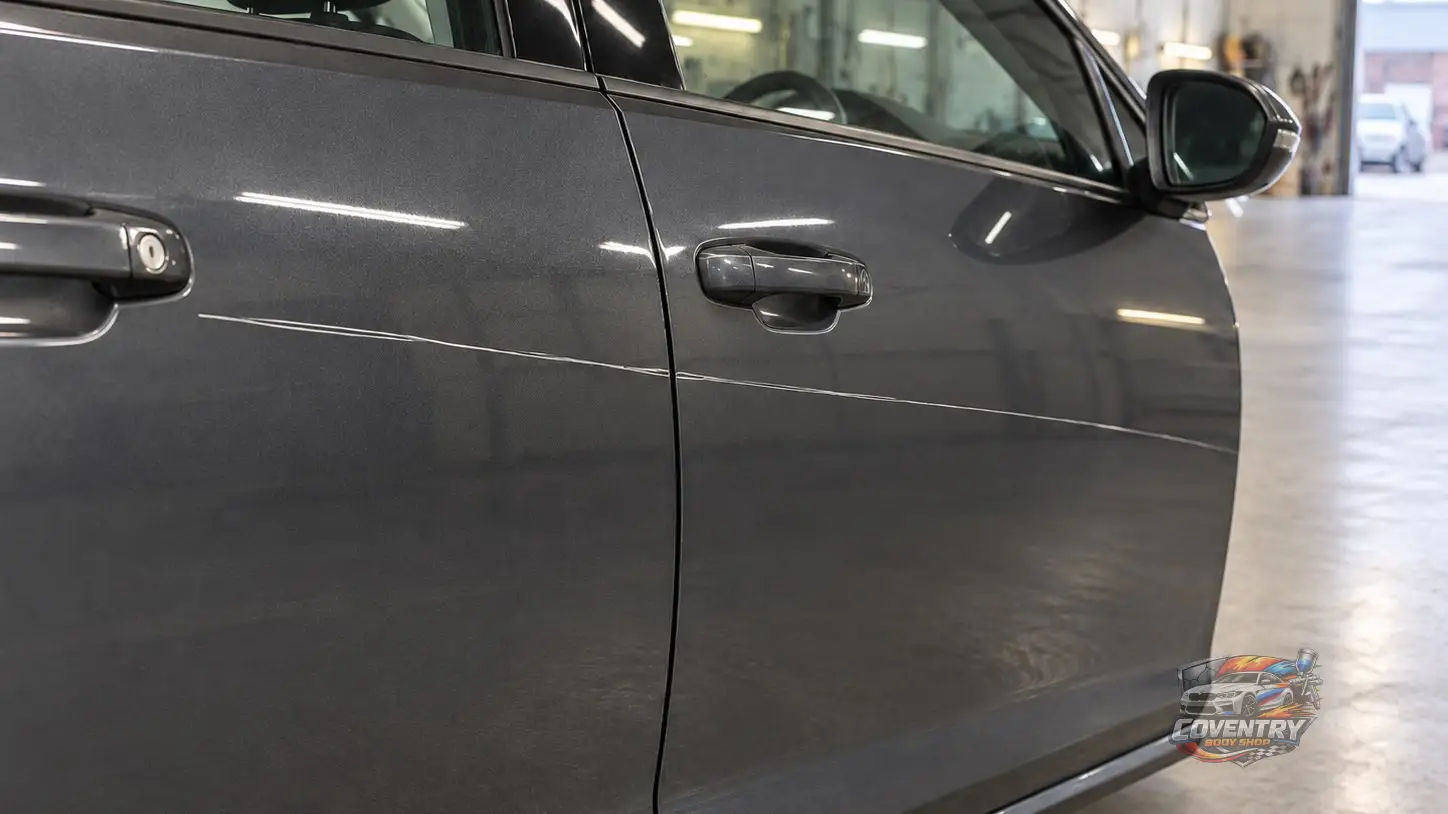
Yes, keyed car paint can usually be repaired. On a gloss finish, a line within the clear coat, the transparent layer over the colour, can often be reduced or removed by machine polishing. Once a key cuts through the clear coat and damages the colour, the repair needs paint even if no primer or metal is visible. Touch-up may cover a narrow line; deeper grooves can need levelling before repainting, with colour blending where needed to soften the transition.
How deep has the key cut into your paint?
A key can leave a shallow mark at one end and a deep groove at the other as pressure changes. A thin line can still be deep, so its width is not a reliable guide to the repair needed.
The colour inside the line gives useful clues, although none is conclusive on its own:
- Your car's paint colour: A line only in the clear coat leaves the colour intact beneath, but a scratch can also cut into the colour without reaching primer. Missing colour needs paint, even if the line still looks similar to your car's colour.
- White or grey: This may be exposed primer. Scratched clear coat can also look white because it scatters light.
- Silver: This may indicate exposed metal, although reflections and silver paint can make it difficult to judge.
An inspection combines these clues with how the surface feels and how reflections break across the groove. A fingernail catching suggests an uneven surface, but cannot identify the damaged layer.
When can a key scratch be polished out?
On a gloss finish, machine polishing can level a shallow mark by removing a small amount of surrounding clear coat. Enough sound coating must remain, so even a scratch contained within that layer may be too deep to remove completely without taking off too much paint. Matt and satin finishes are not polished, because polishing makes them shiny in patches.
With enough sound clear coat left, machine polishing light key scratches can make the line less visible without repainting, though some of the mark may remain.
Repeated rubbing with abrasive products can thin the coating while leaving the deepest part visible. Our guide to paint correction explains how surface defects are treated.
What happens when the keyed line needs paint?
A groove through the colour needs more than fresh paint brushed over its surface. Touch-up can cover a narrow exposed line, but may leave a visible ridge or difference in texture. Where appearance matters, repainting a single panel is often the more suitable approach for damage contained on one panel.
The repair usually involves these stages:
- Prepare the line: Clean the area and sand the damaged edges so loose coating and sharp steps do not remain beneath the repair.
- Level and prime: Use filler only where the groove needs levelling, then sand it smooth and apply primer suited to the surface beneath. The exact order depends on the paint system.
- Apply colour: Cover the prepared repair and blend the colour over a wider area where needed to soften the transition.
- Refinish the panel: On a typical clear-coated finish, apply clear coat across the prepared panel, allow it to cure and check the result.
The preparation area is usually wider than the scratch itself.
What if the key scratch crosses two doors or more?
A continuous line across two doors is damage to two separate panels. If it is deep throughout, each damaged panel needs preparing and painting. Colour may also need blending into neighbouring panels, depending on the finish and where the repair ends.
Blending extends colour gradually into the surrounding paint to reduce a visible change at a panel boundary. It does not mean that every panel receiving paint was scratched. A neighbouring panel receiving blended colour needs clear coat too, across the whole panel or to a natural break suitable for the paint system.
Door handles and trims may need removing to reach the damaged paint properly. Where the line reaches a door edge, access to that edge matters too.
How are words or repeated lines repaired?
Words, patterns and overlapping strokes can usually be repaired, but with a panel repaint the individual lines are not traced with fresh paint. Where repainting is needed, the whole affected area of the panel is prepared and painted, with the finishing coats extended as the repair requires.
Crossing strokes may have deeper points where the key passed more than once. Each groove needs checking and levelling, because an unfilled depression can remain visible through the new finish.
Does exposed metal need attention before the repair?
Bare metal in a deep key line can start to rust on a steel panel. Arrange prompt protection or repair for exposed steel. Keeping the area clean and dry is only temporary care and does not restore corrosion protection.
If rust has already formed, it needs assessing and removing as part of preparation before repainting. For practical steps beyond the repair itself, read what to do after someone scratches your car.
Arrange an inspection of your keyed paintwork
We advise sending photos of the keyed damage by WhatsApp on +44 7903 105777 or the Send enquiry button, though this is optional. This can save you a wasted trip if the damage needs work we do not take on. After booking, we advise everyone to bring the car in for an in-person inspection.
We will tell you what the repair involves at our workshop in Wyken, Coventry. The final price is set after inspection, and no deposit is needed. A small inspection is free. For paint repair prices, see our single-panel painting page.
Leave a Comment
Comments
No comments yet.