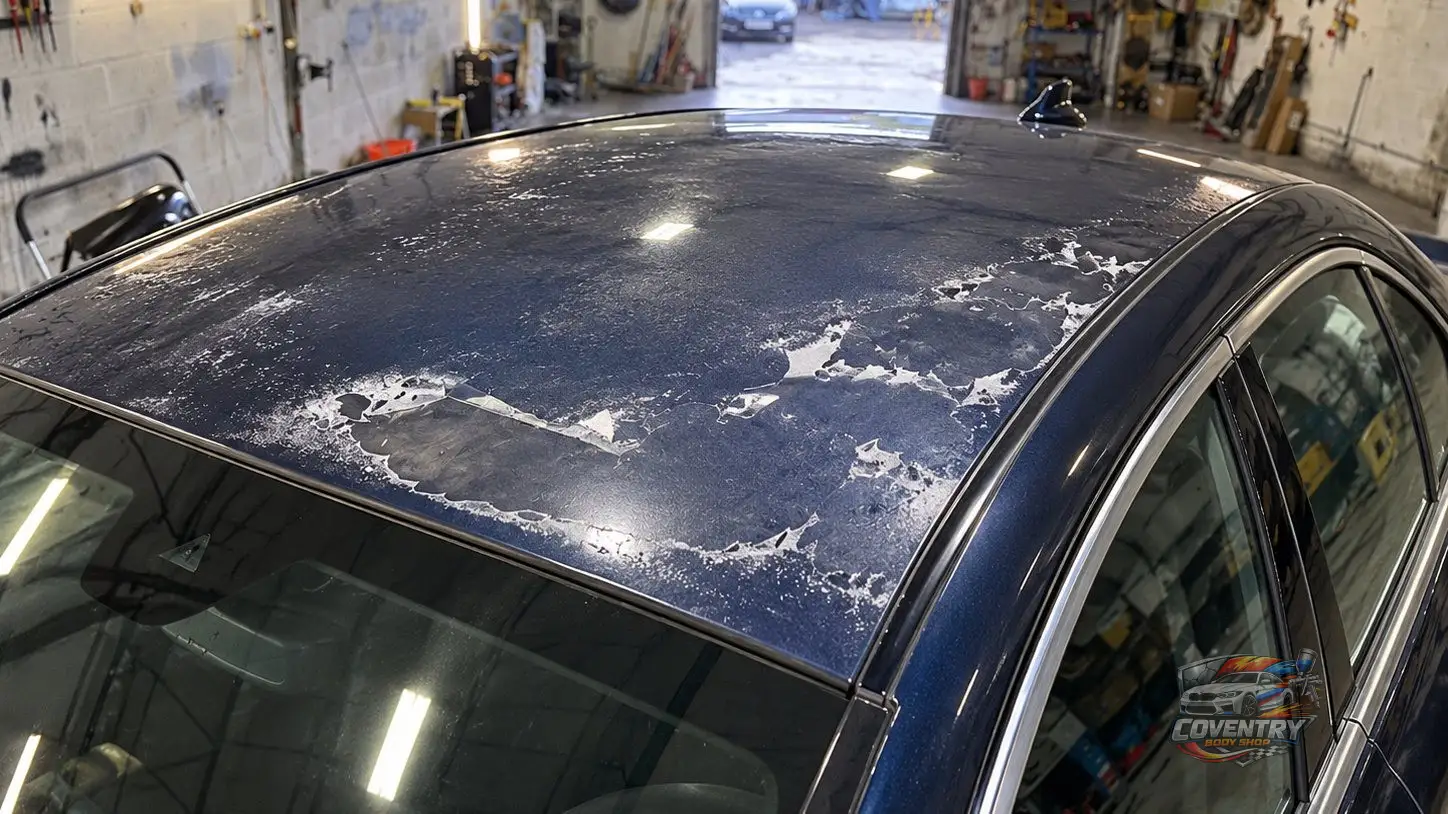
Paint wears out slowly, so it is easy to miss the point where a polish will no longer help. Some of the signs that follow mean a car needs repainting, and a few can be put right without any new paint.
On a modern car, the paint is usually built in layers. Primer sits on the metal or plastic, the colour coat goes over it, and a clear lacquer on top gives the gloss and protects the colour from the weather. Paint faults usually come from one of those layers failing or being cut through, or from damage underneath them.
1. Scratches that catch your fingernail
Run a fingernail gently across the scratch. If the nail slides over it, the mark may be only in the lacquer, and machine polishing may level it. If the nail catches, the scratch may have gone through the lacquer into the colour, though a raised edge can catch a nail too. The test is only a rough guide, and an inspection gives a better idea of the repair a scratch needs. Polishing cannot put back paint that is missing.
Light marks can often be dealt with by our scratch removal and machine polish, priced per panel from £120 plus VAT (£144 including VAT). A short, deep scratch in one area may suit a SMART repair, and a long one along a door or wing can mean painting that panel. Bare metal at the bottom of a scratch should not be left for long, because steel that is open to water will start to rust.
2. Stone chips on the bonnet and front edges
The bonnet, the front bumper and the leading edge of the roof catch the grit thrown up by other traffic. A few chips can be touched in, and our paint touch-up service starts from £49 plus VAT (£58.80 including VAT).
A front end covered in chips can look speckled once each one is touched in. Repainting the bonnet or the bumper can give a cleaner result in that case, with the chips prepared and painted over in one job.
3. Faded colour
Sunlight breaks paint down over the years, and the panels that face the sky take more of it. On an older car the roof, the bonnet and the top of the boot lid can look lighter than the doors. Some older solid colours, reds in particular, are known for fading.
Polishing can bring back some depth when the fading sits in the very top of the paint. If the fading goes deeper than the surface, polishing will not bring the colour back, and repainting is the way to restore it.
4. Lacquer that is peeling or going cloudy
Lacquer failure can start as a milky or cloudy patch on the roof or bonnet, though a cloudy patch can have other causes, so it is worth having it checked. Later the lacquer lifts at the edges and peels away in sheets, leaving the colour coat dull and unprotected underneath.
Once lacquer has started to peel, polish and wax will not stop it. The failed lacquer usually needs sanding back and the area refinishing, and how much of the panel that covers depends on how far the failure has spread. Spraying new paint over loose lacquer would only trap the problem, and the new coat would lift along with the old one.
5. Paint that is flaking or bubbling
Flaking paint is often a sign that the layers have stopped bonding to each other or to the panel. It can follow an earlier repair where the surface was not prepared well enough before painting, and corrosion under the paint can cause it too.
Bubbles under the paint are a different warning. On a steel panel they can mean rust is forming underneath, though moisture or poor adhesion can raise bubbles too. If rust is the cause, the paint will keep lifting until it is dealt with. Have a bubble looked at while it is still small.
6. Rust spots
Rust often shows first around the wheel arches, the sills and the bottoms of the doors, where water and road salt collect. A small surface spot can often be cleaned back to sound metal, primed and painted. Rust under the paint can spread further than it looks, and the full extent sometimes shows only once the repair starts.
Rust that has eaten through the metal is a bigger job. We do not cut or weld metal panels. If your car needs that, we will tell you and recommend a garage we have trusted with welding work before. A rusted bolt-on panel, such as a wing or a door, can sometimes be replaced instead.
7. A panel that does not match the rest of the car
Look along the side of the car in daylight. A door or wing that is a slightly different shade, or that reflects the light differently, may have been repainted at some point. The mismatch can come from a colour that was not matched well, or from new paint that was not blended into the panels next to it. Lighting and the angle of the panel can play tricks too, and painted plastic bumpers can look slightly different from the metal panels beside them.
At inspection we may check the paint with a paint depth gauge, which reads the total thickness of the paint film. A reading much higher than the rest of the car can point to an earlier repair. For a panel repaint, colour matching uses the manufacturer's paint code, specialist colour mixing and a spectrophotometer, and the new colour is blended into the surrounding paint where that helps to hide the join.
8. A dull, chalky finish
Paint left unprotected for years can turn chalky, and a pale residue may come off on a cloth. This is often a sign of oxidation in the top layer of the finish.
If there is enough sound paint left, machine polishing can take off the damaged surface and bring back some gloss. Each polish removes a thin layer, so the paint thickness may be checked with the depth gauge first. If there is too little paint left to polish safely, the panel may need painting. A finish that turns dull again within weeks of polishing is worth having checked, because the paint underneath may be breaking down.
9. Scuffed or cracked bumpers
Bumpers on modern cars are mostly plastic, and they take the knocks from parking and low-speed bumps. A scuffed corner can often be repaired and painted. Some cracks can be plastic welded and filled, and a bumper past repair can be replaced. Our bumper repair is priced after inspection, and our bumper respray starts from £210 plus VAT (£252 including VAT).
A small scuff in one area may suit a SMART repair, which repairs and paints only the damaged spot. SMART repair costs from £75 plus VAT (£90 including VAT). Our SMART repair is for scratches and scuffs, not dents.
10. Dents where the paint has cracked
A dent with unbroken paint can often be pushed out by paintless dent repair for small dents, which leaves the original finish in place. Once the paint in the dent has cracked or chipped, paintless repair on its own is not enough, because the paint needs putting right as well.
The metal is straightened by panel beating, then filled and primed where needed, and the colour and lacquer go on in the spray booth. Our panel dent repair and respray is priced from £175 plus VAT (£210 including VAT).
Repainting one panel or the whole car
Damage limited to one or two panels can be put right by painting just those panels in the existing colour, which keeps the job smaller. Our single panel paint service costs from £150 plus VAT (£180 including VAT). Filler, primer, lacquer and blending go into a panel repaint where the panel needs them.
A full body respray makes sense when faded or failing paint has spread across many panels, or when you want a new colour. It starts from £1,495 plus VAT (£1,794 including VAT), and the final price depends on the paint chosen and the work needed. A full respray takes 3 to 7 days. A colour change is quoted after inspection.
Paint problems that may not need a repaint
Some marks look worse than they are. Bird droppings, tree sap and traffic film can leave a surface feeling rough and looking flat, and a proper wash makes it easier to judge the paint underneath. Light swirl marks from washing usually sit in the lacquer and can be polished out.
If the car is going back to a lease company, check the company's return guide before booking any work, because it sets out which marks are allowed. Our lease return repairs start from £150 plus VAT (£180 including VAT).
How we check whether your car needs a repaint
At Coventry Body Shop, our workshop in Wyken, Coventry, a small inspection is free. For a closer look, the deep inspection is charged from £200 plus VAT (£240 including VAT), and that fee is taken off the repair bill if you go ahead with the work. You get a written, itemised estimate before any work starts.
All paintwork is sprayed in our spray booth. The company director, a former Aston Martin technician and painter, is the only painter on our small team. There is no deposit to pay, and you can cancel or move a booking at any point free of charge. Small jobs can sometimes be done the same day, depending on how busy we are, but allow 1 to 2 days. Every repair carries our 6-month workmanship guarantee, which starts on the day you collect the car.
To ask about the damage before you book, call or WhatsApp +44 7903 105777, or send photographs with the Send enquiry button. Photos taken in daylight, one from a few steps back and one close up, help show the damage.
Leave a Comment
Comments
No comments yet.