The Early Days of Automotive Paint
The first cars were painted much like horse-drawn carriages. Coats of oil-based paint and varnish were brushed on by hand, and coats were usually left to dry and rubbed down before the next went on. Drying was slow, which held up production, and the finish tended to dull and crack with sun and weather.
In the 1920s, sprayed nitrocellulose lacquers came into use on car production lines. They dried far faster than brushed varnish, and spraying laid the paint on more evenly than a brush, although the lacquer was usually polished to bring up a shine.
The Rise of Synthetic Paints
Synthetic resins such as alkyds, and later acrylics, came into wide use. Many of them held their gloss and colour longer than the oil paints and varnishes before them. Metallic finishes also became common, with fine aluminium flakes in the paint that catch the light at different angles as you walk past the car.
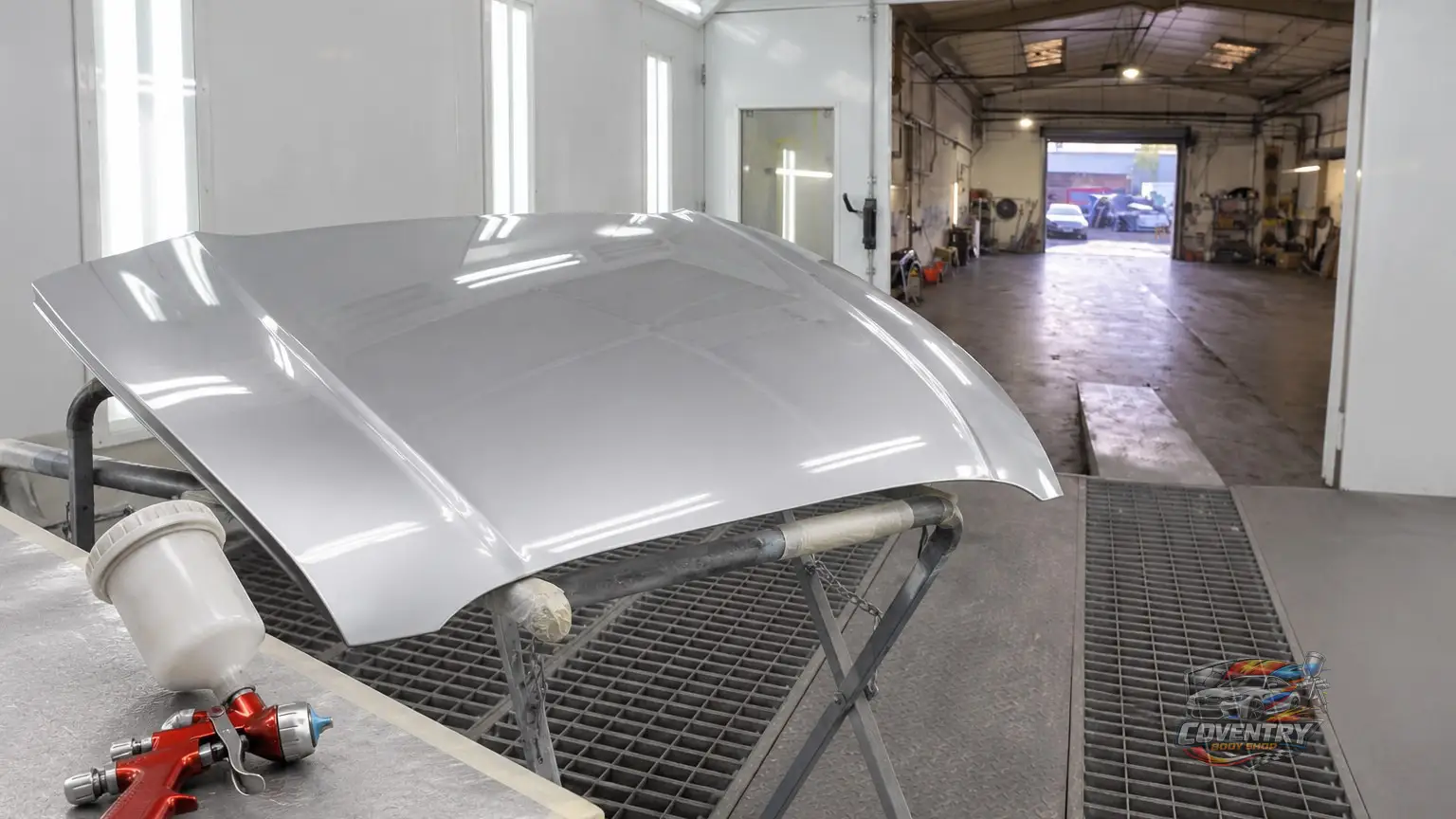
Spraying in an open workshop lets dust settle in the wet finish and fills the air with spray mist, so bodyshops moved painting into enclosed spray booths with filtered air and extraction. A booth helps keep dirt off the wet paint, and its extraction reduces the spray mist in the air. At Coventry Body Shop, all paintwork is sprayed in our spray booth.
Advancements in Paint Application Techniques
Electrostatic spraying gives the paint particles an electric charge, so they are drawn to the earthed car body. Compared with conventional spraying, more of the paint lands on the car and less is lost as overspray. Car factories use it widely, for example on bodies painted before the trim is fitted.
Basecoat and clear coat systems split the job in two. A coloured basecoat goes on first, followed by a clear lacquer. In this system, the clear layer gives the gloss and takes much of the sun and weather that would otherwise reach the colour.
Repairs to a basecoat and clear finish use the same two-layer build. On a single panel paint job the panel is prepared and primed where it needs it, the basecoat is sprayed, and lacquer goes over the top. Blending into the next panel is added where the repair needs it. A full body respray follows a similar order across the whole car, with the preparation set by the condition of each panel. Our director, a former Aston Martin technician and painter, does all of our painting, to the paint maker's and the vehicle maker's methods.
The Impact of Environmental Regulations
Solvent-borne paints release volatile organic compounds (VOCs) when they are sprayed and as they dry. Rules on the VOC content of vehicle refinishing products in the UK and Europe pushed paint makers towards waterborne paint systems, in which water replaces much of the solvent in the basecoat. Clear coats used in repairs are still usually solvent-borne, and many are high-solids products that contain less solvent than conventional clear coats.
Waterborne basecoat dries mainly as its water evaporates. Air movement, temperature and humidity in the booth therefore affect how quickly it dries, and painters adjust their flash-off times to suit.
Colour Matching and Customisation
A repair has to match paint that may have faded for years, and the same paint code can vary slightly between factories and production runs, so the code alone is not always enough.
A spectrophotometer measures the colour of the existing paint, and its software suggests a mixing formula from the paint maker's data. Where the repair needs it, the new colour is blended into the neighbouring panels, which makes small differences harder to see. At Coventry Body Shop, paint is mixed to the manufacturer's paint code and matched with a spectrophotometer.
A wrap is one route to a different look: a film applied over the existing paint. Our guide to car wraps compared with paint sets out the differences. GOV.UK lists colour among the details you must update on your V5C, so a full colour change has to be reported to the DVLA. Check your insurance policy too, since your insurer may need to be told.
Durability and Longevity Considerations
Paint on a car faces sunlight, stone chips, bird droppings, road salt and car washes, and each of these wears it down over the years.
On a basecoat and clear finish, the clear coat takes the wear. Clear coats usually contain UV absorbers that slow the fading of the colour underneath. Where the clear coat has worn through, the colour below is exposed. Peeling clear coat cannot be polished back. In either case the panel usually needs repainting. Our workmanship guarantee on paintwork runs for 6 months from collection.
Light marks in the clear coat can often be polished out. Scratch removal and machine polish takes off a thin layer of lacquer to remove fine scratches and bring back the gloss, provided enough clear coat is left. A paint depth gauge reads the total thickness of the paint, not the clear coat on its own, and a reading well above the rest of the car can point to an earlier repaint.
Innovations in Paint Protection
Besides wax and polymer sealants, paint can be protected with a ceramic coating or with paint protection film (PPF).
A ceramic coating is a liquid applied over the clear coat that hardens into a thin, slick layer, and products differ in how they bond and how long they last. With many products water beads off and dirt sticks less, which makes washing easier. It will not stop stone chips or deep scratches.
PPF is a clear film applied over the paint on areas that take stone chips, such as the bonnet and the front bumper. The film can reduce stone-chip damage to the paint, and how much depends on the film, how it is fitted and the impact.
At Coventry Body Shop, our paint protection and detailing service covers machine polishing and paint protection, not ceramic coating, and a fresh respray can be protected once the paint has cured.
The Future of Automotive Paint Technology
Self-healing clear coats are used on some car models. On these coats, very fine scratches can level out with warmth, depending on the product and the damage.
Spectrophotometers can be linked to paint makers' formula databases, which list the variants of a colour that one paint code can cover.
If your car's paint is damaged, send photos by WhatsApp or through the Send enquiry button. You get a quote before any work starts. Every price is a from price, and the final price is confirmed after inspection.
Leave a Comment
Comments
No comments yet.