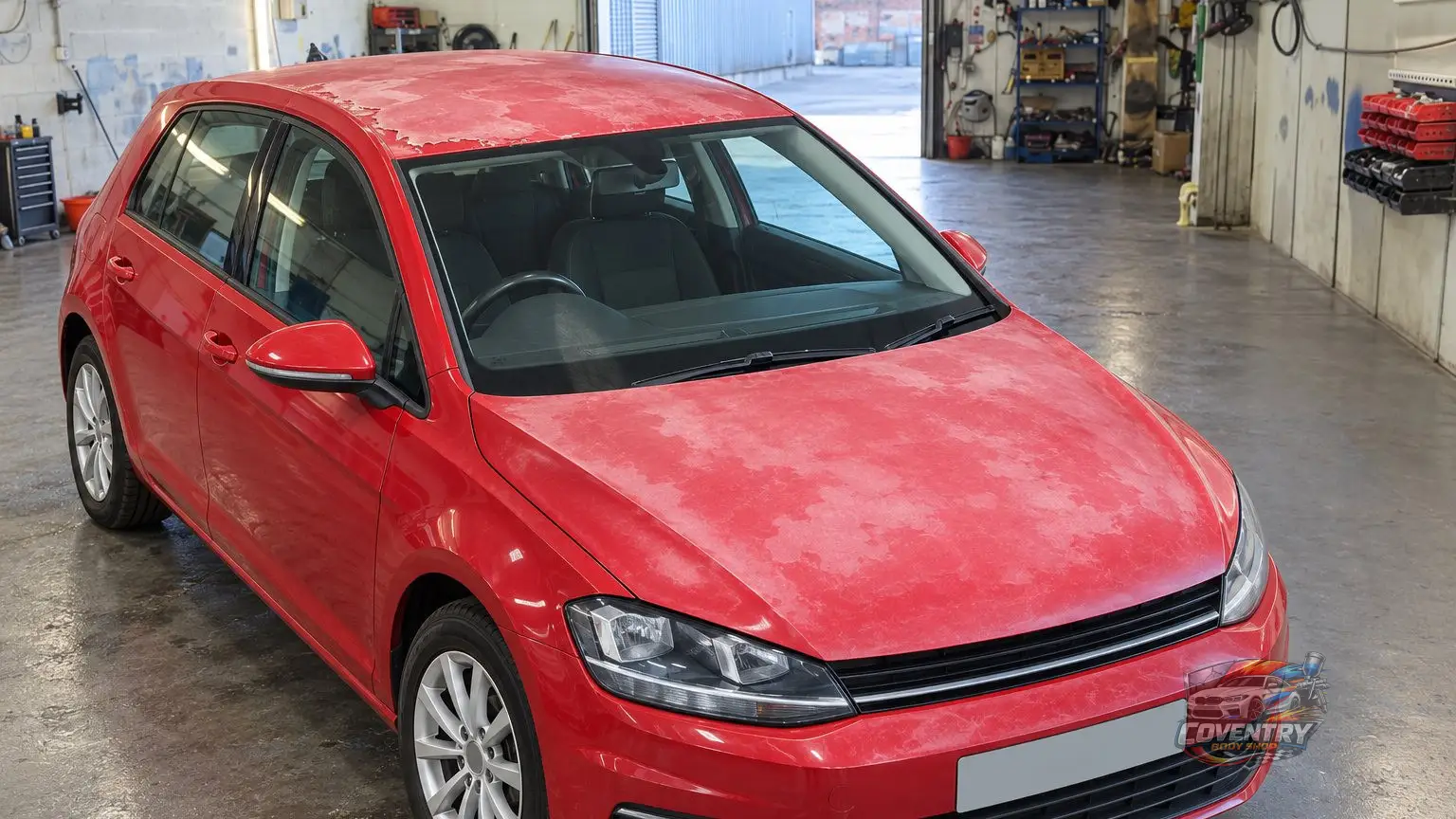
Understanding Sun Damage on Car Paint
Sunlight wears car paint down over the years. Its ultraviolet light can break down the resins in paint, which dulls the gloss and, on some colours, fades the pigment. Flat panels that face the sky, such as the roof and bonnet, often get more direct sun than the sides of the car.
On modern cars the colour usually sits under a clear lacquer, which protects it. Polishing can often bring back gloss while that lacquer is intact, but lacquer that has cracked, flaked or lifted away from the colour cannot be polished back, and the panel usually needs repainting. Cloudy lacquer can go either way, depending on whether the haze is on the surface or inside the coating.
Older single-stage paint has no separate lacquer. As it oxidises, its surface can turn chalky, and a cloth wiped over it may pick up colour. Light oxidation of this kind can sometimes be polished off, as long as enough paint is left.
Assessing the Extent of Damage
Wash and dry the car before you judge the paint, because dirt hides dullness and water makes it look better than it is. Then look at each panel in daylight.
Faded colour looks lighter or washed out next to the same colour elsewhere on the car, sometimes under lacquer that is still glossy. Paint that feels rough after washing may have contamination, etching or a coating that is breaking down. Failing lacquer may look cloudy or white in patches, crack or flake at the edges, and the signs do not always appear in that order. Two panels on the same car can be in different states, so each one is looked at on its own.
Lost gloss on intact lacquer may only need Scratch Removal & Machine Polish, from £120 plus VAT (£144 including VAT), priced per panel. A panel whose lacquer has failed usually needs repainting, and a single panel paint job starts from £150 plus VAT (£180 including VAT). A car with failed lacquer across many panels may need a Full Body Respray, from £1,495 plus VAT (£1,794 including VAT). Every price is a from price, and the final price is confirmed after inspection. A sun-damaged panel that is also dented comes under Panel Dent Repair & Respray, where the dent can be straightened.
We measure paint depth at our workshop. On a metal panel a typical gauge reads the total coating thickness, so it cannot show how much clear coat is left. A low reading can be a reason not to machine polish at all, and a normal reading does not prove there is lacquer to spare.
Preparing the Surface for Repair
Paint has to be clean before it is polished or painted, because dirt, wax and grease can make polish cut unevenly and weaken the bond of new paint.
Where lacquer is peeling, the failing coating has to come off back to a sound, well-bonded surface before new paint goes on, and the damage can extend beyond the visible flakes. How far back a panel is taken follows the paint maker's instructions and the condition of the coating underneath.
Choosing the Right Paint System
The repair paint has to suit the car's finish. Cars built in recent decades usually have a two-stage finish, with a basecoat for the colour and a clear lacquer on top. Some older cars have single-stage paint, where colour and gloss come from the same paint, with no separate clear coat. For more on paint types, see our guide to types of paint systems.
The manufacturer's paint code is the starting point (where it is printed varies by make), but a car that has spent years in the sun may no longer match its code exactly. At Coventry Body Shop, colour matching uses the manufacturer's paint code, specialist colour mixing and a spectrophotometer.
If the problem is a few small chips and not a faded panel, a Paint Touch-Up may be enough, from £49 plus VAT (£58.80 including VAT).
Applying the Paint
At Coventry Body Shop, all painting is done by our director, a former Aston Martin technician and painter, and all paintwork is sprayed in our spray booth, to the paint maker's and the vehicle maker's methods. The booth helps keep dust out of the wet paint.
On a two-stage finish, primer is used where the panel needs it, then the basecoat, then the clear lacquer for gloss and protection, each applied the way the paint maker's data sheet for that system specifies.
Coats usually need a flash-off time before the next one, and the lacquer needs time to harden before it is polished. The data sheet usually gives these times too, and they vary with the product and the temperature.
Blending and Finishing
A sun-faded car may no longer be the colour it was when new, so a freshly painted panel can stand out next to the original ones. Blending fades the new colour into the paint around the repair, so the edge is harder to see.
A colour that matches under booth lights can look different in sunlight, so it is worth looking at the repair outdoors when you collect the car. A Smart Repair is meant for small, localised damage, such as a small scuff or scratch, from £75 plus VAT (£90 including VAT).
Protecting the Repaired Paint
New lacquer may not be fully cured for a while after the repair, so ask before you wax it or use a pressure washer close to it. After curing, a wax, a sealant or a ceramic coating adds a thin layer on top. A ceramic coating is a thin, cured coating that can last longer than wax, depending on the product and the care it gets. Our paint protection and detailing service covers machine polishing and paint protection rather than ceramic coating, and it can follow a respray once the paint has cured.
Parking out of direct sun helps, and a garage keeps the sun off the roof and bonnet. A car cover is a weaker option outdoors. It needs a good fit and a breathable fabric, and should go on a clean, dry car with fully cured paint, because a cover that moves in the wind against grit can scratch it and one that traps damp can harm the finish. Bird droppings and tree sap can etch the lacquer if left to bake in the sun, so wash them off soon after they land.
Sunlight can also turn plastic headlight lenses yellow or cloudy on the outside, which is the job Headlight Restoration is for. Scuffs and small cracks in a bumper usually come from knocks, not sunlight; see Bumper Repair for those.
Conclusion: Restoring Your Car's Shine
Minor scratches and chips usually take 1 to 2 days, and most repairs take 3 to 7 working days once started, parts permitting. Cars are dropped off and collected at our workshop in Wyken, Coventry, as we do not offer collection and delivery.
Send photos of the faded or peeling panels by WhatsApp or through the Send enquiry button, and ask for an inspection. A small inspection is free; a deeper inspection costs from £200 plus VAT (£240 including VAT), deducted if the repair goes ahead.
Leave a Comment
Comments
No comments yet.