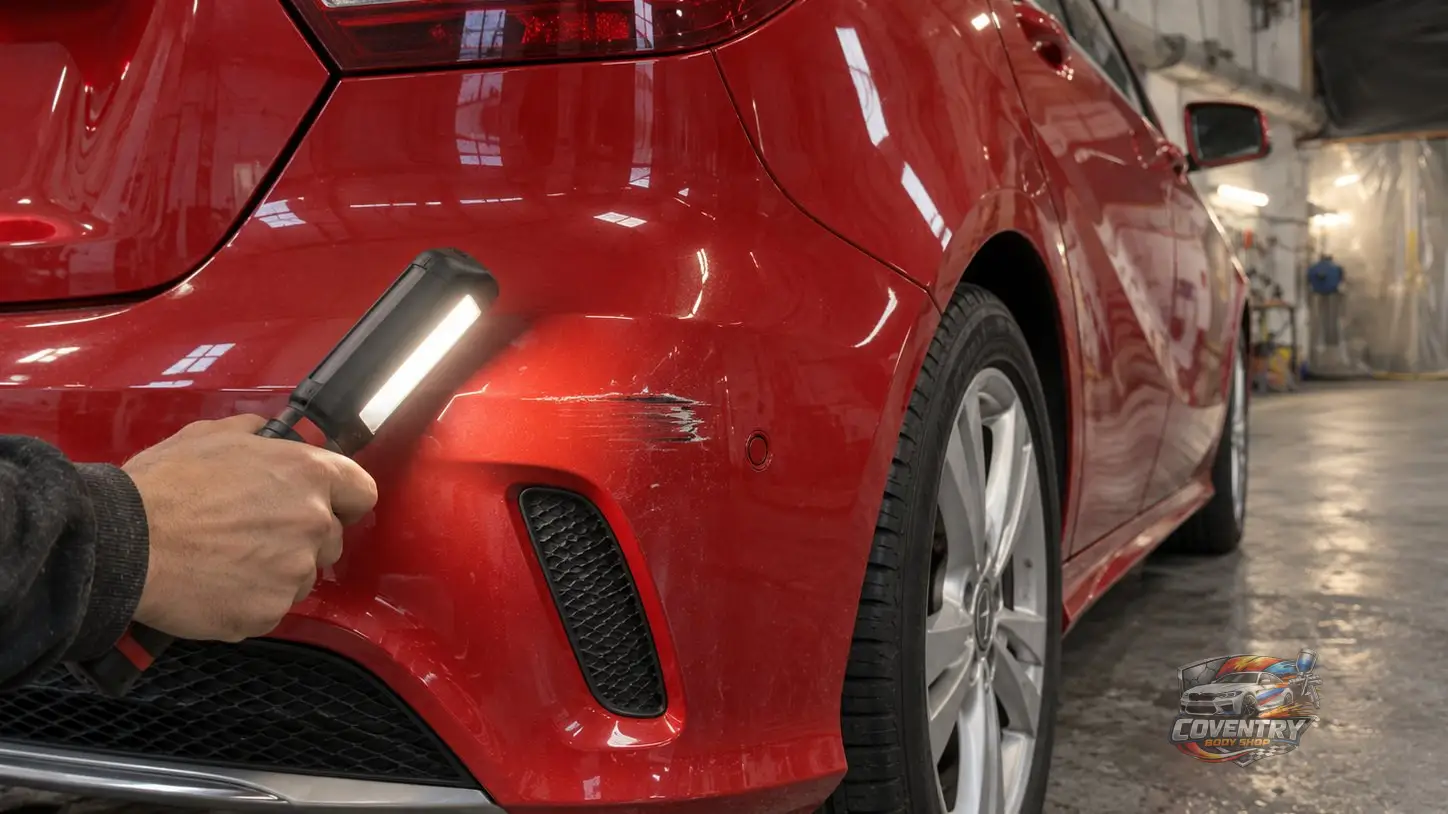
Three habits help keep the cost of car body repairs down: dealing with damage that can get worse before it spreads, choosing a repair that suits the damage you have, and comparing quotes like for like. Saving money does not have to mean choosing the lowest quote. A repair that fails, or a panel that does not match and has to be painted again, can mean paying twice.
This guide explains what affects the price of a body repair, which damage should not wait, which repair methods suit which kinds of damage, how to compare quotes, how to weigh an insurance claim against paying yourself, and what you can safely do at home. The terms in it are our own, at our workshop in Wyken, Coventry.
What decides the cost of a car body repair?
A body repair is priced on the work it needs: the labour, the paint and materials, and any parts. Anything that adds steps adds cost. A shallow mark in the clear coat can often be polished out. Deeper damage that reaches the primer or bare metal needs new paint: a small chip can often be touched up, while a larger area usually needs refinishing, with filler where the surface needs it, then primer, colour and lacquer.
Important cost factors include:
- Depth of the damage: Whether the damage stays in the clear coat or reaches the colour, primer or metal is one of the main things that decides the repair, together with its size and position.
- Size and position: Damage on an edge, a body line or across two panels is harder to repair neatly than a small mark in the middle of a flat panel.
- Repair or replace: Repairing a dented or cracked panel avoids buying a new part, although the repair has its own labour and materials. A badly torn or stretched panel may cost less to replace than to rebuild.
- Paint colour and finish: Metallic, pearlescent and faded older colours can be harder to match, and may need blending into the panels next to the repair so the colour sits closer to the rest of the car.
- Parts that have to come off: Trim, lights, handles, mirrors and parking sensors may need removing and refitting before a panel is painted.
- Hidden damage: After an impact, broken clips, brackets or supports behind a bumper or panel may only show once it is taken apart.
Our guide to bodyshop pricing explains each part of a quote in more detail.
Which damage gets worse if you leave it?
Some damage gets worse with time and some does not, so knowing which is which helps you decide what to repair now and what can wait. A shallow scratch in the clear coat, or a small dent with the paint intact, may stay as it is. Damage that breaks the paint is different. On a steel panel, moisture can reach the metal and rust can start under the paint around it. A crack in bumper paint can lengthen as the plastic flexes, and lacquer that has started to lift can keep peeling.
Signs that damage should not wait include:
- Bright metal showing: If a chip or scratch shows bright metal rather than paint or grey primer, the paint layers have been broken through. On a steel panel, sealing it early helps stop rust starting. If you cannot tell whether it is metal or primer, a free small inspection can show which it is.
- Bubbling paint: Small bubbles near a chip or an edge of a steel panel can be a sign of rust under the paint, although bubbling has other causes too. Rust under paint can spread if it is left, so it is worth having bubbling checked.
- Cracked paint around a dent: Once the paint has cracked, the dent usually needs paint as well as dent work, and on a steel panel the exposed metal can rust.
- Peeling clear coat: Lacquer that has started to lift tends to keep peeling, so the area that needs repainting can get larger.
Acting early does not mean rushing into a big repair. It means having damage that can get worse looked at while the smaller options are still possible.
How do you match the repair method to the damage?
Paying for more repair than the damage needs wastes money, and a repair that is too small for the damage can mean paying twice. The right method depends on how deep the damage goes, how big it is, where it is, what the panel is made of and whether the paint is still intact. The common options include:
- Machine polishing: Light scratches, swirl marks and dull paint that have not gone through the clear coat can often be corrected in the existing paint with scratch removal and machine polishing, with no new paint.
- Paint touch-up: Stone chips and small scratches can be filled with paint mixed to the car's paint code and sealed, which is what our paint touch-up service covers.
- SMART repair: SMART repair deals with minor dents, scratches and scuffs by keeping the work to the damaged area, so it is often a smaller job than refinishing a whole panel.
- Paintless dent repair: Where a dent has not cracked the paint, the panel can sometimes be worked back into shape so the original paint stays on the car. Sharp creases, stretched metal, earlier repairs and access behind the panel all affect whether it is possible. Our paintless dent repair covers door dings, car park dents and small creases.
- Bumper repair: Scuffs, scratches, cracks and corner damage can often be repaired, and some plastic bumpers can be plastic welded. A bumper repair avoids buying a new bumper when the old one can be saved.
- Single panel paint: Deeper or larger damage, or damage across most of a panel, usually needs the panel refinished. Single panel paint refinishes the damaged panel, and the colour can be blended into the panels next to it so the new paint is less likely to show.
- Panel dent repair and respray: A dent too deep for paintless repair is straightened, filled where needed, primed and resprayed.
Not every mark can take the smallest repair. A SMART repair suits small, local damage. A long scratch across a panel can need a bigger repair, and damage on a body line or in some metallic and pearlescent colours can be harder to keep small without the repair showing. If one panel has several marks, repairing them together usually means preparing and painting it once rather than several times. Our guide to repairing or replacing a damaged panel covers the bigger decisions.
How do you compare bodyshop quotes fairly?
Two quotes for the same damage can describe very different repairs. One may repair a panel while another replaces it, and one may blend the colour into the next panel while another paints only the damaged one. Comparing the totals alone does not show which repair you are paying for.
Questions worth asking about each quote include:
- What does the quote include? Ask what work each quote covers, so you can compare what each shop will do and not only the totals.
- Is the panel being repaired or replaced? If a part is being replaced, ask whether it is new, genuine or an equivalent part, and whether the price includes painting it to match.
- What does the paintwork include? Ask whether the colour will be blended into the panels next to the repair, and whether the lacquer goes across the whole panel.
- Is VAT included? Some prices are given before VAT and some after, so compare the totals including VAT. Our service starting prices exclude VAT.
- What if more damage is found? Hidden damage can appear once a panel or bumper is removed. Ask how any extra work would be agreed with you before it is done.
- What guarantee comes with the work? Ask how long the workmanship guarantee lasts and when it starts.
A lower quote is not always the cheaper repair, and a higher one is not automatically better. Quotes can differ because they describe different work, and the price alone does not show which repair suits the damage. What matters is what each quote includes, because putting right a repair that fails means paying again. Once the quotes describe the same repair, comparing the prices tells you something useful.
Should you claim on insurance or pay for the repair yourself?
It depends on your policy. Your insurer can tell you what your policy covers, what excess you would pay and whether a claim could affect your no claims discount or what you pay for insurance in future. Having a quote for the repair gives you a figure to set against those answers before you decide. If the damage came from an accident, GOV.UK says you must report the accident to your insurance company even if you are not planning to make a claim.
We can provide photographs of the damage and a repair quote, and deal with the insurer about the repair if you want us to. We are not on any insurer's list of repairers, so ask your insurer how using an independent workshop works under your policy. Our page on insurance and accident repair support explains the routes in more detail, including claiming from the other driver's insurer.
What can you safely do yourself to keep costs down?
Some small jobs are reasonable for a careful owner, and a few habits can stop small marks turning into bigger ones. Keep to small cosmetic jobs. Anything that involves filler, spray paint over a large area, or damage to lights, sensors or the car's structure is better left to a bodyshop.
Safe things to try include:
- Touching up a single small chip: A touch-up pen or small bottle mixed to your paint code can cover an isolated stone chip on a flat panel. Clean the chip first, then build the paint up in thin layers rather than one blob. A chip down to bright metal on a steel panel is worth treating soon, to help stop rust starting.
- Washing off bird droppings and tree sap promptly: Left on the paint, they can etch the clear coat and leave marks that need polishing.
- Waxing or sealing the paint now and then: A wax or sealant, applied as the product's instructions say, helps protect the clear coat from weather and contamination.
- Photographing new damage: Clear photos taken soon after the damage happens help when you ask for estimates or speak to an insurer.
Things that can make a later repair cost more include:
- Thick touch-up paint on larger damage: Blobs of paint over a long scratch may need flatting back before a proper repair can start.
- Aerosol paint over a whole area: Spray-can paint on a panel or bumper can need removing before the area is refinished, depending on how it was applied and how well it has stuck.
- DIY dent pullers and heat: These can crack the paint or stretch the metal, which can rule out paintless dent repair.
- Heavy compounding on thin paint: Aggressive hand or machine compounding can cut through the clear coat and turn a polish into a repaint.
Our guide to the cheapest way to fix car paint damage covers touch-up kits and their limits in more detail. If a collision may have caused structural damage, or has affected a light or sensor or brought on a warning light, have the car checked before you drive it again.
Our prices and how we quote
Each repair on our services page shows a starting price where we publish one. What you pay depends on the damage, the paint and the work needed, and we set the price after inspecting the car.
Before any work starts, you get our quote and decide whether to go ahead. A small inspection is free. If a deeper inspection is needed, it costs from £240 including VAT (£200 plus VAT), we tell you its price before it starts, and the charge is taken off the repair bill if you go ahead with the work.
How do you get a repair quote in Coventry?
Photographs give a first idea of the size and position of the damage, but hidden damage and the condition of the paint can only be checked with the car in front of us.
To start, call or WhatsApp +44 7903 105777, or send photographs with the Send enquiry button. Useful to send:
- The whole side of the car: Taken in daylight from a few steps back, so the damage can be seen in context.
- The damage up close: One photo straight on and one at an angle, which shows dents and creases more clearly.
- The car's details: The make, model and year, and the paint code if you can find it. Where it sits varies between makes, and it is often on a label in a door shut or under the bonnet.
Paint is mixed to the manufacturer's paint code and matched with a spectrophotometer, and our director, a former Aston Martin technician and painter, is the only person who paints the cars. You drop the car off and collect it from our workshop in Wyken, Coventry.
Leave a Comment
Comments
No comments yet.