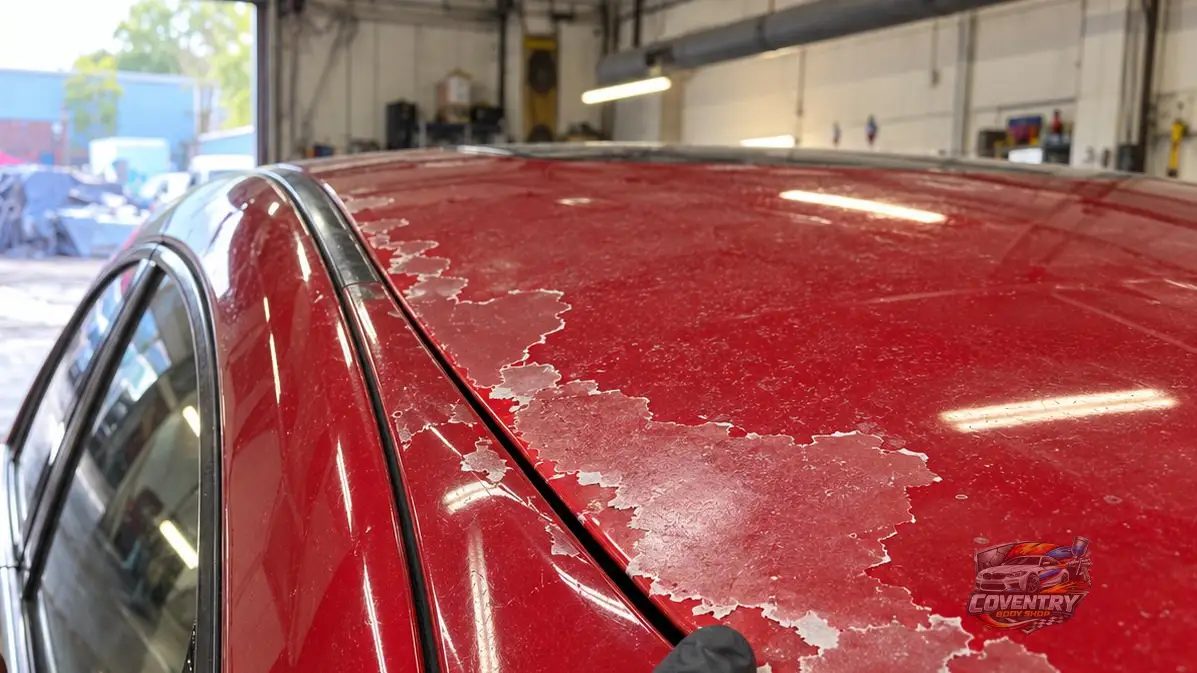
Clear coat peels when it loses its bond with the colour coat beneath. Years of sun can break it down, an earlier repair can fail if it was badly applied, and stone chips or harsh chemicals can start the damage. Once peeling has started, it does not stop on its own and cannot be polished back.
Why has your clear coat started peeling?
The cause matters because new paint needs a stable surface underneath it. Covering a failed coating, with polish or a fresh coat of lacquer, leaves the original weakness in place.
- Years of sunlight: UV exposure gradually breaks down the clear coating, leaving it brittle and less able to stay intact. Cracking and flaking can follow as it deteriorates.
- Faults in an earlier respray: Clear coat needs a clean, properly prepared colour coat to bond to. Wax or grease left on the surface, a colour coat applied too heavily, clear coat mixed wrongly, or clear coat sprayed before the colour coat had dried enough can all leave a weak bond. The finish can look right at first and lift later.
- Clear coat applied too thin: Too little clear coat leaves less protection against sun and wear, so it can wear through and fail sooner.
- Chips and chemical damage: A stone chip breaks the coating locally. Harsh chemicals can damage its surface, creating another starting point for deterioration.
If only a previously repaired panel is peeling, tell us about that repair. It is useful context, although the pattern alone does not prove the cause.
Is it clear coat failure or just dull paint?
Look at clean, dry paint in daylight. Dirt and water can disguise the edges of a failing coating, so judge the surface after a gentle wash rather than while it is wet.
- Cloudy or milky patches: Areas look pale or hazy beneath what remains of the glossy surface.
- Persistent dullness: A patch stays dull after washing, rather than clearing when surface dirt is removed.
- Fine cracks: A reason to have the finish looked at. Cracks can have other causes and can run through more than one layer, so they do not prove the clear coat is separating.
- Lifting edges: A thin, transparent layer curls or flakes away, leaving a visible boundary.
None of the first three signs confirms peeling on its own. Oxidised but intact paint can sometimes respond to polishing because the coating is still attached. Lifting edges are the sign that the layer itself is separating.
If coloured paint is coming away and exposing primer or bare metal, the damage extends beyond clear coat failure. Avoid picking at a loose edge to investigate it, as this can enlarge the exposed area.
Why does it often start on the roof or bonnet?
The roof, bonnet and boot lid usually receive more direct sunlight than upright panels. These upper surfaces can show UV damage first, particularly on a car regularly parked outside.
Check across the whole panel rather than concentrating on the most obvious patch. Several cloudy areas or cracked sections can indicate that the affected coating extends beyond the visible peeling. Sound doors do not rule out deterioration on the roof.
Does peeling clear coat mean a full car respray?
Usually not: a peeling panel needs refinishing, not the whole car. The visible flake is not necessarily where the damage ends, so we inspect the panel to find where the coating is still bonded, check whether the colour beneath has faded or been exposed, and look at the other upper panels for the same early signs. That inspection decides between a panel repaint and a full respray.
- Remove failed material: The failed clear coat is sanded back to a sound edge, so nothing loose stays under the new paint.
- Renew the colour where needed: Where the colour coat has faded or been sanded through, it is renewed so the colour is even again. Where it is sound, it is prepared for fresh clear coat. Bare metal is only reached where the damage goes that deep.
- Clear coat across the panel: Fresh clear coat usually goes over the whole panel, because a clear coat edge in the middle of a panel tends to show and the old coating around a patch may be weak too. Repairs are sprayed in our spray booth, and our director, a former Aston Martin technician and painter, is the only person who paints the cars.
That is why a small peeled patch can still mean repainting a single panel.
Our guide to whether clear coat can be repaired without repainting explains the limits of treating the surface alone. We recommend a full respray for widespread paint failure when many panels are failing, not because one area is peeling.
What happens if you leave it?
Peeling spreads as more of the weakened coating lifts. The exposed colour coat then fades and weathers without the clear layer above it, making the damage more than a difference in gloss.
On metal panels, continued deterioration can eventually break through the remaining coatings and expose the metal. Clear coat peeling does not itself mean that rust is already present, but leaving the finish to deteriorate can increase the preparation needed before repainting.
How can you protect paint that is still sound?
Care can slow deterioration on intact paint. It cannot restore adhesion where clear coat has already lifted.
- Wash and dry gently: Use products intended for car paint and clean, soft washing and drying materials. Soften stubborn dirt before removing it rather than scrubbing it off.
- Avoid harsh chemicals: Follow cleaning product directions and dilution instructions. Stronger mixtures can damage the finish rather than clean it more effectively.
- Keep pressure away from edges: Do not aim a high-pressure jet close to chips, cracks or lifting clear coat.
- Reduce strong sun exposure: Park under cover or out of direct sunlight where possible.
- Protect intact paint: Wax or sealant can help protect the surface from contamination and make cleaning easier. Neither will secure a loose coating.
Send photos for a written estimate
Send photos of the peeling area on WhatsApp to +44 7903 105777 or with the Send enquiry button on this page. Include a close view of the damage and one showing the whole panel, ideally with the paint dry and in daylight.
At our workshop in Wyken, Coventry, a written, itemised estimate comes first, with no deposit. A small inspection is free. A deeper inspection costs from £240 including VAT (£200 plus VAT), deducted if the repair goes ahead.
Leave a Comment
Comments
No comments yet.