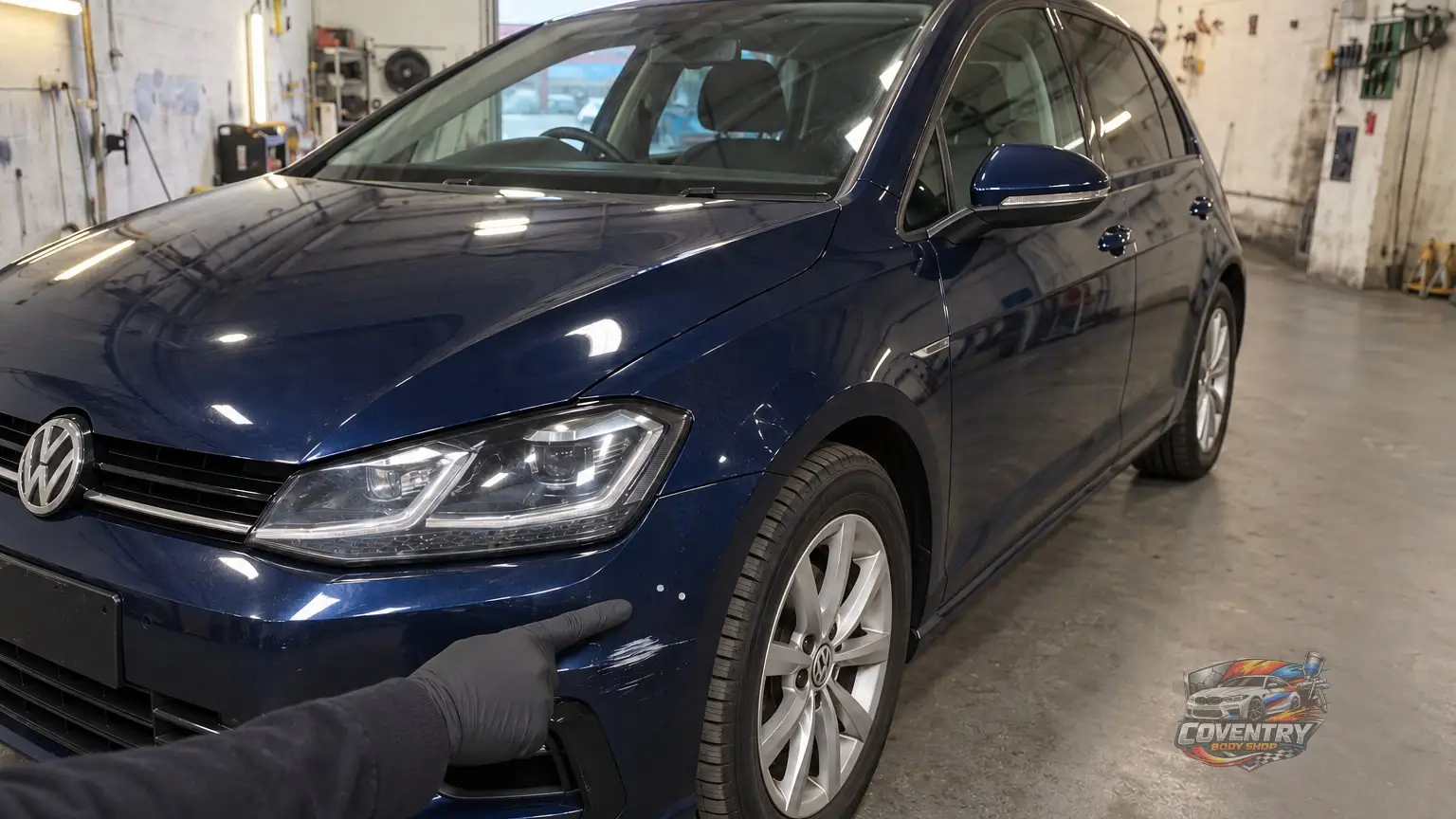
The cheapest way to fix car paint damage depends almost entirely on how deep the damage goes and how large the affected area is. For very light surface marks that have not broken through the clear coat, a colour-matched touch-up pen or a small DIY kit is usually the lowest-cost option. For stone chips, scuffs, scratches down to primer or bare metal, and small panel damage, a SMART repair carried out by a bodyshop is normally the cheapest professional route and gives a much longer-lasting finish than most DIY attempts.
Before choosing a method, you need to know what kind of paint damage you actually have, because the wrong approach can cost you more in the long run than doing nothing or booking a proper repair from the start.
How to Tell What Kind of Paint Damage You Have
Paint damage is not one thing. The repair method, the cost, and the result all change depending on which layer has been broken through, so the first job is to identify the damage honestly.
The paint system on a modern car is built up in layers. There is the metal panel, then primer, then the base colour coat, and finally a clear lacquer on top. Each layer protects the one below it, and once a layer is breached, the layers beneath start to deteriorate quickly.
Run a clean fingernail gently across the mark. If it catches, the scratch has gone into the colour or primer, not just the surface. If water sits in the scratch and you can see a different colour underneath (often grey or white primer, or even bare metal), the damage goes deeper than the lacquer.
- Clear coat scratch: A light surface mark that does not catch your fingernail and shows no colour difference. Cheapest to fix.
- Colour coat scratch: The scratch catches your nail and the underlying primer or grey primer shows through. Needs colour and lacquer to repair properly.
- Primer or bare metal exposed: A pale or shiny spot inside the scratch. Needs priming before any colour goes on, or rust will start.
- Scuffed panel: Paint transferred from another object, often a different colour sitting on top of your paint. Can sometimes be polished out, but often needs refinishing.
- Stone chip cluster: Multiple small dots, usually on the bonnet, leading edge of the wing, or around the grille. Common and usually affordable to repair if grouped.
The deeper the layer exposed and the larger the area, the more involved the repair. That is why the honest answer to the cheapest fix always comes back to how bad the damage really is.
Is a DIY Touch-Up Pen or Kit the Cheapest Option?
For very small, isolated stone chips and short clear-coat scratches, a DIY touch-up pen or a basic touch-up kit bought online or from a motor factor is usually the cheapest option in absolute terms. A pen or a small bottle of colour-matched paint costs a few pounds, which is why so many people reach for one after a chip appears.
The result depends on three things: whether the colour actually matches, how well the area is prepared, and how the paint is applied.
- Colour match: Your car's paint code is on a sticker in the door shut, under the bonnet, or in the service book. A pen matched to that code is a better starting point than a generic colour, but age, fading, and respray history can still cause a mismatch.
- Preparation: The chip needs to be clean, dry, and free of loose paint or wax. A quick wipe with isopropyl alcohol and a light touch with a fine sanding stick gives the paint something to grip.
- Application: Less is more. Build the chip up in thin layers with the tip of a fine brush, allow each layer to dry, then level it off carefully. A blob of paint on top of the chip will dry unevenly and often look worse than the original damage.
DIY works for a single chip on a flat panel where the colour is a common solid shade. It is a poor choice for long scratches, curved panels, bumper scuffs, or metallic and pearl finishes, where the blend required is beyond what a pen can deliver. Our guide on different car paint types explains why some colours are far harder to blend than others.
Why SMART Repair Is Usually the Cheapest Professional Option
SMART stands for Small to Medium Area Repair Technique. It is a bodyshop method designed to repair localised damage without respraying the whole panel, which is what keeps the cost down. Instead of prepping and painting an entire bonnet or door, the repairer prepares only the damaged area, blends the new colour into the surrounding paint, and finishes with lacquer to match the original sheen.
For damage that is too deep or too large for a DIY pen, SMART repair is almost always cheaper than a full panel respray. The saving comes from less prep time, less paint, less masking, and no need to remove trim, mirrors, or handles to refinish a whole panel. You can read more about the method in our guide to SMART repair in auto bodywork.
SMART repair works well for:
- Stone chips and small scratches up to roughly the size of a credit card.
- Bonnet scuffs and kerb rash on wings where only the front edge is marked.
- Minor bumper scuffs without cracking or broken plastic.
- Door edge chips and handle-area scratches caused by keys or rings.
- Single-panel damage on a door, wing, or tailgate where the rest of the panel is undamaged.
If you are based in or around Coventry, our SMART repair service covers all of these everyday repairs, with the work kept to the damaged area only. A recent before-and-after example on a Citroen C3 SMART repair shows what the result looks like when preparation, colour, and blending are done properly.
What the SMART Repair Process Actually Looks Like
The reason SMART repair is cheaper is not magic. It is a controlled process that avoids unnecessary work while still producing a proper finish. Knowing the steps helps you judge whether the quote you have been given is reasonable.
- Inspection and colour check: We confirm the damage type, locate the paint code, and check the colour against the panel in good light. Metallics and pearls often need a toner adjustment before spraying.
- Cleaning and prep: The area is washed, degreased, and sanded with fine paper to give the primer a key. Any loose or flaking paint is removed so the new finish does not lift later.
- Primer and build-up: Exposed metal or bare primer is sealed with a thin coat of primer. Deep chips are built up level with the surrounding surface so the final finish sits flush, not proud.
- Base colour and blending: Colour is applied in light coats and blended into the surrounding panel so there is no hard edge between old and new paint. This is where a good sprayer earns their money.
- Clear lacquer and curing: Lacquer is applied to match the original sheen, then baked or left to cure. The panel is not polished until the lacquer has hardened enough.
- Final polish and check: The repaired area is polished flat, then checked under good lighting for blend lines, dust nibs, or colour mismatch before the car is returned.
Skipping any of these steps is usually how cheap repairs end up looking cheap within a few months. If a quote sounds too low, ask which of these stages are included.
What Affects the Cost of Paint Damage Repair
Exact prices depend on the vehicle, the damage, the paint system, and the workshop, but the factors that push cost up or down are consistent. Use this as a checklist when comparing quotes.
- Size of the damaged area: A single chip costs less than a panel covered in chips. A scuff on the corner of a bumper costs less than a long scrape along a wing.
- Depth of damage: Clear coat work is the cheapest. Damage that has gone to primer or metal adds prep, primer, and curing time.
- Paint type: Solid colours are the easiest to match. Metallics and pearls need careful blending and may add time. Non-standard or aged colours are harder.
- Panel accessibility: A flat door is quicker to mask and spray than a bumper with grilles, sensors, or trim that needs removing.
- Plastic, metal, or composite panel: Plastic bumpers need flexible primer and paint systems. Additives and process steps can affect cost.
- Hidden damage: Once paint is stripped back, dents, rust, or cracks sometimes show up. Good workshops flag this before starting, not after.
- ADAS sensors and parking sensors: Bumpers with radar, cameras, or parking sensors often need recalibration after paintwork. This adds cost but is non-negotiable for safety.
DIY vs Professional Repair: When Each One Makes Sense
DIY is rarely the cheapest route once you include your time, the kit, and the chance of having to redo it. That said, there are situations where DIY is the sensible choice, and situations where it will simply waste money.
DIY makes sense when the damage is one or two isolated chips, the colour is a common solid shade, and you are happy with a result that is visible only on close inspection. It is the right answer when the alternative cost of a professional repair would be disproportionate to the value of the car.
Professional repair makes sense when the damage is visible from a couple of metres away, when the scratch goes to primer or metal, when the colour is metallic or pearl, or when the panel is curved and needs proper blending. The same logic applies to anything on a leased car, where the return condition will be checked closely.
When Insurance Is and Isn't Worth Using for Paint Damage
Paint damage is one of the most common accident repair queries we deal with, and the insurance question comes up almost every time. The honest answer is that for most minor paint repairs, paying the bodyshop directly is cheaper than going through insurance.
Consider insurance when the damage is the result of an accident with a named driver, when the repair cost is well above your excess, and when you have protected no-claims bonus cover. In those cases the insurer may cover the repair and offer a courtesy car, which can offset some of the inconvenience.
If you do claim, our insurance and accident repair support page explains how we work with your insurer.
Skip insurance when the damage is below your excess, when you only have basic third-party cover, or when a small claim would push your premium up by more than the repair itself would cost. For a SMART repair on a small area, most drivers find that paying the bodyshop is the more cost-effective route.
Mistakes That Make Paint Repairs More Expensive Later
The cheapest repair now is rarely cheap if it fails in six months. A few common errors turn a small problem into a much bigger one.
- Ignoring bare metal: Even a tiny exposed metal spot will rust under the paint if it is not primed. A small chip today becomes a bubbling repair next spring.
- Using the wrong paint system: Putting hard topcoat over flexible plastic, or skipping primer, leads to cracking and flaking within months.
- Covering over loose paint: Spraying over flaking clear coat seals in a problem that will lift the new finish from underneath.
- Choosing a cheap bodyshop on price alone: The lowest quote often skips blending, uses a poor colour match, or rushes the lacquer. The work then has to be redone.
- Skipping ADAS recalibration: Painting over radar or sensor bezels without recalibration can disable safety features. This is a safety issue, not just a cosmetic one.
How to Get an Accurate Estimate Before Booking
The best way to keep the cost of any paint repair down is to give the bodyshop the right information up front. A vague description leads to a vague estimate, which usually grows once the panel is inspected.
- Send clear photos in daylight: One shot of the whole panel for context and one close-up of the damage. Avoid flash, which hides the true depth of a scratch.
- Include the paint code: A photo of the sticker in the door shut or under the bonnet saves a trip and helps the bodyshop check colour match.
- Mention any sensors: If the panel has parking sensors, a radar cover, or a camera, flag it so the estimate includes any recalibration.
- Describe how it happened: A kerb scrape is different work to a trolley impact or a key scratch. The cause tells us what to look for underneath.
- Say what you want from the result: A near-invisible repair costs more than a tidy, visible-but-improved finish. Being honest about your expectation stops quotes from coming back higher than they should.
Paint Repair in Coventry and the Surrounding Area
Drivers across Coventry, Warwickshire, and the surrounding villages deal with the same mix of paint damage: supermarket car park dings, kerbed alloys, and the slow build-up of stone chips on motorway-driven cars. For those outside Coventry, our car body repair coverage for Stratford-upon-Avon covers the same range of SMART and panel repairs with the same workshop standards. Where you are based does not change the cheapest method, but it does affect how easily the workshop can inspect, source colour-matched materials, and offer a courtesy arrangement.
Send Photos for a Same-Day Estimate
If you would like a realistic estimate rather than a guess, send us two or three daylight photos of the damage, the paint code from the door shut or service book, and a short note on how it happened. We will come back with the cheapest sensible route, whether that is a DIY-friendly approach, a SMART repair at the workshop, or a full panel respray where that genuinely is the right answer. The aim is to give you the right repair at the right price, not the most expensive one we can justify.
Leave a Comment
Comments
No comments yet.