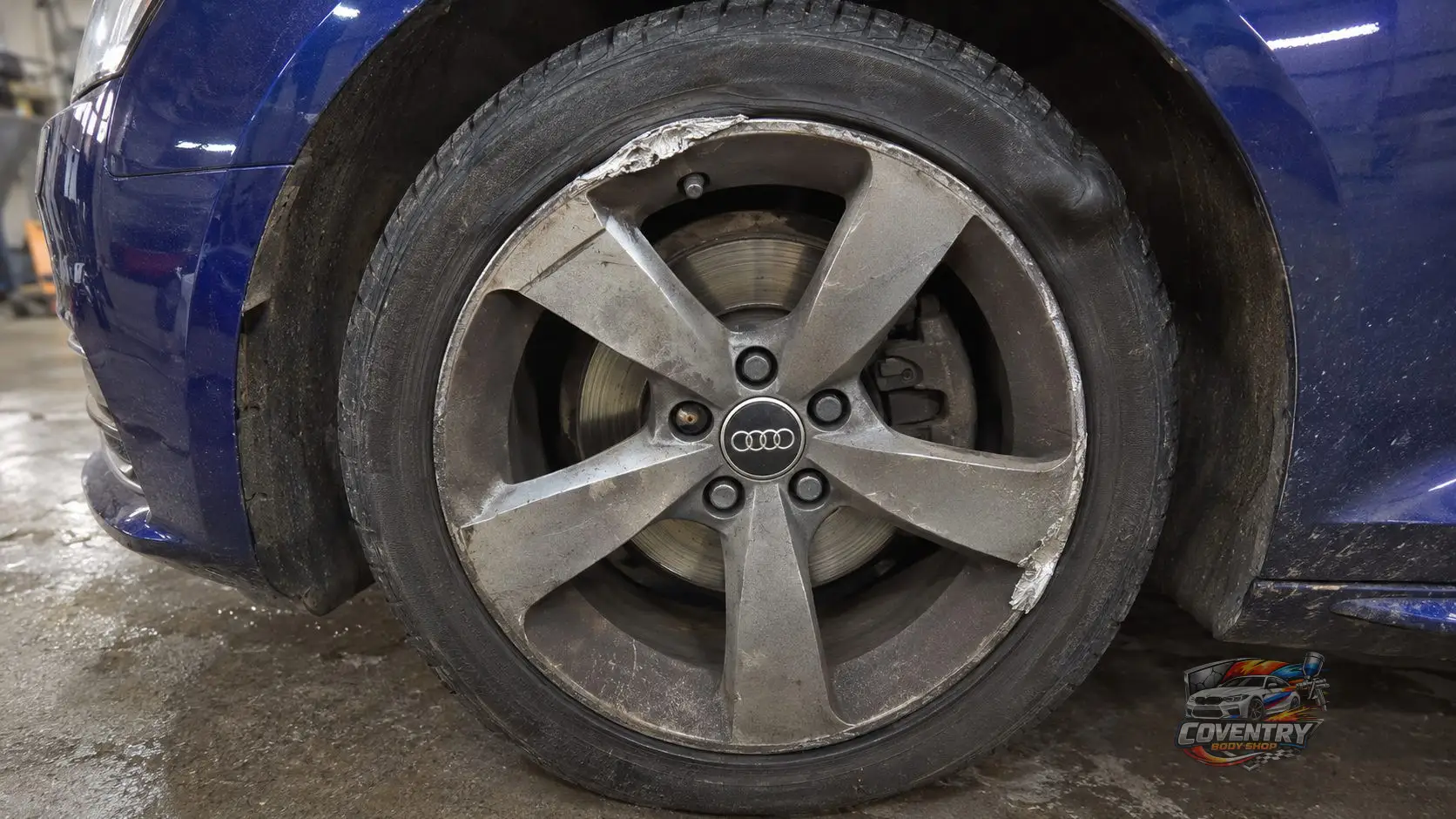
A hard pothole hit can damage more than the visible finish of an alloy wheel. If the steering vibrates, the car pulls to one side, the wheel wobbles, the tyre loses air or you notice a crack, bent rim or damaged tyre sidewall, stop somewhere safe and arrange a professional check. Even if the wheel only looks scuffed, a tyre or wheel specialist needs to confirm it is sound before you treat the damage as cosmetic.
If the pothole was on a public road in or around Coventry, you may also be able to claim for the damage. That depends on who maintains the road, what caused the damage and whether the authority met its maintenance duties. A damaged wheel and a photograph of the pothole do not automatically establish a right to compensation.
Is it safe to keep driving after a hard pothole hit?
You cannot reliably judge whether a wheel is safe after a hard impact by looking at its outer face. A pothole can damage the tyre or distort part of the rim that is difficult to see. If the car behaves differently or you notice visible damage to the tyre or wheel structure, stop as soon as it is safe and arrange an inspection by a tyre or wheel specialist.
The warning signs to take seriously are:
- Steering wheel vibration: A new shake through the steering wheel or car body can indicate a wheel, tyre or other running-gear problem.
- Pulling to one side: If the car no longer tracks straight, the impact may have affected the tyre, wheel alignment or steering and suspension components.
- A noticeable wobble: If the wheel seems to run unevenly, it could be distorted.
- Air loss: Any tyre pressure warning or repeated loss of air needs attention, even when there is no obvious puncture.
- A tyre sidewall bulge or cut: Bulges can point to internal structural damage, and a deep cut may have reached the tyre's reinforcing cords.
- A cracked or flattened rim: Stop using a wheel with a visible split, kink or flat spot until a specialist has assessed it.
The Driver and Vehicle Standards Agency's MOT inspection manual classifies any wheel fracture as a dangerous defect. It also treats a badly distorted wheel as a major defect, rising to dangerous where the wheel or tyre could become detached. A tyre bulge caused by structural failure is also classed as dangerous.
Do not continue a normal journey to see whether the vibration disappears. Stop in a safe place, away from moving traffic, and arrange roadside assistance or recovery if there is any doubt about the wheel or tyre. On a motorway, follow the appropriate breakdown safety procedure and never enter the carriageway to inspect a pothole or take photographs.
Is the wheel only scuffed, or is it buckled or cracked?
Cosmetic damage affects the wheel's surface finish. Structural damage affects the shape or integrity of the wheel itself. Scratched paint or damaged lacquer may be suitable for refurbishment, but a buckle or crack requires a specialist assessment. The difficulty is that cosmetic and structural damage can occur together, so the visible mark does not tell the whole story.
- Scuffed paint or lacquer: The coating has been scraped or chipped, but there is no confirmed distortion or fracture. Once the wheel is professionally confirmed sound, this is normally a refinishing issue.
- Corrosion beneath the finish: Paint may bubble or flake as corrosion develops. Surface corrosion can sometimes be dealt with cosmetically, but a specialist must assess anything that could affect the wheel's integrity or its seal with the tyre.
- A buckled alloy: Part of the rim has bent or the wheel is no longer running true. You might see a flattened section or notice vibration, although some distortion is difficult to identify without specialist equipment.
- A cracked alloy: The metal has fractured. A crack may appear as a fine line across the rim, barrel or spoke, and it may be hidden on the inside of the wheel.
The useful distinction is whether the impact has changed only the coating or the metal underneath it. After a heavy strike, a shallow-looking mark is not enough to settle that question. A tyre or wheel specialist can assess the complete wheel, including areas hidden by the tyre or inaccessible while the wheel is fitted.
Do not try to straighten a visible bend yourself or use filler to conceal a suspected crack. The DVSA's wheel defect classifications concern the condition of the wheel, regardless of how tidy its painted surface appears.
What else should a tyre specialist or garage check?
A pothole impact can affect the tyre, wheel alignment, steering or suspension as well as the alloy wheel. The checks required depend on the severity of the impact and the symptoms afterwards. Ask a qualified tyre specialist or garage to assess the affected corner of the car rather than assuming every new vibration comes from a buckled alloy.
Useful checks to request include:
- Tyre condition: Check the tread, inner and outer sidewalls, air pressure and any damage that may require tyre replacement.
- Wheel condition: Examine the rim and inner barrel for distortion or cracks, and the tyre seating area for anything that could let air out.
- Wheel balance: Ask whether the wheel and tyre assembly runs correctly and can be balanced after any necessary work.
- Tracking (wheel alignment): Check whether the wheels remain correctly aligned, especially if the steering wheel is no longer centred or the car pulls to one side.
- Steering and suspension: Ask the garage to look at the joints and arms on that corner of the car if the impact or the symptoms point that way.
Ask the specialist to explain the findings and identify which work is necessary before deciding what to do about the wheel's appearance. If you intend to make a pothole claim, keep the inspection findings and associated invoices because they may help connect the damage with the incident.
Can a buckled or cracked alloy wheel be repaired?
A superficially damaged wheel can be cosmetically refinished once it has been confirmed sound. A buckled wheel may be considered for straightening by a specialist only where the wheel manufacturer's guidance permits the procedure. Some manufacturers prohibit straightening altogether. A cracked wheel, or a wheel that a specialist cannot approve for continued use, should be replaced rather than given a cosmetic repair.
- Cosmetic refinishing: Suitable for surface marks, damaged paint and lacquer on a wheel already confirmed structurally sound.
- Specialist straightening: A wheel specialist may assess whether a limited distortion is eligible for correction under the applicable manufacturer's instructions. The specialist must establish that the procedure is permitted before carrying it out.
- Replacement: The appropriate route for a cracked wheel, severe distortion, prohibited structural repairs or damage that cannot be accepted by the specialist.
Manufacturer restrictions are important. For example, Tesla's approved wheel repair instructions for the 2022 to 2024 Model Y Structural Pack do not allow its wheels to be straightened or bent, by hot or cold methods, and rule out welding and crack repair too. The manual warns that such processes might cause sudden wheel failure.
That rule covers those Tesla wheels only, yet it shows why the wheel maker's own guidance decides which repair is allowed.
Where straightening is permitted, a qualified wheel specialist assesses and does the work. A replacement wheel goes to a wheel or tyre specialist, who checks the tyre at the same time.
Paint over a buckle and the wheel keeps its bent shape; filler over a crack leaves the metal fractured underneath.
Do you claim from the council or National Highways?
You claim from the organisation responsible for maintaining the road where the damage occurred, provided there is a legal basis for the claim. In Coventry, that will generally be Coventry City Council for roads it maintains. National Highways manages England's motorways and some major A roads. The road number alone is not enough to establish responsibility, particularly around major routes and council boundaries.
The government's vehicle damage claims guidance explains how to identify the responsible organisation. For a local road, you can use the location postcode to identify the relevant council, and GOV.UK's advice is then to contact that council and ask about compensation. For a motorway or major A road, check whether it forms part of the National Highways network before submitting a claim.
This matters around Coventry because a journey may cross from the city into Warwickshire. A road outside Coventry's boundary may be maintained by Warwickshire County Council rather than Coventry City Council. If the location is uncertain, identify the exact stretch of road first instead of sending the claim to whichever council is nearest your home.
Reporting the pothole is a separate action from claiming for damage. Coventry City Council provides an official pothole reporting page and asks for a precise location, such as the nearest house or lamppost number. The council says it investigates reports and considers the defect's size, position, visibility and the traffic using the road.
For a road managed by National Highways, its Red Claims guidance explains how to submit a damage claim. A report to the road authority does not automatically start or approve a compensation claim, so follow its claims procedure as well.
What evidence should you record for a pothole claim?
The strongest starting point is a clear record connecting a particular road defect, a particular incident and the damage later confirmed by a professional. Write down exactly where and when it happened. Photograph the scene only where it is safe, and keep evidence of the damage and of what the repair cost.
Use this sequence once you have reached a safe stopping place:
- Record the incident details. Write down the date, time, road name, direction of travel and approximate location. Include a nearby junction, building, lamppost or marker post where possible.
- Preserve location evidence. Save a map pin, journey information or relevant dashcam footage if available. Do this when safely parked, not while driving.
- Photograph the pothole if safe. Include its position in the road and recognisable surroundings. Record its approximate dimensions only if this can be done without entering traffic or putting anyone at risk. Never return to a motorway carriageway to take photographs.
- Photograph the vehicle damage. Take pictures of the affected wheel, tyre and any visible cracks, bends or sidewall damage. Keep any relevant tyre pressure warning information.
- Record witnesses. If someone saw the incident and is willing to help, note their contact details and what they observed.
- Obtain a professional assessment. Ask the tyre or wheel specialist to record what was found, what needed repairing or replacing, and whether the damage is consistent with the reported impact.
- Keep the paperwork. Retain quotes, invoices, proof of payment, recovery costs where relevant and any documentation supplied with replacement parts. Keep the original records.
- Report the defect and retain the reference. Follow the relevant highway authority's reporting process and keep confirmation of the report. Then submit the damage claim through that authority's claims route.
GOV.UK asks claimants to identify the damage, explain why the road authority is considered responsible, and provide the precise location and incident date and time. National Highways additionally requests evidence of financial losses, including invoices and supporting documents.
Check your motor insurance policy as well. Some policies expect you to report an incident even when you do not claim on it, and claiming on your own cover brings the excess and your no-claims discount into the decision. Our guide to whether car insurance covers paint damage explains how the cause of the damage affects cover.
Do not delay necessary safety work simply to preserve the damaged wheel for a claim. Photograph and document the damage before repair or replacement where practical, and ask the specialist whether the removed component can be retained. Road safety takes priority over gathering further evidence. National Highways' guidance also advises repairing damaged property promptly, because compensation settles the original loss and not later ones, and it expects claimants to keep their losses to a minimum.
Why might a pothole claim be refused, and what can you do?
A pothole claim can be refused even when the damage is genuine. Under section 58 of the Highways Act 1980, a highway authority can defend a claim if it demonstrates that it took the care reasonably required to keep the road from being dangerous. The authority's inspections, maintenance response and the evidence connecting the defect to your damage all matter.
National Highways explains this defence in its published claims guidance. The authority may not be liable if it can demonstrate that reasonable inspection and maintenance measures were followed. It also requires evidence of the failure alleged, the connection with the incident and the resulting loss.
Possible reasons for refusal include:
- The authority can demonstrate that its inspection and repair arrangements met its legal duties in the circumstances.
- The evidence does not clearly establish which road defect caused the damage.
- There is insufficient evidence that the claimed wheel or tyre damage resulted from that particular incident.
- The road is maintained by another organisation.
- The amount claimed includes costs that have not been supported or adequately connected to the damage.
A frequently misunderstood point concerns pothole depth. Coventry City Council's pothole page sets a target of repairing potholes more than 40 mm deep within five to twenty working days, and other potholes it judges need work within 40 working days. Those are the council's published repair targets. They are not a rule that every pothole over 40 mm automatically creates a successful compensation claim or that a smaller defect can never be relevant.
If your claim is refused, read the explanation and identify which part of the case the authority disputes. You can ask the claims handler to clarify its reasons and request relevant inspection records, previous defect reports, repair history and the maintenance policy that applied to that road.
Compare the response with your evidence and the location details. If you find an error or obtain additional information, send it back and ask the authority to reconsider its decision. National Highways' published process allows additional evidence to be reviewed after a denial. Councils set their own process, so ask the authority handling your claim how it reviews a decision.
There is no guarantee that requesting reconsideration will change the outcome, and a general complaint about the road is different from establishing liability for compensation. If the dispute remains unresolved, independent legal advice can help you understand whether further action is appropriate, including its potential costs and risks. This is general information rather than advice on the merits of an individual claim.
When is cosmetic alloy refurbishment the right next step?
Cosmetic refurbishment becomes an option after a tyre or wheel specialist has confirmed that the affected wheel is structurally sound and suitable for continued use. If the remaining problem is chipped paint, scuffs, damaged lacquer or treatable surface corrosion, the finish can be restored. It should never be used as a way to hide an unresolved bend, crack or tyre problem.
If you are considering doing the paintwork yourself, our guide to painting alloy wheels explains the cosmetic preparation and finish considerations.
How much work a refurbishment needs depends on the wheel's finish and how far any corrosion has spread. A sound wheel with isolated surface marks presents a different job from one with extensive flaking or damaged coatings.
For information about the service and what affects a quote, see our alloy wheel refurbishment service.
What Coventry Body Shop can do after pothole damage
At Coventry Body Shop in Wyken, we carry out cosmetic refurbishment of alloy wheels, including scuffed finishes and surface corrosion, once the wheel has been confirmed sound by an appropriate specialist. Wheels can be refurbished with the tyres fitted or removed, though we prefer them removed.
We look over each wheel's surface before refinishing it, but that is not a roadworthiness check, and we do not certify wheels as safe. Cracked wheels are outside our work, and so is diamond-cut refurbishment. A buckled wheel needs a wheel specialist's assessment before anything else. Our refinishing work does not replace a tyre or wheel specialist's inspection, and we cannot make a damaged structural component safe by repainting it.
If a tyre or wheel specialist has already confirmed that your alloy is sound and only the finish needs attention, you can use our contact form to enquire about cosmetic work. Photos are helpful and can be sent through the Send enquiry button or by WhatsApp to +44 7903 105777, rather than through the contact form. A workshop visit can then be arranged for a quote.
Leave a Comment
Comments
No comments yet.