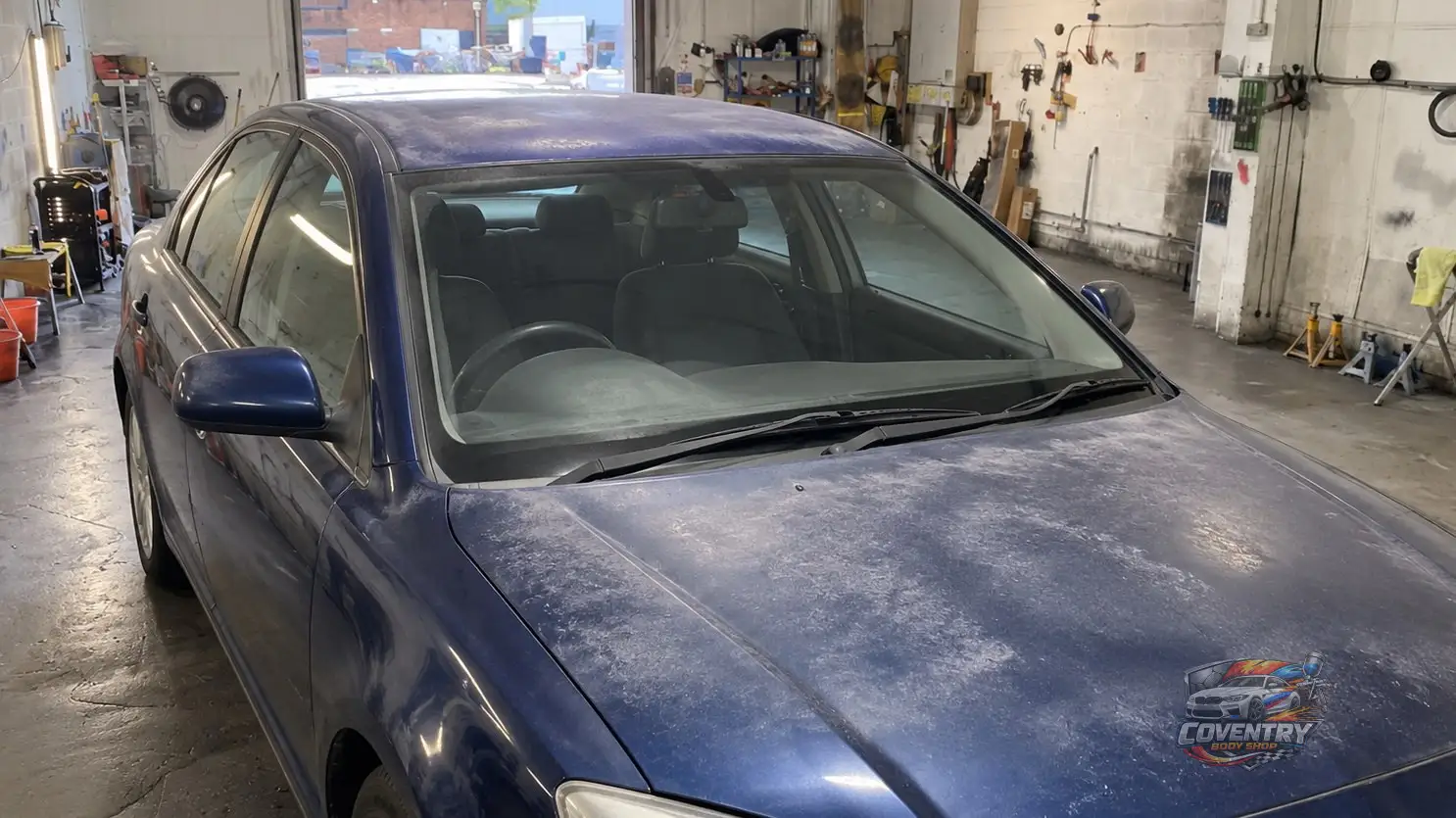
UK weather can leave car paint looking dull or marked, and it can make chips worse, but the cause matters more than the season. Sunlight gradually ages the finish, while rain, damp and winter road salt mostly matter where protective layers are already broken and metal is exposed. A car parked outdoors does not automatically need paintwork, though. Many marks improve with careful washing; peeling lacquer, spreading rust and deeper chips call for a different approach.
Dirt sitting on the paint, damage confined to the clear coat and damage that has reached the layers underneath can look alike at first glance. Telling them apart before reaching for a polish or booking a repaint can save unnecessary work.
Which weather is hardest on car paint?
There is no single worst weather condition for every car. Repeated sunlight is a long-term problem for exposed paint when a vehicle spends years parked outdoors. For a car with existing chips, damp conditions and winter road salt are more concerning because they can encourage corrosion where protective coatings have been broken. Frost generally presents a greater risk when ice and dirt are scraped across the finish.
Take one car with sound paint that spends its weekdays in an uncovered parking space, and another with a chipped wheel arch that regularly travels on gritted roads. For the first, watch UV exposure and cleaning; the second needs its damaged paint checked before corrosion spreads.
What does sunlight do to car paint?
Ultraviolet light gradually damages the chemical structure of automotive coatings. Over prolonged exposure, this can contribute to fading, reduced gloss, discolouration and cracking. BASF explains how UV radiation degrades coatings and why manufacturers add light stabilisers to slow that process. Modern finishes are built to resist sunlight, but their protection is not permanent.
Modern cars usually have a coloured basecoat with a transparent protective layer above it. This outer layer, commonly called lacquer or clear coat, provides gloss and helps protect the colour underneath. Our explanation of what clear coat does covers why damage to that outer surface changes the appearance of the whole panel.
A roof or bonnet may eventually look less glossy than the doors because its position gives it substantial exposure to the sky. However, dull horizontal panels are not proof of UV damage by themselves. Previous polishing, contamination, poor washing and an earlier repaint can also affect their appearance.
Wash and inspect the finish before deciding that the colour has faded. If the surface remains cloudy after cleaning, the next question is whether the clear coat is merely marked or has started to fail.
Parking under cover reduces direct exposure, although the choice depends on the space available and whether it stays reasonably dry. Our comparison of garage and outdoor parking for paint longevity looks at that practical trade-off.
How does hot weather affect paintwork?
Heat can contribute to the ageing of coatings, but a few hot days do not normally destroy sound factory paint. Its more immediate effect is on what happens at the surface. Water and cleaning products dry faster on a hot panel, sometimes leaving deposits or marks. Direct sunlight can also make contaminants harder to remove once they have dried onto the finish.
That is why washing a car straight after it has stood in strong sunshine is not ideal. A bonnet can feel much hotter than the surrounding air, and shampoo may begin drying before it can be rinsed away. Ford's vehicle cleaning guidance advises against washing hot bodywork or working in direct sunlight.
If the car has been parked outside on a warm afternoon, move it into shade and allow the panels to cool before washing. Choose a time when the shampoo can remain wet long enough to do its job, then rinse and dry without leaving deposits behind.
What do rain and damp conditions do to car paint?
Ordinary rain does not automatically damage a properly protected car. The problems arise when moisture reaches exposed metal, dirt remains trapped around panel edges, or water dries with contaminants on the surface. Polluted rainfall can also contain acidic compounds that affect coatings. Regular cleaning and early attention to chips will do more than worrying about every shower.
The US Environmental Protection Agency explains that acidic deposition can accelerate the deterioration of paint and metal. That describes one type of chemical exposure; it gives no reason to think a British shower will strip lacquer from a car.
Dampness is especially relevant around an existing chip, the lower edge of a door or an arch where dirt collects. Corrosion depends on the underlying material, the condition of its protection and what remains in contact with it.
After heavy rain, look for persistent deposits once the car is clean and dry. If a mark disappears with washing, there may be nothing to repair. If the finish has a sunken or rough patch that remains visible, further assessment makes more sense than repeated scrubbing.
What do frost, ice and snow do to car paint?
Frost does not usually harm an intact paint finish simply by forming overnight. Damage is more likely when someone drags ice, frozen dirt or a hard scraper across painted bodywork. Gentle snow removal matters more than trying to make every panel completely ice-free.
Lift loose snow with a clean, soft brush and a light hand, because grit caught in it can still scratch. If ice is stuck firmly to a bonnet or roof, avoid forcing it off with a scraper. Allow it to thaw where practical, and keep sharp or abrasive tools away from painted panels.
Windscreens and other glass need their own approved de-icing method. Follow the vehicle handbook, particularly around cameras and sensors, and do not pour very hot water over frozen glass.
Before driving, the Highway Code says to clear snow and ice from the windows, make sure lights and number plates are clear, and remove snow that could fall into the path of other road users. That includes snow sitting on the roof, even if the windscreen is already clear.
On a day when temperatures remain below freezing, postpone a full wash rather than leave fresh water to freeze around seals and openings. Remove the road dirt when conditions make washing and drying practical again.
What does road salt do to car paint?
Road salt mainly threatens metal rather than intact paint. Salt dissolved in water helps corrosion develop on vulnerable metal, where chips, scratches or failed coatings have exposed it. Wet road spray carries salty deposits into wheel arches, along sills and underneath the car. Removing those deposits reduces the time they remain against vulnerable surfaces.
Salt and road grit do different kinds of damage. Salt contributes to corrosive conditions, while stones and loose grit thrown by tyres can physically chip a coating. A small stone impact creates the opening that makes later exposure to salty water more significant.
Pay particular attention to the front edge of the bonnet, lower doors, wheel arches and areas behind the wheels. These parts can receive repeated road spray and debris even when the roof still looks clean. Ford's maintenance advice also recommends washing underneath vehicles exposed to salted roads.
When temperatures permit, rinse loose road dirt away before making contact with a wash mitt. Clean accessible arch edges and lower bodywork, and use a suitable vehicle wash facility for underside cleaning. Avoid directing a powerful jet into loose paint, seals or sensitive components.
A chip that has reached metal needs more attention than an ordinary dirty panel. Leaving road salt to collect around exposed steel increases the possibility of a small cosmetic defect becoming a corrosion repair.
What do bird droppings and tree sap do to paint?
Bird droppings and tree sap can stain or chemically affect automotive finishes if left in place. They are contaminants, not weather, although heat can make them harder to remove. Clean off both promptly and gently. A hard deposit should be softened before removal because scraping it away can create scratches that were not present underneath.
Vehicle manufacturers, including Ford, advise removing these deposits promptly. Start by wetting the affected area with water and an appropriate car shampoo or cleaner. Give the material time to loosen, then lift it gently using a clean, soft cloth.
Do not attack a stubborn spot with a fingernail, kitchen scourer or household solvent. If the residue will not release without pressure, stop. Use a product approved for that surface, or get it checked.
Sometimes a pale outline remains after the material has been removed. This may be surface marking or etching rather than dirt. Further rubbing will not necessarily remove it, and aggressive polishing could make the finish worse.
How can you tell whether weather has damaged the paint?
Start with a properly washed, dry panel viewed in daylight. Weather-related deterioration can appear as fading, persistent cloudy patches, water marks, roughness, cracking or peeling lacquer. Chips may reveal a different colour underneath, while corrosion can produce brown marks or raised paint around an edge. The appearance gives clues, but it does not always identify the cause or depth of damage.
Walk round it and look from several angles. Reflections help reveal fine scratches and patches with uneven gloss. A smooth-looking panel in shade may show haziness in brighter light, while harmless dirt can look surprisingly serious before washing. Compare the same panel before and after a careful wash, with no abrasive treatment in between.
- Fine circular marks: Often associated with washing or rubbing the surface. These should not automatically be blamed on sunlight.
- Dullness without peeling: Could come from surface contamination, oxidation or a worn finish. Cleaning and inspection help establish whether polishing is worthwhile.
- Distinct spots that remain after washing: May indicate mineral deposits or chemical etching. Avoid trying increasingly harsh cleaners without identifying the problem.
- Flaking or missing clear coat: Indicates a coating problem that wax cannot replace or conceal permanently.
- Rust-coloured marks or raised bubbles: Suggest corrosion or another problem beneath the surface and need a closer look.
- Small, sharp-edged chips: Usually point to impacts rather than weather alone, although exposure afterwards can worsen the damage.
Oxidation is often used as a general description for old, dull paint, but different paint systems can fail in different ways. Our guide on restoring oxidised car paint explains why some finishes respond to polishing while others require refinishing.
How can you protect car paint throughout the year?
Regular, gentle cleaning is more useful than applying increasingly aggressive products. Remove gritty dirt before touching the surface, avoid washing hot panels, and clear winter salt when conditions allow. A suitable wax or sealant can make maintenance easier, but neither repairs damaged lacquer nor stops corrosion beneath broken paint. Check the surface periodically so small defects do not go unnoticed.
Base the routine for a car parked outdoors on what it has been exposed to, with no fixed weekly timetable. It needs more attention after gritted-road journeys or when the car is visibly contaminated. When conditions are mild and the car remains fairly clean, there is less reason to keep washing it unnecessarily.
- Prepare the surface: Park safely in shade where possible, allow warm bodywork to cool, and check that the paint is not lifting. If you find loose lacquer or exposed corroded metal, do not scrub or polish that area.
- Rinse before touching: Remove loose grit and dirt with water, using equipment in line with the vehicle manufacturer's guidance. Pay attention to lower panels where abrasive debris collects.
- Wash with suitable products: Use automotive shampoo, a clean wash mitt and gentle pressure. Rinse the mitt frequently and avoid wiping dirt back over an area you have already cleaned.
- Rinse and dry: Remove shampoo thoroughly, then use a clean, soft drying towel to reduce water spotting. Inspect the dry surface before deciding whether it needs any further treatment.
- Protect sound paint: Apply a compatible wax or sealant following its instructions. Our explanation of what paint sealant does can help you decide whether it suits your maintenance routine.
- Check vulnerable areas: Look at chips and arch edges after winter driving, and inspect the bonnet and roof for changes in gloss after prolonged outdoor parking. Arrange an assessment if coating damage or corrosion appears to be developing.
Ford recommends waxing once or twice a year in its owner guidance, although the right interval for an individual car depends on the product and how it is used. A water-repellent finish may be easier to clean, but beading alone cannot tell you whether the lacquer underneath is healthy.
If you are considering machine polishing, remember that it removes a small amount of the surface material. Repeated or heavy correction thins the protective coating. Professional paint protection and polishing is one option when you want the existing finish assessed and treated without doing that work yourself.
When does weather-damaged paint need a bodyshop?
A bodyshop becomes useful when a mark survives careful cleaning and polishing could make it worse, or when the protective coating itself needs repairing. Have peeling lacquer or corrosion assessed before applying more products. A slightly dull but intact panel may need nothing beyond cleaning and suitable protection, so repainting should not be the starting assumption.
Different defects call for different work. A single stone chip may be suitable for a paint touch-up, depending on its size and condition. Small marks confined to the surface may respond to scratch removal by machine polishing, on a gloss finish with enough sound coating left.
A localised scratch or minor panel defect may be worth assessing for a SMART repair. Where lacquer has peeled or the finish has failed across a larger part of a panel, a single-panel paint repair may be the more suitable route. The size, depth, existing finish and extent of preparation determine what is sensible.
Inspection matters because two similar-looking marks can require different treatment. A white patch caused by residue may disappear with washing, while a white patch caused by failing lacquer will not. If you cannot tell which you are looking at, avoid aggressive polishing until someone has examined it.
Damage involving possible structural corrosion or another safety-critical part needs a qualified inspection, never a cosmetic home repair. We do not cut or weld metal, so if rust has gone that far we say so and recommend a garage we have used before. Do not judge a vehicle's roadworthiness from the appearance of its outer paint alone.
How can you get weather-damaged paint checked in Coventry?
Our one workshop is in the Wyken part of Coventry, and we look at weather-worn paint there. You pay nothing if all it takes is a small inspection. You can book online and bring the car in, and we will tell you whether the finish needs cleaning, polishing or paint repair. If it does need repair, you see the quote before the repair begins.
We use a paint depth gauge when assessing paintwork. On suitable metal panels, a conventional gauge reads the total coating thickness above the metal, including primer, colour coat and clear coat, and it cannot measure the clear coat separately. DeFelsko's technical guidance on paint gauges explains this distinction. Readings help with assessment, but they cannot establish on their own how much lacquer can safely be polished away.
Where repainting is necessary, our director handles the paintwork himself. He is a former Aston Martin technician and painter, and all our paintwork is sprayed in our spray booth. Colour matching uses the vehicle manufacturer's paint code, specialist mixing and spectrophotometer measurements; how much preparation and blending it takes depends on the panel.
There is no need to diagnose the problem before booking. If you want to ask about a mark first, use our contact form. Photographs are optional and can be sent beforehand through WhatsApp to +44 7903 105777 or the Send enquiry option, but they are not required for an appointment. Bring the car in after booking so we can inspect the finish in person and give you a quote.
We may simply advise washing and maintaining the paint. If we do suggest repair work, whether to go ahead stays your decision.
Leave a Comment
Comments
No comments yet.