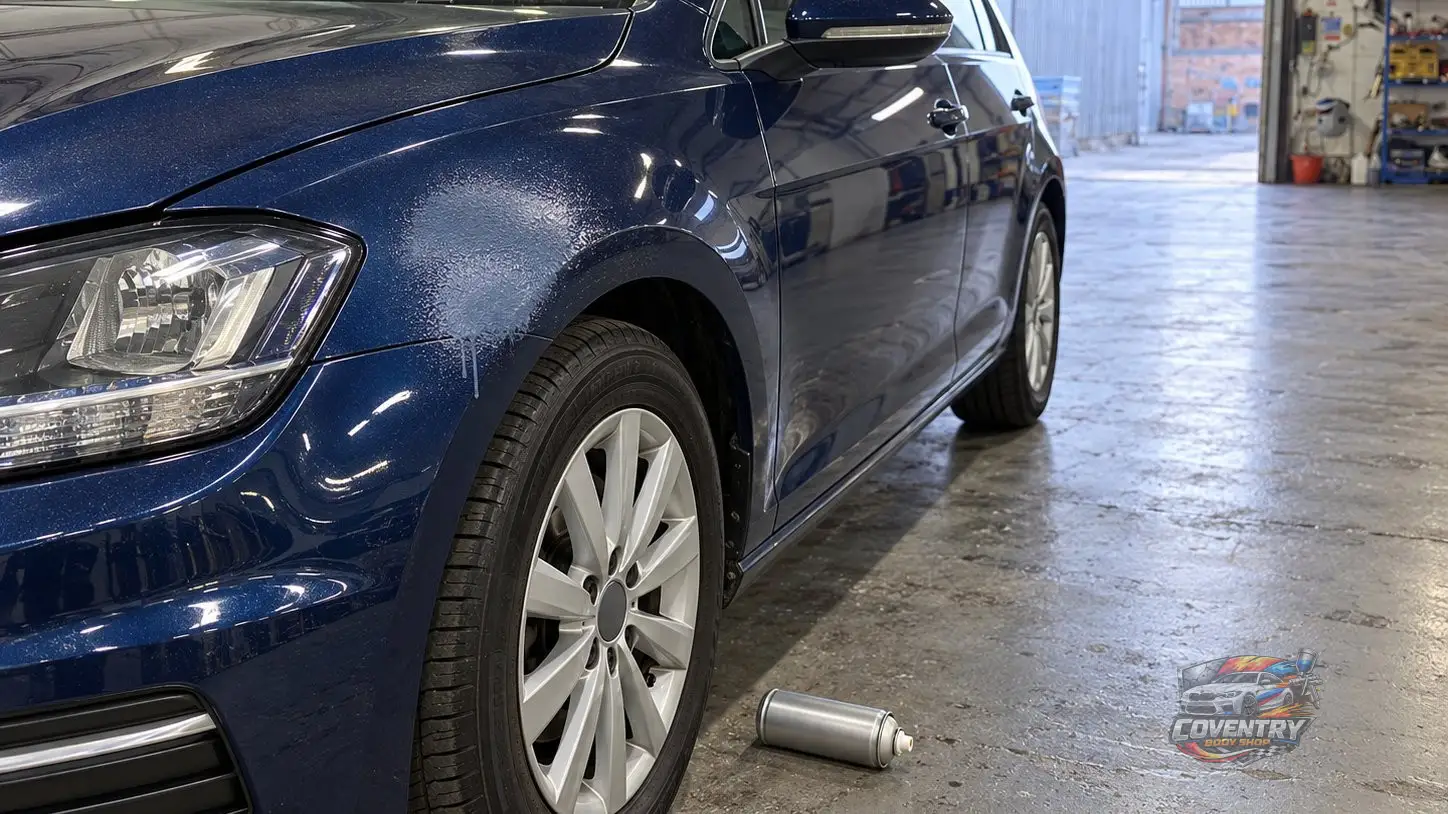
The Allure of DIY Car Spray Kits
Many DIY car spray kits are aerosol cans of colour mixed to the car's paint code, sometimes with primer and lacquer. A kit can cost less than a bodyshop repair, and you do the work yourself. For a small scuff low down on a bumper, that can be enough, and a small chip may suit a touch-up better than a spray. On a larger area the result is harder to get right, and on a panel the eye falls on first, small faults are easier to see.
Colour is hard to get right. A paint code identifies the colour, but one code can come in slightly different shades, and the paint on the car may have faded or changed since it left the factory. So a kit mixed to the code can still sit a shade away from the panels around it. A bodyshop offering single panel paint can check the colour against the car itself before it is sprayed.
Even spraying takes practice. Aerosol paint goes on fast, and without practice it is easy to end up with drips, a dry and rough patch, or overspray on the panel next door. Any of these can catch the eye more than the scratch did.
Preparation: The Foundation of a Quality Finish
A kit's instructions usually say to clean and sand the area. What they cannot judge is how much sanding your panel needs. Where the damage has left a hard paint edge, that edge usually needs feathering smooth, or it can show through as a ring under the new paint.
The surface also has to be free of wax and silicone. Some car shampoos and polishes leave them behind, and paint can fail to bond over them. A wipe with a panel degreaser suited to the paint, used as its instructions say, before sanding and again before painting, can help.
Bare metal usually needs primer before colour, and bare plastic, such as an unpainted patch on a bumper, may need an adhesion promoter or a primer made for plastic. Paint sprayed straight onto either can flake off.
Masking is easy to rush. Tape lines and overspray on glass, rubber seals and trim are hard to clean off afterwards.
Priming and Blending: Achieving Smooth Results
Primer gives the colour an even base to bond to and, depending on the type, helps protect bare metal. It usually goes on in light coats and is sanded flat once dry, though some primers are made to be painted over without sanding. Primer laid on too thick, or sanded too soon, can leave marks that show through the colour coat.
Poor blending can give a DIY repair away. Instead of stopping the new colour at a hard edge, a painter fades it out into the paint around it, so the change from new paint to old is harder to see. An aerosol usually gives less control over the spray than a spray gun, which can make a clean fade hard to achieve.
We match colour with the manufacturer's paint code, specialist colour mixing and a spectrophotometer, and on a panel repaint the new colour is blended into the surrounding paint where it needs it.
Application Techniques: From Spray Guns to Aerosols
An ordinary aerosol usually gives little control over pressure or how much paint comes out, though some cans have adjustable spray heads. That can suit a small area. Over a whole panel it is hard to keep every pass at the same distance and speed, and uneven passes leave stripes and patches.
A spray gun lets the painter set the width of the fan, the amount of paint and the air pressure for the job. In practised hands a gun puts the paint on in more even coats, which is part of why a professional respray can look smoother.
Where you spray matters as well. Outdoors, dust and insects can land on wet paint, and damp or cold weather can affect how it dries. Our paintwork is sprayed in our spray booth, which helps keep dust off the wet paint.
If you do use a kit, read the label and the safety data sheet before you buy it. Some products, especially two-pack (2K) lacquers, contain isocyanates, and breathing in their spray mist can cause asthma. Health and Safety Executive guidance for vehicle paint shops says isocyanate paints should be sprayed in a booth or spray room with extraction, by a painter wearing air-fed breathing equipment. A dust mask or an open garage door does not give that protection, so a product that lists isocyanates is not one to spray at home. With any kit, coat weight and the time between coats depend on the product, so follow the can, and bear in mind that heavy coats are more likely to run.
Curing and Lacquer Systems: Ensuring Longevity
Paint is dry to the touch long before it is fully hard. Until it has cured it marks more easily. When new paint can be washed, waxed or polished depends on the product, so follow the instructions on the can. The paint maker sets the curing times, and cold, damp weather can slow them down.
On a two-stage finish, the base coat needs lacquer on top. The lacquer gives the gloss and protects the colour from UV and moisture. Aerosol lacquers are sold for this, and the lacquer needs to suit the base coat it goes over. Too thin a coat may not protect the colour for as long, and a heavy one can run.
Lacquer can also let a home repair down over time. The colour may look right on the day, then dull early where the lacquer went on too thin.
Quality Control: The Professional Edge
Before a car goes back, a painter should check the repair in good light and from several angles, because a colour step or an orange-peel texture can be hard to see under some lights. Small dust marks on the surface can sometimes be flatted and polished out where there is enough lacquer to work with, while dirt trapped under the lacquer usually means painting the area again.
With a DIY repair, you are the one doing that check. Look at the repair from a few steps back as well as close up, and compare it with the panel beside it.
When we do the work, our workmanship is guaranteed for 6 months from the day you collect the car.
Cost Considerations: DIY vs. Professional Services
The sums can change if a DIY repair has to be redone, because a bodyshop may then have to take the DIY paint back to a sound base before it can paint the area, and that can add time to the job.
For small damage, you may want a bodyshop quote before buying a kit. A paint touch-up suits a small chip. Scratch removal by machine polish is priced per panel; it suits marks that stay in the lacquer, as polishing does not replace missing paint. One damaged panel comes under single panel paint, and a whole bumper under bumper respray. Where paint has failed across the car, a full body respray is the one to look at. Each of those pages shows the price it starts from.
The final price is confirmed once we have inspected the car, and a small inspection is free.
Making the Right Choice for Your Vehicle
A DIY kit can be a fair choice for small, shallow damage where a close colour match matters less to you. On a large panel such as a bonnet or a door, or on a metallic colour, the colour match and the blend are harder to get right with an aerosol.
If a bumper is scuffed or cracked, ask about our bumper repair service, which includes plastic welding of cracks where the bumper can be repaired. For minor scuffs and scratches on one part of a panel, a SMART repair can treat just the damaged area.
To arrange an inspection at our workshop in Wyken, Coventry, or ask about a repair, call or WhatsApp +44 7903 105777, send photographs with the Send enquiry button, or use our contact form.
Leave a Comment
Comments
No comments yet.