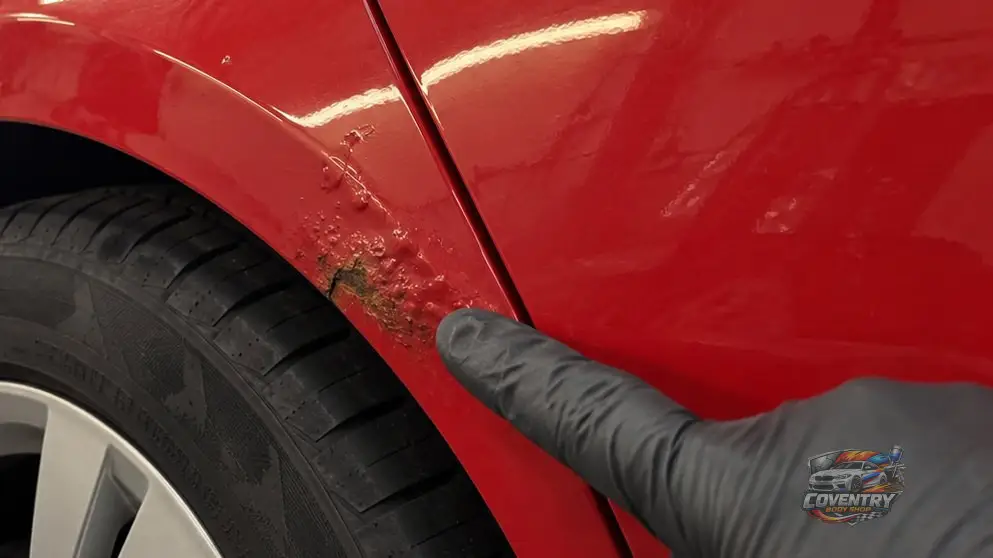
Bubbling paint means something beneath the finish is pushing it up or causing it to lift. On older steel panels, a common cause is rust forming underneath, often starting at a chip, seam or edge. Moisture or dirt beneath the paint can also cause bubbles, so bubbling does not always mean rust.
Why would an older paint finish start bubbling?
Paint normally forms a protective barrier over the panel. A stone chip, damaged edge or opening at a seam can let water reach steel beneath it. As rust forms, it expands and can lift the surrounding paint, even where the surface still looks unbroken.
The visible bubble may be some distance from the original opening. The damage under the paint can be larger than the bubbles.
An earlier repair can also lose its bond if moisture or contamination was left beneath the paint. That may show up later as raised patches. On recently painted panels, trapped air or paint materials that do not work together can cause bubbles. PPG's blistering guidance also lists paint applied too thickly as a cause. Appearance alone cannot reliably separate a preparation problem from corrosion; the panel material and what lies beneath the loose finish matter.
What does the position of the bubbles tell you?
Where bubbling appears gives useful clues, especially around places that hold dirt and moisture.
- Wheel arches: Bubbles along a steel arch lip often suggest rust. Mud and moisture can collect behind the folded edge.
- Sills: Bubbling along a steel sill or seam can indicate corrosion beneath the coating. Corrosion there can affect your car's structural strength, so have it checked by a professional. Bubbles alone do not show how serious it is.
- Door bottoms and boot lids: Folded steel edges can hold moisture, and corrosion may begin on the inner side before becoming visible outside.
- Around old chips: A raised ring or patch beside exposed steel often points to rust spreading beneath the surrounding paint.
- Plastic bumpers: The plastic itself cannot rust. Bubbles there come from the paint layers, such as trapped solvent or moisture, or a coating that has lost its grip on the plastic or on an older repair.
- Aluminium panels: Aluminium can corrode, but it does not produce the reddish rust associated with steel. Exposed corrosion often looks white and powdery.
Do not assume every panel on your car is made from the same material. A vehicle can have a mixture of steel, aluminium and plastic parts, each requiring a suitable repair approach.
How can you recognise a bubble without disturbing it?
Look across the panel in daylight from a shallow angle. Bubbling usually appears as raised bumps or uneven patches, sometimes with brown staining at an edge. The paint may still cover the whole bump, so a lack of visible rust does not rule out corrosion beneath it.
Cracking looks more like lines or splits through the finish, although cracking and bubbling can occur together. If lines are the main symptom, our guide to what causes paint cracking explains that separate problem.
A visual check cannot reveal how much sound metal remains. Avoid testing a bubble with a fingernail, screwdriver or pressure from your thumb.
What should you do while waiting for an assessment?
Do not pop, pick, sand or paint over the bubbles. Breaking the surface can expose more of the underlying area, while covering it hides the evidence without resolving the cause.
Keep the area gently cleaned and dry where practical. Avoid directing a pressure washer at lifted edges.
Rust or moisture underneath can keep spreading, even when the bubbles look the same. There is no reliable timetable for this. Arrange an assessment rather than waiting for the paint to fall away.
For separate chips where the surrounding paint is still firmly attached, our advice on stopping rust after paint damage explains how early attention can help protect exposed metal. For small chips with firm edges, paint touch-up for small chips may be suitable.
Can bubbling car paint be repaired?
It can often be repaired, but the condition beneath the paint determines the work needed. An assessment should consider the surrounding finish and, where accessible, the reverse of the affected edge.
A small inspection is free. If the extent of the bubbling needs a deeper inspection, this costs from £240 including VAT (£200 plus VAT), taken off the repair bill if the work goes ahead.
When bubbles are unrelated to rust, such as those on plastic bumpers or in an earlier repair, the repairer identifies which layers have failed. Those layers are taken back to a sound surface before suitable preparation and repainting.
For bubbling caused by rust on a steel panel, the repair usually follows these stages:
- Expose the affected area: The bubbled paint and unstable layers are removed to expose the affected metal.
- Deal with the corrosion: Rust is removed and the exposed metal treated as appropriate. The remaining metal must be suitable for a paint repair.
- Rebuild the finish: The prepared area receives suitable primer, colour and clear coat. Colour is blended into the panel where appropriate, and clear coat may need to cover the whole panel.
If rust has eaten through the metal, a paint repair alone is insufficient. A bolt-on panel can be replaced instead if the inspection shows that suits it better. We do not cut or weld metal panels. If your car needs that, we will tell you and recommend a garage we have trusted with welding work before.
Where the metal remains sound, repainting a single panel may be suitable. The area needing paint can be larger than the original bubble because preparation must reach firmly attached edges.
How can you arrange an assessment?
We advise sending photos of the bubbling by WhatsApp on +44 7903 105777 or the Send enquiry button so we can check whether it is a job we take on before you make the trip.
Tell us your car's make, model and year, when you first noticed the bubbles, and whether that area has had a previous repair. After booking, we advise everyone to bring the car to our workshop in Wyken, Coventry so we can see the affected paintwork in person.
The final price is set after inspection, and no deposit is needed.
Leave a Comment
Comments
No comments yet.