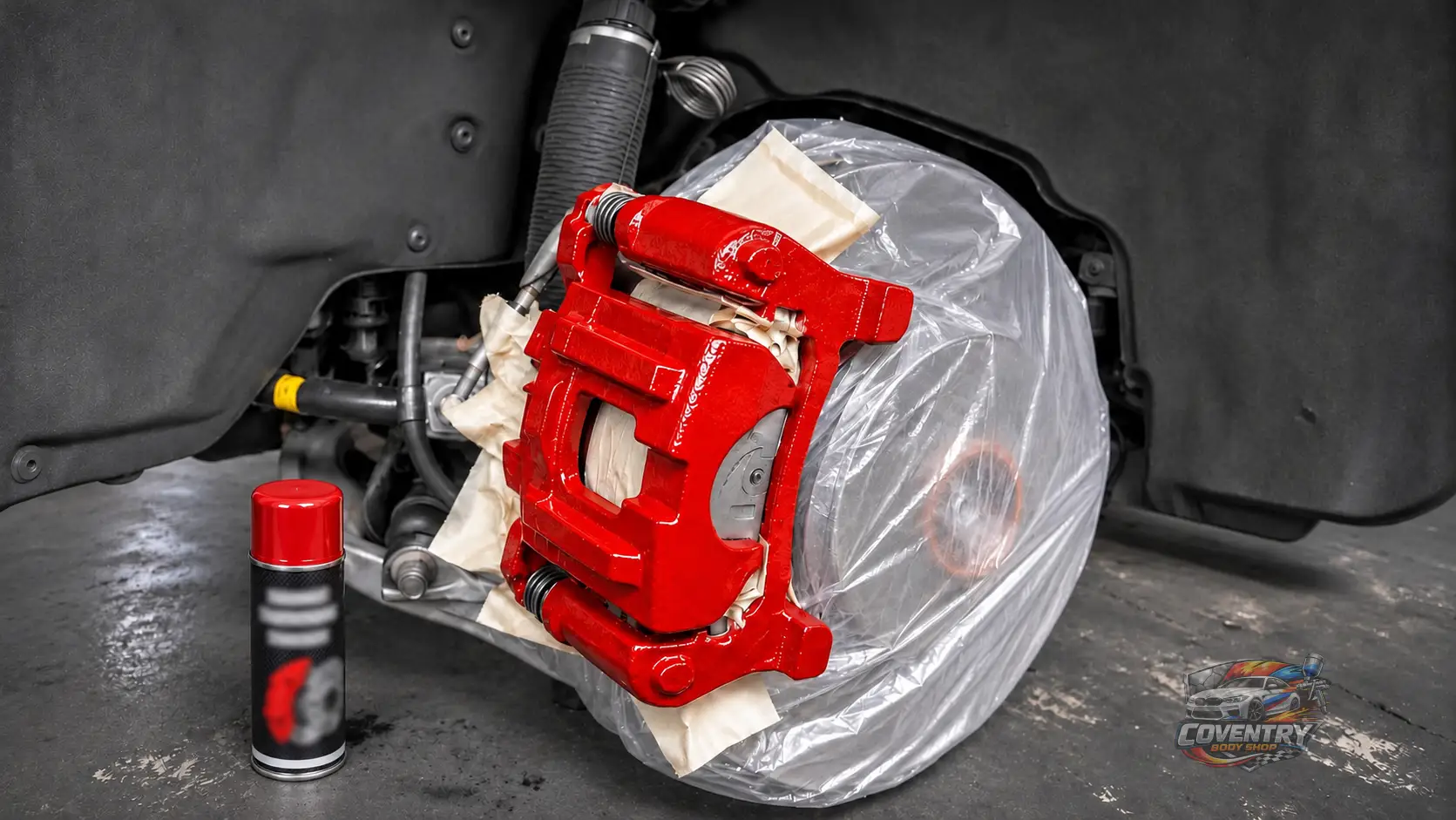
Yes, you can paint brake calipers without taking them off the car. With the wheels removed, you clean the calipers, mask the discs and rubber parts, then brush or spray on paint made for calipers while the brake pads stay in place. The one thing that must not go wrong is where the paint lands: none of it should reach a braking surface or anything the brakes need to move, seal or be serviced.
What stays on the car?
Leave the calipers bolted on and the pads fitted. Take the wheels off so you can clean the metal and mask the discs properly. Check your rear brakes first, as a car with drums at the back has no caliper to paint there.
Do not unbolt a caliper to make it easier to reach, and do not disconnect a brake hose. Refitting brake parts and bleeding a hydraulic system are brake repairs, and a mistake there affects how the car stops. Kept to the outside metal, paint should leave the brakes working as they did. It will not make the car stop any better.
If you would rather hand the job over, or want the calipers taken off, we offer brake caliper painting in Coventry.
Check the brakes before you reach for a brush
Surface rust is no reason to stop, as it can be cleaned off. Seizing is harder to spot, because a caliper can seize without leaking, so a dry outside proves little.
These signs mean leave the paint in its box and have the brakes checked:
- Any leak around the caliper or hose.
- Deep scaling, structural damage, a torn piston dust boot or a seized bleed nipple.
- A wheel that drags, or one side that runs unusually hot.
- The car pulling to one side under braking.
- One pad worn far more than the other.
- Smoke, a burning smell or a pedal that feels wrong.
Choose the paint before you start
Buy paint sold for brake calipers. Fast Car describes these as high-temperature gloss enamels, while ordinary very-high-temperature paint often dries matt and soon looks dirty with brake dust.
A brush kit makes it easier to keep paint where you want it. Fast Car says the enamel flows out as it dries, so brush marks are less of a worry than you might expect. It is runny, though. Overload the brush and it drips into the places you have just masked.
Check whether a brush kit has a hardener before you buy it. Fast Car says a mixed kit usually gives you a couple of hours before it goes off, which means painting all four in one go. Raising both ends of a car takes four stands rated for its weight, placed at the handbook's support points, and that is a bigger job than lifting one corner. If you are not set up for it, pick a paint that does not need mixing and do one axle at a time.
An aerosol can cover the visible metal, but everything around it needs protecting from overspray. Halfords warns that its caliper aerosol is extremely flammable, can burst if heated, causes serious eye irritation and may cause drowsiness or dizziness. Use it with plenty of fresh air and well away from anything that could light it.
Do you need primer or clear coat? Only if the product's instructions call for them. Cox Motor Parts says its own caliper paint needs no primer, while saying primer is usually needed in general, and Fast Car's brush kit goes on with no primer mentioned.
Hammerite and other general metal paints are a different matter. We have not seen a temperature rating for them, so judge any paint not sold for calipers by the heat rating on its own data sheet.
Do not spray two-pack paint at home. The Health and Safety Executive's guidance on isocyanate paints calls them one of the main causes of occupational asthma reported in the UK, and notes that "water-based" does not mean isocyanate-free. It expects spraying to happen in a booth or similar extraction, with air-fed breathing apparatus. Brush kits with a hardener are two-part as well, so read the safety data sheet before you open one and follow what it says on gloves, ventilation and breathing protection. The same limit on spraying at home runs through our guide to DIY versus professional car paint, if the calipers are only the start of what you want to paint.
How to paint brake calipers at home
Cleaning and masking usually take longer than the painting, and the car then has to sit. Allow a full day for the work, then leave the car for at least 24 hours, and up to 2 days if your paint asks for it. Gather a jack, axle stands, chocks, a wheel brace, a torque wrench, gloves, eye protection, brake cleaner, a toothbrush, wet rags, a wire brush, abrasive paper, masking materials and the paint, and look up the wheel-nut torque figure before you lift anything. Read the safety data sheets for the cleaner and the paint as well, and wear what they ask for.
- Park and loosen the wheel nuts. Let the brakes cool fully after any drive before you start. Work on firm, level ground. Apply the handbrake, chock the wheels and loosen the nuts slightly while the tyres are still on the ground.
- Lift and support the car. Jack at the points shown in the handbook and put the car on axle stands before any wheel comes off. Never work under a car held by a jack alone.
- Wipe off the brake dust first. Do this with wet rags, before any brushing or sanding. The HSE's brake and clutch dust guidance says all such dust is potentially harmful, warns against blowing it out with an airline and recommends wet rags for cleaning up. Older and classic cars may still have asbestos in their friction material, and the HSE says rags used on such parts should be disposed of as asbestos waste, so ask your council how before you start.
- Clean the metal and remove loose rust. Once the dust is off, wire-brush the caliper with the metal still damp, without touching the rubber around the pistons. Then sand it lightly so the paint has something to key to. wikiHow suggests 150 to 200 grit.
- Degrease, then let it dry. National Tyres and Autocare suggests putting brake cleaner on a toothbrush rather than spraying the assembly directly. Keep it off the pad friction material, rubber seals, hoses and electrical connectors, and away from any flame or spark. Repeat until the dust and grease are gone, then, as Fast Car says, let it evaporate before you go on.
- Mask what must stay bare. Cover the disc, including its braking faces, and protect the pads. Keep paint off rubber boots, hoses and fittings, guide or slide pins, bleed nipples, threads, bolts, mating surfaces and electrical connectors. Halfords puts it plainly: paint nothing but the metal of the caliper. If you cannot cover something properly with everything still fitted, leave the metal next to it bare or stop there.
- Apply light coats. Follow your tin rather than trying to hide the rust in one thick pass. Fast Car recommends at least 3 or 4 coats about 15 minutes apart, and says not to go back over a patch during a coat. Cox Motor Parts' guide gives 3 to 4 coats, 10 to 15 minutes apart, from 15 to 20 cm for its spray. Those are guide figures, and another product can ask for something else.
- Leave the finish alone. Take the masking off carefully so no wet paint transfers to the parts you protected. Do not press the finish to test it. Timing advice varies widely, so use the waits under What we recommend below.
- Inspect before the wheels go back on. Check that no tape or masking is left and that every part you covered is clean. Paint on a disc face, on pad friction material or on anything that has to move stops the job. Do not drive the car until that paint has been properly removed or the part replaced, because a gentle road test will not clear it. If you are unsure, get a mobile mechanic to look at it where it stands.
- Refit the wheels and test the brakes. When the paint's instructions allow it, fit each wheel and run the nuts up by hand. Lower the car, then tighten them with a torque wrench to the car maker's figure, in the order it gives. Once the 24 hours, or your paint's longer wait, have passed, try the brakes gently at low speed before a normal journey, and keep that first drive calm until the paint has fully cured. If the pedal or the way the car stops feels different, stop using the car and get the brakes checked.
Where the painting guides disagree
What we recommend
Let the label on your own paint decide when the wheels go back on, and take the longer end if it gives a range. Before you drive, give it at least 24 hours, or longer if the label asks for it. We advise 24 hours for the paint to cure on our own work, which is why ourbrake caliper painting service usually keeps the car for 2 days. For a home job, leave the calipers and pads where they are.
When can the wheels go back on?
Getting the wheels back on and driving away are separate deadlines. Kwik Fit quotes Foliatec at 2 hours for refitting wheels and Rust-Oleum at 5 to 9, with Rust-Oleum touch dry in 2 to 4 hours and possibly not fully dry for 24. National also says 5 to 9 hours.
When can you drive?
Fast Car says wait at least 12 hours. Kwik Fit, National and wikiHow say 24, while Cox Motor Parts advises 24 to 48. Kwik Fit adds that Foliatec gives full hardening as up to 7 days.
How much heat will the paint take?
Halfords rates its 400ml aerosol up to 150°C once fully cured, and Cox Motor Parts gives 200°C for its paint. Kwik Fit says dried paint withstands up to 300 degrees, and National says calipers can go over 250°C. Those figures belong to different products, and none of them tells you how hot your own calipers run. Buy a paint sold for calipers with a rating you can read, and look for a higher one if you tow regularly or do track days.
Pads in or out, and front and rear together?
Fast Car's brush method leaves the calipers and pads in place, while wikiHow takes both out. Kwik Fit does the fronts and rears on separate days, which will not work with a mixed kit.
What makes caliper paint peel?
Early peeling usually comes down to preparation. Paint put over dust, grease or loose rust is only as well stuck as whatever sits underneath it. Panels fail for the same reason, and our article on the truth about DIY car spray kits sets out a degreasing routine for those.
Heavy coats bring their own trouble, because runs collect at the casting edges and can reach parts that must stay clean. Rushing between coats does damage too, and so does refitting the wheels before the finish can take it.
Weather counts as well. Halfords specifies +10°C to +25°C for its aerosol and warns against direct sun, cold, damp, humidity and wind.
How long will the finish last?
National gives around 3 to 4 years, depending on the quality of the paint. Treat that as one guide's estimate.
Brake dust and heat wear it over time. With the bolts and slide pins left bare, the pads should come out as normal at the next change, though the work can scratch the finish.
MOT and insurance
The GOV.UK MOT inspection manual for brakes has no line on caliper colour. It does list callipers that are cracked or damaged, and discs or pads contaminated with oil, grease and the like, and those still apply to a painted caliper.
Ask your insurer before you paint. Some want cosmetic changes declared, and the answer depends on your policy.
Is doing it at home worth the cost?
On sound brakes, it is worth doing if the look matters to you, more so behind open-spoke wheels. All it changes is how the car looks.
Halfords listed its 400ml aerosol at £10.99 when we checked on 1 November 2026. Add cleaner, abrasive paper, masking materials and, if you do not own them, a jack, axle stands and a torque wrench. A workshop's price covers the preparation and labour as well as the paint, so it will not compare directly with one can. Our brake caliper painting page shows the current price and what the job involves.
With the wheels off, you will also get a good look at them. If yours need attention, our article on painting alloy wheels covers what paint can and cannot fix, and alloy wheel refurbishment is the workshop route.
When to leave it to a workshop
Hand it over if you have no firm, level ground or axle stands, or if you would rather not have the car on stands at all. The same goes if you want the calipers off the car, because refitting them is brake work. A brake fault goes to a garage first, whoever does the painting.
At Coventry Body Shop in Wyken, Coventry, we paint brake calipers in the colour and type of paint you ask for. You decide whether they stay on the car or come off. Around 9 in 10 can be resprayed without being removed, with the body parts around them protected first.
We clean off rust, but we turn down calipers that are seized or leaking. Some cannot be repainted at all, and we will say so. Our company director does all the painting. We usually keep the car for 2 days so the paint has its 24 hours to cure.
Our 6-month workmanship guarantee covers the paint fading or flaking, though not stone chips or marks from cleaning products. Photos help us see the job, but we will not insist on them. Send them on WhatsApp to +44 7903 105777 or use the Send enquiry button, then bring the car in after you book. A small inspection is free.
Leave a Comment
Comments
No comments yet.