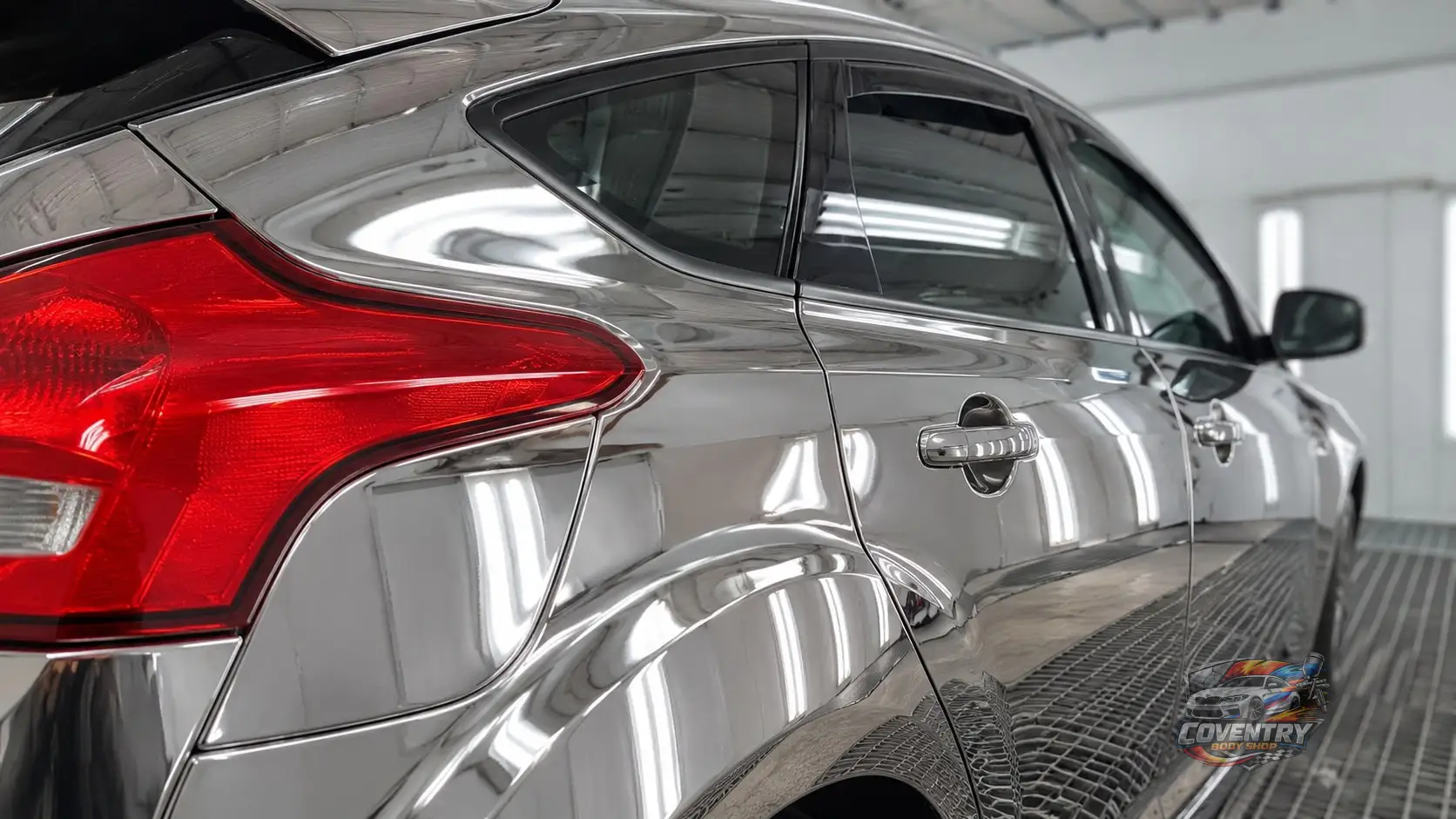
No law or GOV.UK guidance we checked for this guide bans chrome paint by name. The law sets a wider test instead: a car and its parts must be kept in a condition that causes no danger, and a mirror finish that throws strong glare at other drivers could fall foul of it. Before changing your car, you also need to consider the DVLA, insurance, MOT requirements and any finance agreement.
Is chrome paint legal on a car in the UK?
The rule that does apply is general. Regulation 100 of the Road Vehicles (Construction and Use) Regulations 1986 says a vehicle and all its parts and accessories must at all times be in a condition where no danger is caused, or likely to be caused, to anyone in it or on a road. Section 40A of the Road Traffic Act makes it an offence to use a vehicle whose condition involves a danger of injury to any person. Neither names a paint finish, so the question is what a particular finish does: an ordinary metallic silver and highly reflective mirror chrome may behave very differently in direct sunlight.
Both laws apply in England, Scotland and Wales. Drivers in Northern Ireland should check the rules there, as this guide follows the rules for Great Britain.
GOV.UK's DVLA guidance on vehicle modifications says the keeper is responsible for keeping a vehicle roadworthy. It also confirms that a vehicle can be unsafe even when it has a current MOT certificate. You can read this in the DVLA's guidance on vehicle changes and safety.
The same DVLA guidance adds that there are penalties for driving a vehicle in a dangerous condition. It does not name chrome, or any other paint finish, as dangerous in itself.
For a driver considering chrome, this leaves an important question unanswered by the colour name alone: how reflective will the finished surface actually be? A silver effect with a conventional painted appearance is different from a surface that produces recognisable reflections of surrounding buildings, vehicles and sunlight. The more mirror-like the result, the more carefully its potential effect on other road users needs to be considered.
Can the police stop you for driving a chrome car?
Yes. The police can stop a vehicle, and the Highway Code's Rule 106 explains that a driver must pull over and stop safely when directed to do so. A chrome finish does not have to be a proven offence before an officer can stop the vehicle.
An officer might stop a car because an unusually reflective surface looks like a road-safety hazard, or because a modification has affected the visibility of the registration plates or lights. Any penalty would then depend on whether the car breaks a rule that applies, and none of the rules checked for this guide names chrome.
Sunlight is the obvious practical concern. A mirror finish can reflect bright light towards another driver as the position of the car and sun changes. The effect will depend on the surface, the angle of reflection and the surrounding conditions, so the word "chrome" does not establish whether a particular vehicle is dangerous.
There is also a legal distinction between reflected sunlight and vehicle lighting. The Highway Code's Rule 114 prohibits using lights in a way that dazzles other road users. That rule concerns lights and sets no reflectivity limit for body paint, so a finish itself falls under the general duty in regulation 100.
Before committing to a genuine mirror finish, ask for the intended material's technical information and evidence of its suitability for exterior road-going vehicles. A description such as "road legal chrome" is not a substitute for considering the finished vehicle's safety.
Do you have to tell the DVLA about chrome paint?
Yes, if the chrome finish changes the car's recorded colour. GOV.UK's DVLA V5C guidance lists colour among the vehicle details that must be updated. A full chrome respray or colour-changing wrap should therefore be treated as a colour change when the vehicle's recorded colour no longer accurately describes it.
Chrome is a description of a finish rather than necessarily a separate registered colour. Where the colour has changed, GOV.UK says to fill in section 1 of a newer log book, the one with multi-coloured numbered blocks on the cover, or section 7 of an older one. Our guide to legally changing your car's colour in the UK covers the rest of the process.
Do you have to tell your car insurer?
Tell your insurer before arranging chrome paint or a chrome wrap, even if the new finish looks similar in colour to the original paint. MoneyHelper's car insurance guidance tells drivers to notify their insurer about modifications. Updating the DVLA record does not establish that your insurance company has accepted the change.
Ask whether the insurer regards the proposed finish as a modification, whether it will continue providing cover and whether the finish itself would be covered if damaged. A policy might accept a modified car without agreeing to pay the full cost of restoring a specialist finish, so ask both questions.
Failing to disclose relevant information can have serious consequences. The Financial Ombudsman Service's guidance on non-disclosure explains that insurers may restrict cover, settle claims proportionately or avoid a policy when qualifying misrepresentation occurs. These outcomes are not automatic for every undeclared change.
The Ombudsman also makes an important distinction between incorrect information given when taking out or renewing insurance and changes made during an existing policy. For mid-term changes, the policy wording matters, and the Ombudsman considers whether the insurer's response is fair. Checking before the work and keeping the insurer's response gives you a clearer basis for deciding whether to proceed.
Raise future repairs as well. If a bumper needs painting after a minor collision, will the insurer pay for the specialist finish, an ordinary replacement colour or something else?
Will chrome paint affect the MOT?
The DVSA's MOT inspection manual checks the condition of the body rather than its colour, and its body section has no test for how much light a finish reflects. A car with a chrome finish can still fail for any defect the manual does list.
Section 6.2.1 of the DVSA MOT inspection manual covers body condition and unsafe modifications. It identifies damaged or insecure body components likely to cause injury, as well as unsafe body modifications, as potential defects. A finish should not conceal damage that needs attention.
Registration plates are another concern. The DVSA manual's identification section requires registration plates to remain readable and prohibits films or other features that change the legibility or appearance of the characters. Chrome film should not be carried across the number plate as though it were another painted panel.
The required lights and reflectors also need to keep working as they should. A finish that interferes with those items raises separate inspection concerns, regardless of whether the body colour itself is acceptable. An MOT pass is not advance approval of every modification or a guarantee that the vehicle will remain roadworthy afterwards.
What if your car is leased or on finance?
Check your agreement before authorising any permanent paintwork or removable film. MoneyHelper's guide to personal contract hire says the car goes back to the dealer when the contract ends, with a penalty for damage beyond the agreed terms. Ask whether a change of finish would count.
The same guide explains that hire purchase payments cover the rest of the car's value, while on personal contract purchase (PCP) the car is only bought outright if you make the optional final balloon payment, which many people do not. Until the car is yours, the agreement's wording on changes and on handing the car back is what counts.
Do not assume a wrap is acceptable just because it can be removed. Removing film may leave adhesive residue or reveal damage that requires attention, and a leasing company may assess the returned vehicle against its agreed condition. A painted colour change is harder to reverse because restoring the original appearance means further paintwork.
Ask the finance or leasing company for permission in writing, explaining whether you intend paint or film, how much of the car will change and what you propose to do when the agreement ends. Find out whether the original appearance must be restored and who pays for any resulting work. Keep that response with your vehicle records.
Chrome paint or chrome wrap: what differs?
Chrome-effect paint creates its appearance through a coating system applied to prepared bodywork. A chrome wrap uses a film over the existing finish. The practical difference is that painted chrome becomes part of the car's paint system, while suitable wrapping film may be removable without repainting the whole vehicle.
Neither option guarantees an easy repair. A chrome effect can be hard to match on a single damaged panel, so ask how a damaged panel would be put right before any work starts. Film may allow a damaged section to be replaced, but matching its appearance and removing it without harming the underlying finish depend on the material and the condition of the paint beneath it.
Costs need comparing for the actual vehicle and intended effect. Preparation, panel complexity, coverage, specialist materials and future repair requirements all matter; a wrap should not automatically be assumed cheaper or easier. For a broader explanation of the two methods, read our car wrap versus paint comparison.
How long does a chrome finish last?
There is no single supported lifespan for every chrome paint system or mirror-effect wrap. The products differ, and a quoted durability figure may apply to one particular film, surface orientation or use rather than an entire vehicle. Chrome paint also needs to be assessed against the specification of the actual coating system being proposed.
As one example, a film maker's product page lists its chrome film at up to three years, and sells its mirror-like chrome for accents such as mirrors and trim, with a matte chrome version for full wraps. Its figure and its recommended uses belong to that film alone, so check what a maker recommends its film for before planning a full mirror wrap.
Whoever specifies the finish should be able to give you its written durability and care information, including any distinction between panels exposed directly to sunlight and those receiving less exposure. A useful answer should identify the exact coating or film being proposed. Without that information, a prediction about how many years your particular chrome finish will remain attractive would be guesswork.
How should you wash and protect chrome paint or wrap?
Mirror-like surfaces make dirt, water marks and small surface imperfections more noticeable, so regular, gentle cleaning matters. However, a cleaning method suitable for conventional lacquer may be unsuitable for a specialist reflective coating or film. Follow the particular finish manufacturer's instructions instead of assuming ordinary polishing methods are harmless.
Ask for the care sheet for the exact film or paint and keep to it. As a general approach, rinse off grit before anything touches the surface, then wash with a soft cloth or sponge and a non-abrasive car shampoo, and dry with a clean microfibre towel. Keep a mirror finish out of brush car washes unless its maker says they are safe for it.
Do not try to remove a scratch with cutting compound until the coating or film manufacturer confirms that polishing is appropriate. Abrasive treatment can alter the surface texture and make the affected area stand out more. For a painted chrome effect, the correct repair procedure depends on the coating layers; for film, it depends on whether an individual section can be replaced and matched.
Keep bird droppings, road contamination and other deposits from remaining on the surface unnecessarily. Clean them using the method specified for the material, without aggressive scrubbing. When damage appears, establish which layer has been affected before attempting to restore the shine.
What does getting a chrome finish involve?
The appearance of a finished chrome car depends heavily on the surface beneath it. Ripples and uneven panel surfaces show up more when reflections are sharp. A decision about the final effect should therefore begin with the condition of the car and the suitability of the proposed finish, rather than a colour sample alone.
- Establish the effect. Decide whether you want a bright metallic appearance, a softer chrome-like effect or a genuinely mirror-like surface. Those descriptions do not necessarily refer to the same type of paint or film.
- Inspect the existing bodywork. Check for dents, scratches, previous repairs, peeling lacquer and other defects that could affect appearance or adhesion. Damage that may affect safety needs a qualified inspection before cosmetic work is considered.
- Define the coverage. Decide whether the change concerns external panels alone or visible areas around door openings and other edges. Discuss trim, lighting, registration plates and any vehicle sensors that could be affected by the proposed material.
- Confirm the practical terms. Obtain the exact finish specification, permitted cleaning methods, repair approach and any stated durability conditions. Resolve insurer and finance-company questions before authorising the work.
- Check the finished vehicle. Examine the surface and panel edges, confirm that lights and plates remain unobstructed, and check that the vehicle's recorded colour and insurance details are correct. If there is a concern about roadworthiness, have it inspected by a qualified professional before driving.
What would Coventry Body Shop check before a colour-change respray?
Our Wyken workshop takes on full body resprays, colour-change resprays, single-panel resprays and paint repairs. Before quoting for a colour change, we inspect the existing paintwork and the condition of the body panels. We use a paint depth gauge to assess the existing coating and look at damage or previous repairs that could affect the work.
When we match an existing factory colour, we start from the manufacturer's paint code, with specialist paint mixing and spectrophotometer colour matching. Every coat of paint goes on in our spray booth.
We cannot promise a chrome-effect or mirror finish, and wrap fitting is not a listed service. For a colour change, we quote for a conventional respray after seeing the car, because the condition of the existing panels and the amount of preparation both need assessing first. Our full body respray service page explains the work and how a respray is assessed after inspection. Specialist colours can add stages to the paintwork, which we explain in our article on why custom paint jobs cost more.
To arrange an assessment, use our contact form or message us on WhatsApp at +44 7903 105777. Photos tell us early whether it is work we can do, and they go through WhatsApp or the site's Send enquiry button. After that, book a visit so we can look at the car. Customers bring their vehicles to our Wyken workshop and collect them once the agreed work is completed.
Leave a Comment
Comments
No comments yet.