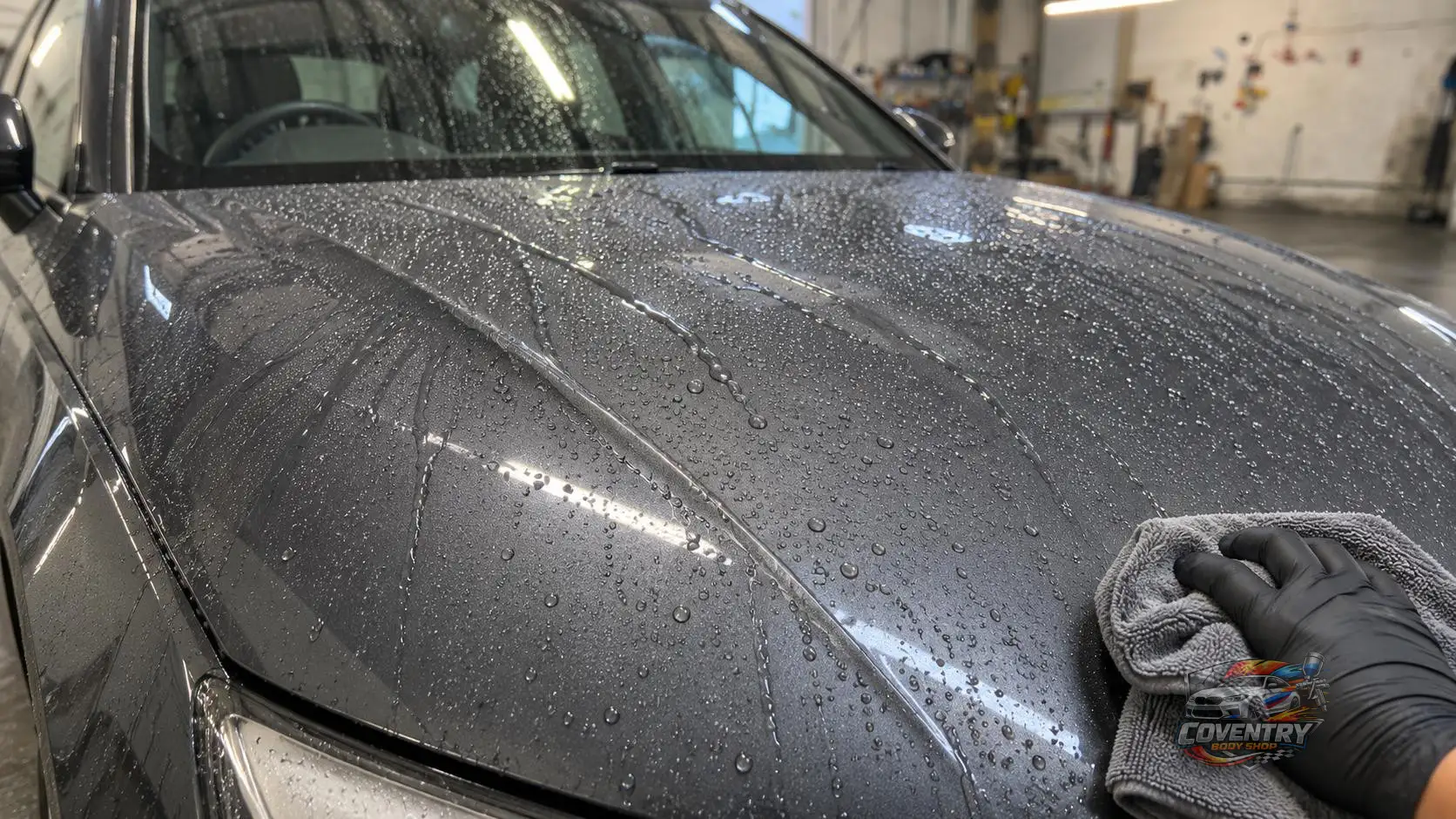
Ceramic coating can be worth paying for if your car's paint is already in good condition and you want it to be easier to wash. It will not reliably stop stone chips, it cannot remove scratches, and it does not make careless washing harmless. Coventry Body Shop does not apply ceramic coatings or offer a full detail; at our Wyken workshop we polish and repair paint, which is often the job to sort first. Before spending money, check whether the paint needs polishing or repairing, what the coating quote includes and how much upkeep you are willing to do.
What is a ceramic coating and what does it actually do?
A ceramic coating is a liquid treatment applied to thoroughly prepared paintwork, where it cures into a thin protective layer over the clear coat. Its main practical benefit is making contamination less inclined to cling to the surface, so routine washing and drying can be easier. It can also help the finish retain its gloss, provided the paint looked good before application.
The word 'ceramic' describes a family of treatments rather than one identical product. Professional coatings generally need careful cleaning, surface preparation and a controlled application; a quick spray sold for use after washing is a different proposition. Neither should be confused with a fresh coat of lacquer or a repair to the paint underneath.
Water often forms beads or runs off a coated panel more readily. That is useful when washing, but beading alone is a poor buying test: a recently applied wax may also bead water, and a coating covered in road film may behave differently from a clean one. Judge it by whether the car becomes easier to keep clean without changing the way you use it.
What damage will ceramic coating not prevent?
A ceramic coating will not make paint resistant to every scratch or impact. Loose grit pulled across a panel by a wash mitt can still leave swirl marks, a stone can still chip the front bumper, and contact with a wall or another vehicle can still damage the bodywork. The coating cannot undo damage that is already there.
Some coatings are designed to add limited resistance to very light surface marking, but that is different from protecting a panel against a sharp object or a knock. Bird droppings and tree sap should still be removed promptly; a coated surface is not permission to leave contamination on the car indefinitely.
You may see a coating advertised as '9H'. One coating maker's December 2025 technical data sheet reports that result for its own product, tested under ISO 15184 and ASTM D3363. Those are pencil-hardness tests, in which graded pencil leads are pushed across a coated test panel. The scale has nothing to do with the Mohs scale used for minerals, and a 9H result does not stop gravel, keys or poor washing from scratching the car.
Paint protection film is a different material designed to take physical wear on exposed panels, particularly from road debris; our separate article explains what affects paint protection film costs. A coating should not be bought as a substitute for impact protection.
How long does a ceramic coating last?
There is no single lifespan for every ceramic coating. That same maker's data sheet says one application protects for up to two years or 50 washing cycles under normal conditions, and lists resistance to weather, chemicals, UV light, bird droppings and tree resin. Those are the maker's claims for its own product, and the sheet does not say what normal conditions are. Preparation, exposure, cleaning habits and the instructions for the particular treatment determine how it performs on your car.
Think about where the car spends its days. A vehicle parked outdoors, washed with aggressive chemicals or regularly put through a brush wash may not behave like a carefully maintained vehicle used less often. A long advertised term also needs scrutiny: does it describe the expected finish, a maintenance programme, or the conditions of a limited guarantee?
Loss of water beading does not by itself prove the coating has gone. Road film and mineral deposits may hide water repellency, so wash the car properly and check it against the coating maker's maintenance advice before paying for anything to be stripped and coated again. If the beading does not come back after that, the coating may have worn.
Why do UK ceramic coating quotes vary so much?
A professional ceramic coating has no dependable fixed UK price because the quoted job may include very different amounts of paint preparation. A car with clean, sound paint and a car covered in swirls are not comparable jobs, even if the same coating is used. Ask for the preparation, correction, coating application and any later maintenance requirements to be explained separately before comparing totals.
No standard share of a coating bill goes on paint correction. The Professional Valeters & Detailers Trade Association describes light enhancement, more involved enhancement and full correction as distinct processes, with increasing labour and no guarantee that every defect can be removed. That difference matters more than a headline package label.
If the paint is already clear and relatively unmarked, washing, decontamination and appropriate surface preparation may account for much of the work. Where visible swirls need machine polishing across several panels, the correction labour may become the dominant part of the quote. Severe defects might not be safely removable at all, regardless of the coating budget.
Before agreeing to a UK coating quote, ask what happens if inspection reveals scratches that need repainting rather than polishing. Establish whether the quote includes machine work, how many areas will be corrected, what aftercare is required and what any advertised guarantee actually covers. An attractive price for coating over scratched paint is poor value if your real aim is a better finish.
Why should paint be corrected before a coating goes on?
A ceramic coating is transparent and does not remove defects in the paint beneath it. A coating manufacturer's published guidance says its professional coating needs a full paint correction first, because defects left uncorrected are sealed in beneath it. Swirls, hazy polishing marks and fine scratches stay in the paint unless they are addressed first. Removing them later may mean polishing away some or all of the coating, so the sensible time to assess the finish is before application.
Paint correction mostly means reducing suitable defects with controlled machine polishing, although full correction, as the trade association describes it, can include wet sanding. It removes some of the paint film, and wet sanding removes more than polishing, which is why paint depth and the condition of previous repairs matter. A scratch that extends too far into the finish needs a different assessment, and it may need paint. On matt or satin paint, machine polishing can leave glossy patches, so those finishes need different handling, and any coating used on them should be one its maker approves for that finish.
Not every new car needs extensive correction. Even a recently delivered vehicle should be inspected in good light, because transport, storage and cleaning can leave marks, but sound paint should not be cut down simply to justify an expensive package. Where a coating is planned, its own preparation instructions set the minimum. The proper preparation level depends on what is actually present and what finish the owner expects.
If you are weighing polishing against repeated future maintenance, our guide on how often a car should be polished explains why there is no reason to machine-polish on a fixed calendar. Repeated correction uses paint thickness; a coating does not put that material back.
How does ceramic coating compare with wax and sealant?
Wax is a useful choice if you enjoy maintaining your car and are happy to renew the protective finish as needed. Ceramic coatings generally aim to remain effective through more cleaning and weather exposure, but that only saves effort if the coating is cared for properly. Wax remains a reasonable option for a modest budget or a car you are unlikely to keep for long.
A paint sealant is another applied protective treatment, with its own preparation and renewal instructions; it is worth comparing those rather than assuming all products described as 'ceramic' offer the same thing. Our explanation of what a paint sealant does covers that alternative in more detail.
For a driver who washes regularly, the deciding factor is the work each option needs over the years the car will be kept. If paint repairs are due soon, a lighter protection routine makes sense until they are done.
When is a ceramic coating worth the investment?
A coating makes the strongest case on sound paint that you plan to keep looking tidy for a while, particularly if you wash the car carefully and value easier cleaning. It may also make sense after paint correction, when the finish has already been improved. It is weaker value when visible damage needs repair, the car will soon be returned or sold, or you expect protection against knocks.
Before paying, work through these questions:
- Is the paint sound, or does it need polishing or repair first?
- How long do you plan to own it?
- Is it parked outdoors, and how often is it washed?
- Will you follow the coating's aftercare instructions?
- Do you want easier cleaning, or protection from chips and knocks that a coating cannot be relied on to give?
On a new car, inspect the paint before agreeing to a dealer-added treatment. A new registration is not evidence that the clear coat is free of marks, and an expensive preparation package should have a reason beyond the age of the vehicle. Consider whether you would still pay for the coating if no improvement in trade-in value were promised.
On an older car, start with the condition of the panels. A little dullness or shallow swirling may respond to polishing, while peeling lacquer, exposed primer, stone chips and deep scratches require a different repair decision. Spending on a long-life coating before sorting those problems can leave you paying twice. A coating also cannot correct a true colour mismatch between a repaired panel and the paint around it; that takes a paint repair, although a dull or weathered panel can look off-colour and may need only polishing.
With a lease car, the handback rules come first. Coating does not remove your responsibility for condition at handback, and the agreement's wear-and-tear requirements matter more than how glossy the roof looks. If there are scuffs or damage likely to need rectification, deal with that question before buying a finish treatment.
For a car that is about to have a bumper, door or quarter panel repainted, postpone the coating decision until the paintwork is complete and its treatment instructions are clear. Otherwise, coating material and preparation on the affected panel could be lost during the repair. If the main irritation is frequent grime rather than paint damage, try improving your wash routine before committing to a professional coating.
Can ceramic coating go on a freshly repaired or resprayed car?
It can go onto repaired paint once the particular paint system and coating are compatible and ready for it. The paint manufacturer's technical data sheet and the ceramic-coating maker's application instructions decide when, not a universal waiting period found online. If neither set of instructions answers the question, ask both makers before the coating goes on. A panel that feels dry or is ready to collect is not automatically ready for every coating or polishing process.
Refinish products use different drying processes. For example, one paint maker's application guide for a standard clearcoat lets the same clear dry for 10 hours at 20 degrees C or for 30 minutes at 60 degrees C, which is why a generic rule is unreliable. The painter must identify the materials used and consult the actual data sheet, while any later coating application must also satisfy the coating instructions.
At our Wyken workshop, the spray booth has a diesel-fired heating system with a bake cycle, and we do not use infrared lamps. Even after a bake, fresh paint is not automatically ready for an unrelated coating treatment.
Waxing fresh paint has timing rules of its own, set out in our post on the wait before waxing new paint. The advice for wax should not be treated as permission to apply a ceramic coating.
How should you wash and look after a coated car?
Keep washing it, but reduce the chance of dragging grit across the surface and follow the coating maker's early-care instructions. The aim is to remove dirt safely, without harsh chemicals or automatic brushes. If you do not know what treatment is on the car, find out before using strong cleaners or abrasive products.
- Check the initial curing instructions. Ask when the coating may first get wet, be shampooed and receive other treatments; the answers depend on the product. One maker's data sheet lists a touch cure at 4 hours, a wash cure at 7 days and a full cure at 28 days. If those details were not supplied, ask for them before washing.
- Remove loose grit first. Rinse thoroughly before touching the paint, especially around sills, wheel arches and the rear of the vehicle where road dirt collects. Never rub a dry dirty panel with a cloth.
- Use clean equipment. Choose a coating-compatible shampoo, a clean wash mitt and a method that keeps contaminated wash water away from the paint. Change or rinse equipment when you notice grit rather than trying to work through it.
- Dry without abrasion. Rinse away shampoo fully and dry with clean, soft materials, keeping pressure light.
- Deal with stubborn contamination carefully. Bird droppings and stuck deposits need prompt, gentle attention using compatible products. If a mark will not lift safely, stop scrubbing and seek advice rather than using a cutting compound that may remove the protection.
- Check the result once clean. Look at the finish in good light and assess water behaviour only after the road film has been removed. Ask about suitable maintenance or inspection if the coating still seems to be failing, instead of assuming that more product must be layered over it.
Brush car washes can leave fine marks regardless of the coating, and abrasive polishing can remove the coating itself. If someone else washes your car, tell them that the paint is coated and make sure their process follows the instructions you were given.
What can Coventry Body Shop do before or instead of ceramic coating?
We can inspect the condition of the paint, machine-polish suitable panels and repair cosmetic paint damage where polishing will not solve it. You can then sort the finish itself before deciding whether a separate coating is worth paying for.
Our machine polishing service is priced per panel, so you can discuss the affected areas rather than assume the whole car needs work. Before polishing, we measure the paint with a depth gauge. The reading covers every layer of paint together, including any earlier repair, and cannot tell the clear coat apart from the layers below it, so it guides the decision without settling it, and a deeper scratch may need a paint repair rather than more polishing.
Our paint protection work is machine polishing and paint protection only. For chipped or scratched paint, our paint touch-up and repair work is relevant; we also deal with scuffs, single-panel paint repairs and resprays where the condition calls for them. When a repair is sprayed, it is sprayed in our booth by the company director, who once worked for Aston Martin as a technician and painter, and a test card is sprayed and checked against the car first.
Start with an inspection. Book a slot online and drive the car over to Wyken, because the paint condition decides what work makes sense. Questions before then can go through our contact form. Photos help but are not compulsory; they come to us through the Send enquiry button or a WhatsApp message to +44 7903 105777, never the contact form. A quick look at minor damage is free. A fuller inspection costs a fee, which we take off your bill if the work goes ahead. No work starts before you have the quote, and the price is settled after we have looked the car over.
Leave a Comment
Comments
No comments yet.