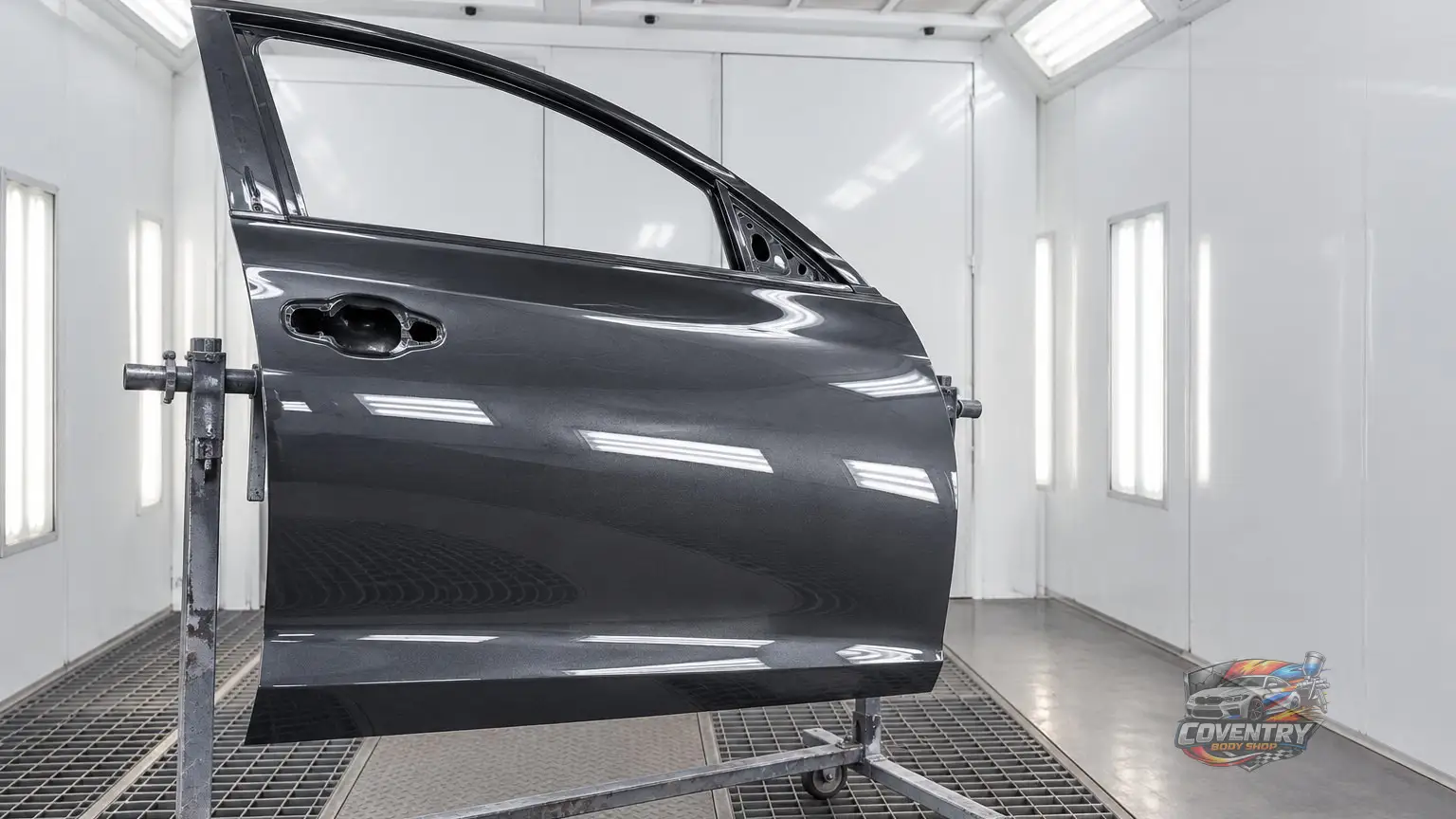
Understanding Car Paint Drying Times
There is no single drying time for car paint. As a rough guide, the wait between coats is usually a matter of minutes, and a freshly lacquered panel is often dry enough for careful handling in the workshop within hours. That is not the same as being ready to wash or polish, and full hardness can take days or weeks. The paint maker's technical data sheet usually gives flash-off and drying times at a stated temperature, and the real times change with temperature, air movement and the thickness of the coats.
Data sheets use their own names for these stages, such as touch dry or dry to handle, and the terms and test conditions differ between products. When to first wash or polish a repaired panel depends on the products used, so ask the bodyshop before you do.
Liquid refinish paint is usually described as solvent-borne or waterborne, which names the liquid that carries it. In a typical repair the colour is a basecoat with a clear lacquer on top. A basecoat dries mainly as its solvent or water evaporates, and waterborne basecoat needs moving air and dries more slowly in humid weather. Many clear coats are two-pack (2K) products. Solvent leaves the film, and the lacquer also hardens through a chemical reaction with its hardener, which warmth speeds up.
A Full Body Respray at Coventry Body Shop usually takes 3 to 7 days, depending on what the car needs, and the drying time of each layer is part of that.
The Role of Preparation in Paint Drying
Preparation has a large effect on how well the paint bonds, along with the products used and the conditions when they are sprayed. A poor bond can show up later as peeling or flaking. In a typical repair the panel is cleaned and degreased, then sanded so the next layer has something to grip. Any filler is left to harden and sanded smooth. Many primers are then left to dry and sanded before the colour goes on, while wet-on-wet primers are painted over after a set flash-off time without sanding.
Each of those layers has its own drying time. Sanding filler or primer before it is hard tends to clog the paper and leave a poor surface. Paint sprayed over a layer before the recoat time on its data sheet can blister or shrink back later. A Paint Touch-Up on a small chip still needs the area cleaned and the paint left to dry, though the area is far smaller.
Application Techniques and Their Impact on Drying
Coat thickness depends on the product and the spray gun set-up as well as on how the painter applies it. Coats of the thickness the data sheet calls for, with the right flash-off between them, tend to dry evenly. A coat that is too heavy can stay soft for longer and sag down the panel. If a run does form, it can often be flatted and polished once the lacquer has hardened; see our guide to runs or sags in the paint.
Where the repair needs it, the new colour is blended into the surrounding paint so the edge of the repair is harder to see. The lacquer then goes over the repair and has its own drying time.
Solvent-borne and water-based paints are sprayed differently. Waterborne basecoat relies on air moving across the panel to help the water leave the film. Solvent-borne basecoat flashes off as its thinner evaporates.
On a Panel Dent Repair & Respray, the dent is straightened first. Filler, primer, colour and lacquer follow where the repair needs them, and each new layer goes on once the one below has dried enough.
Environmental Factors Affecting Paint Drying
Paint makers quote their drying times at a stated temperature, and in a cold workshop the same paint can take longer. Warmth speeds up evaporation and also the hardening reaction in 2K products.
Humidity matters for waterborne basecoat in particular, because damp air slows the evaporation of water from the film. Controlled air movement helps carry solvent and water vapour away from the surface, and waterborne basecoat depends on it.
A spray booth helps keep dust out of the wet finish. At Coventry Body Shop, all paintwork is sprayed in our spray booth.
A small speck of dust in the lacquer can often be removed once the lacquer has hardened, by fine sanding and polishing, depending on how deep it sits. Machine polishing can also reduce light surface scratches that have not gone through the lacquer, as in our Scratch Removal & Machine Polish service.
Quality Control and Longevity Considerations
Good practice is to check a repair before painting, for damage or earlier repairs that need more work, and to look at the finish again in good light once the lacquer is dry enough to inspect, for runs or dust and for any difference in gloss or colour. We measure paint depth as part of our checks. A paint depth gauge reads the total coating thickness within its range, and different panel materials need a suitable gauge. A reading well above the rest of the car can point to an earlier repair, though one reading on its own proves nothing.
Paint that is rushed, with coats piled on before the last one has flashed off, can look fine on the day and fail later through shrinking or small blisters. Keeping to the drying times on the data sheet helps prevent this.
On a Car Body Paint (Single Panel) repair we use filler and primer where the panel needs them, then basecoat and lacquer, with blending where required. Our workmanship guarantee runs for 6 months from collection.
Choosing the Right Paint System
For a repair, much of the paint system is set by the existing finish on the car. The new colour should match the car as it is now, which on an older or repainted car can differ from the original paint code. The products also have to bond to the paint already there. At Coventry Body Shop, colour matching uses the manufacturer's paint code, specialist colour mixing and a spectrophotometer. All our paintwork is sprayed to the paint maker's and the vehicle maker's methods.
Waterborne basecoat uses water as its main carrier, so it usually releases fewer volatile organic compounds (VOCs) than a comparable solvent-borne basecoat. It also needs moving air to dry well.
Practical Workshop Insights on Paint Drying
Paint can feel dry well before it is hard, and a soft finish can still be marked by a polishing pad. Data sheets usually give drying times and often a time before the surface can be polished. When the paint is ready for wax or a coating is a separate question. We offer paint protection after a respray once the paint has cured.
A coat sprayed over one that has not flashed off can trap solvent. The trapped solvent can show later as dulling or small pinholes in the finish.
After collection, treat fresh paint gently and ask us when the car can first be washed. When it can, hand washing with a soft mitt is kinder to it than a brush wash. If you are unsure whether a mark is in the paint or sitting on top of it, send a photo by WhatsApp or through the Send enquiry button.
Conclusion: Achieving a Lasting Finish
When you collect a freshly painted car, ask when it can first be washed or polished, and keep to that advice even if the paint already feels hard.
If your car needs paintwork, send photos by WhatsApp or through the Send enquiry button. We give you a quote before any work starts.
Leave a Comment
Comments
No comments yet.