Understanding the Importance of Professional Auto Body Painting
A paint repair has two jobs. It has to match the rest of the car, and it has to protect the metal or plastic underneath. Much of the work behind both happens before any colour is sprayed. Small jobs can sometimes be done the same day, depending on how busy the workshop is, but allow 1 to 2 days, and a full respray takes 3 to 7 days.
A panel repaint usually goes through assessment, preparation, primer, colour, lacquer and a final check. A stage that is rushed can show later, as peeling, bubbling, a visible colour step or a finish that dulls early.
At our workshop in Wyken, Coventry, all paintwork is sprayed in our spray booth, and the director, a former Aston Martin technician and painter, is our only painter. The stages below describe a panel repaint. A touch-up, a SMART repair or a machine polish uses fewer of them, and a full respray goes through them panel by panel, using each stage where the paintwork needs it. As a guide, painting a single panel is from £150 plus VAT (£180 including VAT), and a full body respray is from £1,495 plus VAT (£1,794 including VAT).
Initial Assessment and Preparation
The job starts with an inspection of the damage: dents, scratches, chips, rust and any earlier repairs that might sit under the paint. That inspection sets how much work is needed and how it will be done. A paint depth gauge measures the total thickness of the paint on a metal panel, all layers together, and a reading well above the rest of the car can point to an earlier repaint. At our workshop a small inspection is free, and the final price is set once we have inspected the car.
Preparation comes next and takes much of the time. The panel is washed and degreased, because wax, silicone or road film can weaken the bond and cause defects in the finish. Bent panels are straightened and dents are filled where they need it, then the area is sanded smooth so the next coat has something to grip.
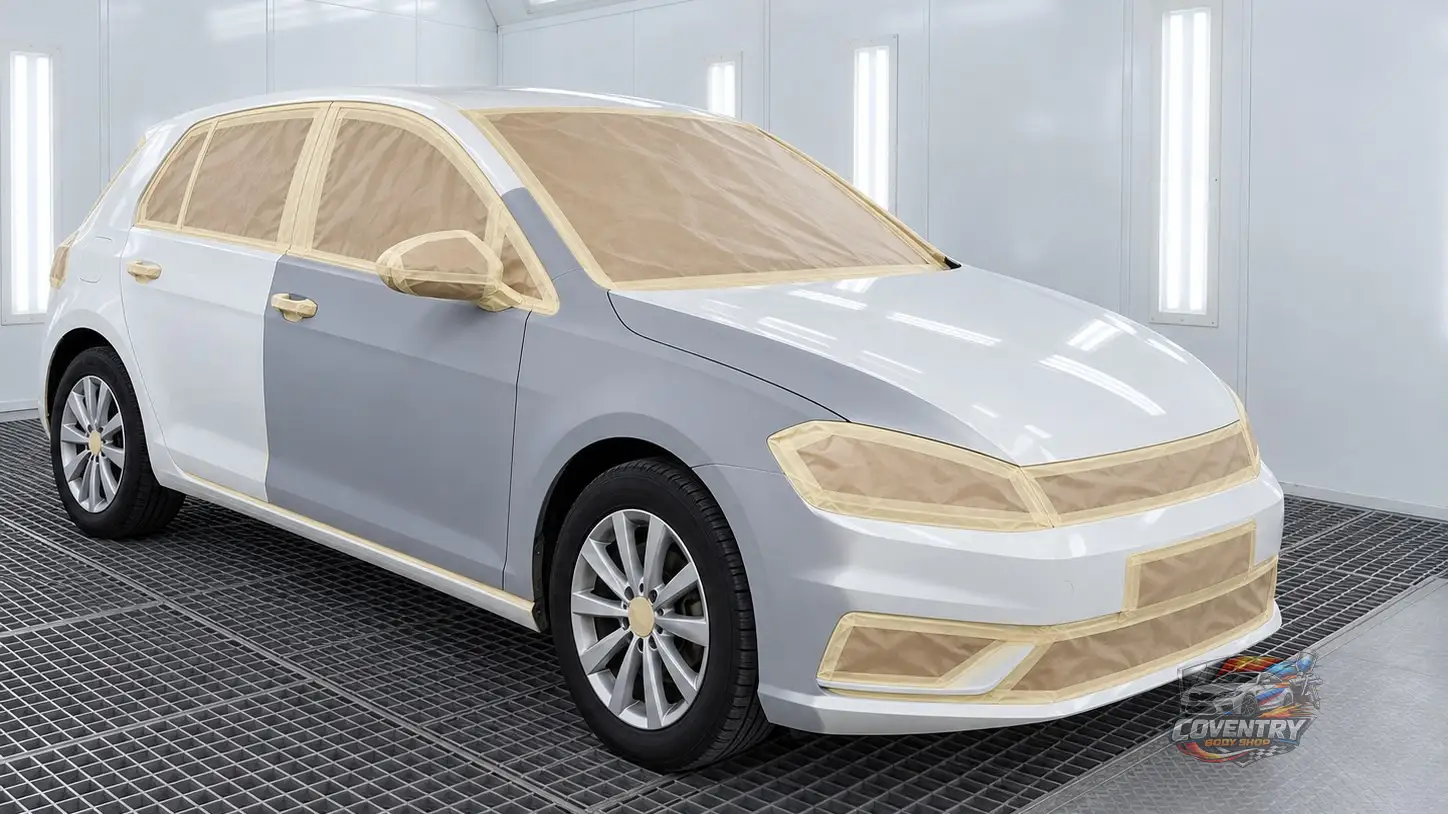
Masking follows. Windows, trims, lights and the panels that are not being painted are covered to keep overspray off them, and the edge of the masking affects how clean the lines look when the paper comes off. Some trims and lights may be taken off instead, where that gives a cleaner result.
For minor scuffs and scratches on one part of a panel, a SMART repair can treat the damaged area without repainting the whole panel, and it usually costs less.
Priming the Surface
Where the repair needs it, primer goes on over filled and bare areas. Depending on the type, it gives the paint a surface to bond to, helps protect bare metal and fills fine sanding marks. The right primer depends on what it covers, since bare steel, aluminium, plastic and existing paint each need a suitable product.
It goes on as the product's instructions set, with flash-off time between coats. Primer laid on too heavily, or painted over before it is ready, is one cause of later faults such as peeling or bubbling.
Primer is usually sanded once dry, though some wet-on-wet primers are made to be painted over without sanding. A ripple or deep scratch left at this point can show through the colour coat, and gloss makes it more obvious, so the surface has to be flat before colour goes on.
Small stone chips with no rust around them can often be dealt with by a paint touch-up instead of a full repaint.
Colour Matching and Paint Application
Colour matching is a large part of whether a repair can be seen, along with the texture and gloss of the finish. The paint code on the car gives the factory colour, but paint fades with sun and age, and one code can be made in slightly different shades, so the code alone is not always enough.
At our workshop colour matching uses the manufacturer's paint code, specialist colour mixing and a spectrophotometer.
The colour goes on in the spray booth, which helps keep dust off the wet paint. Several thin coats are usually applied, each left to flash off before the next, until the colour covers evenly.
If you are changing the colour of your car, you need to update your vehicle's registration details with the DVLA.
Blending and Curing
Blending fades the new colour out, within the repaired panel or onto the panels next to it, so the change from new paint to old is harder to see. On metallic and pearl colours it is often what makes a repair hard to spot, because those paints look different from different angles. We blend on panel repaints where the colour needs it.
Before the lacquer goes on, the base colour is left to flash off for the time the paint maker sets. The final cure of the finish, when the whole paint system hardens through, comes after the lacquer.
Applying the Clear Coat
Lacquer, or clear coat, is the last layer. It gives the gloss and protects the colour coat from UV, moisture and road grime.
Two coats are common, with flash-off time between them, though the paint maker's instructions set the schedule. Too thin and it wears through early; too heavy and it can run. On a panel repaint, lacquer is usually taken across the whole panel, so there is no lacquer edge within that panel.
The paint then cures. How long that takes depends on the products used and on temperature. Once the lacquer is ready, as the paint maker's instructions set, light swirls in the finish can be machine polished out. Our scratch removal and machine polish service does the same for older paint with light scratches.
Lacquer gives some resistance to light marks and slows fading, though it will not stop stone chips or deep scratches.
Paint protection products such as wax, sealants or ceramic coatings add a further layer on top, and they need reapplying or topping up over time.
Quality Control and Final Inspection
Before a car is handed back, the paintwork should be checked in good light from more than one angle. The check looks at the colour against the panels next to it and at the texture of the finish, and for runs, dust or edges left by masking.
Small dust marks can usually be flatted and polished out once the lacquer is ready. A colour step, or a run that goes deeper, needs the area put right before the car is collected.
When you collect your car, look at the repaired panels in daylight before you drive away and raise anything you are not happy with. Our workmanship is guaranteed for 6 months from the day you collect the car.
Dented panels and the paintwork over them come under our panel dent repair and respray service. We straighten bent panels but do not cut or weld metal.
Maintaining Your Vehicle's New Finish
Treat new paint gently while it cures. When it can be washed, waxed or polished depends on the products used, so ask us when you collect the car. After that, regular washing and a coat of wax or sealant now and then help protect it.
Deal with new chips and scratches early. A chip through to bare metal lets water in, and rust can start under the paint around it. Our bumper repair service covers scuffs on bumpers, which take a lot of the knocks, and the cracks that plastic welding can fix.
To arrange an inspection or talk through a paint repair, call or WhatsApp +44 7903 105777, send photographs with the Send enquiry button, or use our contact form.
Leave a Comment
Comments
No comments yet.